Get Your Free CTV Advertising Playbook

25194164105 159743919891 164947799710 170424822844

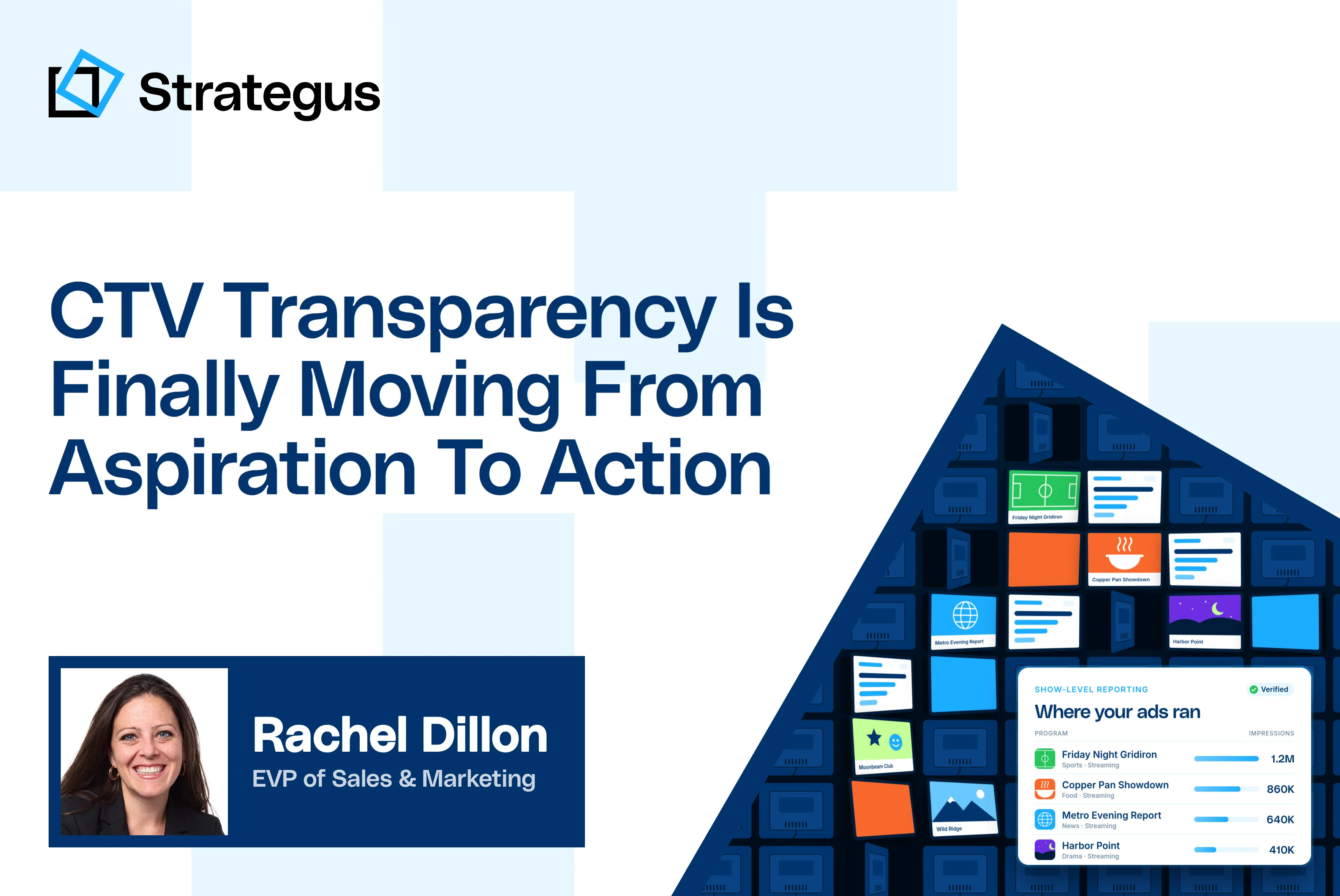
CTV Transparency Is Finally Moving From Aspiration to Action

CTV Transparency Is Finally Moving From Aspiration to Action

For traditional linear advertisers, the promise of programmatic CTV has always been compelling: more flexibility, more precise audience strategy, and the ability to connect television exposure to measurable business outcomes.

But there has been a persistent gap between the promise and the buying experience. Visibility into programmatic delivery has been uneven. In many cases, the signals available to advertisers have been shaped by content providers and supply partners—and by how each chooses to represent information in the bid stream. That has made it difficult to answer a basic question: Where, exactly, did the ad run?

That is why the recent announcement from Gracenote and The Trade Desk is encouraging. Their integration brings Gracenote’s content IDs, metadata, and standardized taxonomy into The Trade Desk, giving advertisers the ability to use show-level intelligence in planning, targeting, curation, and reporting across eligible connected-TV inventory.


The industry’s demand for this capability is clear. Gracenote reports that 91% of programmatic traders surveyed said the lack of show-level data limits CTV advertising, while 95% of media planners said show-level reporting would be valuable. Those numbers reflect what many linear buyers have been asking for: the ability to bring more of the context and accountability they are accustomed to in television into a programmatic environment.

Why Show-Level Intelligence Matters

Audience data tells us who we are trying to reach. Content intelligence helps us understand the environment in which the message appears. Both matter.

At a practical level, show-level signals can help advertisers move beyond broad labels such as “streaming” or “entertainment.” They create a more informed foundation for deciding which content is appropriate for a brand, evaluating the quality of a supply path, understanding campaign delivery, and improving future planning.

They can also strengthen the connection between media and measurement. When advertisers have a clearer view of where impressions ran, they are better positioned to interpret performance, manage reach and frequency, and make more confident decisions about where to invest next.

This is a win/win. Advertisers gain greater control and accountability. Content providers and supply partners gain a more consistent way to make the value of their programming visible. DSPs can help connect those signals to activation and optimization. The result is a healthier marketplace—one where better information can support better decisions for everyone in the chain.

show level data survey results

The Strategus POV

At Strategus, we believe transparency should be practical, usable, and connected to outcomes. It does not mean exposing every proprietary algorithm or requiring that every partner present information in exactly the same way. It does mean giving buyers enough consistent signal to understand who sold the impression, where it ran, how the supply path was constructed, and what value each layer is contributing.

For CTV specifically, that baseline should increasingly include program-level context. It should also support stronger supply-path optimization, more deliberate curation, better frequency management, and more defensible measurement. Transparency is not a replacement for audience strategy or attribution; it makes both more effective.

Our view is that programmatic CTV will earn more budget from traditional television advertisers when it can offer both the scale of automation and the accountability of a well-governed media plan. The goal is not to recreate linear television inside a DSP. The goal is to give advertisers the visibility they need to make programmatic’s additional flexibility a strength rather than a source of uncertainty.

New call-to-action

The Work That's Still Ahead

This announcement is meaningful progress, but it is not the finish line. Adoption will need to extend across more inventory and supply paths. Signals will need to become more consistent. Buyers will continue to ask for clearer fee structures, auditable seller identity, and reporting that is useful beyond a single platform or partner.

The larger opportunity is to move from provider-specific visibility to industry-wide standards that advertisers can actually use. That will take continued cooperation among content owners, publishers, SSPs, DSPs, agencies, and measurement partners—and continued pressure from buyers who are willing to reward quality and accountability.

Still, progress matters. For an industry that has spent years discussing the need for greater transparency in programmatic CTV, seeing show-level content intelligence move directly into a major DSP is a constructive step forward.

The needle is moving. That is good news for advertisers, good news for the content ecosystem, and good news for the future of CTV.

Rachel Dillon leads all go-to-market activities at Strategus, overseeing both sales and marketing. Her team works with hundreds of brands and agencies to design and execute comprehensive connected television campaigns that leverage the most innovative programmatic capabilities. Rachel is passionate about designing and scaling revenue organizations that deliver high-value customer experiences at every step of the journey, having done so in leadership roles at House of Revenue, Rachio, and eScience Labs. She was named a Top Women in Ad Tech by AdMonsters and AdExchanger in 2022 and 2025.

Strategus Favicon

Strategus is a managed services connected TV(CTV) advertising agency with over 60,000+ campaigns delivered. Find out how our experts can extend your team and drive the result that matter most.

Talk to an Expert