How Does Programmatic Audio Buying Work?

Table of Contents
Programmatic audio ads are bought one play at a time, in real-time auctions across music apps, podcasts, and online radio. Each time a listener’s stream reaches an ad break, software checks whether that listener fits each advertiser’s campaign, and the highest bid wins the spot. You choose who to reach and what to spend, and the bidding takes it from there.
Key takeaways
- Each programmatic audio ad play is sold in an auction that starts when a listener presses play and ends before the ad begins.
- Your campaign’s targeting decides which breaks to bid on: who’s listening, where, to what, and on which device.
- Podcasts play ads before, during, and after episodes, music apps play them between songs, and digital radio swaps them into the station’s commercial breaks.
- A companion banner gives listeners something to tap, and attribution ties listening to later visits to your site or store.
- Online audio reached 81% of Americans 12 and older in a month, according to Edison Research’s Infinite Dial 2026.
How programmatic audio buying works, step by step
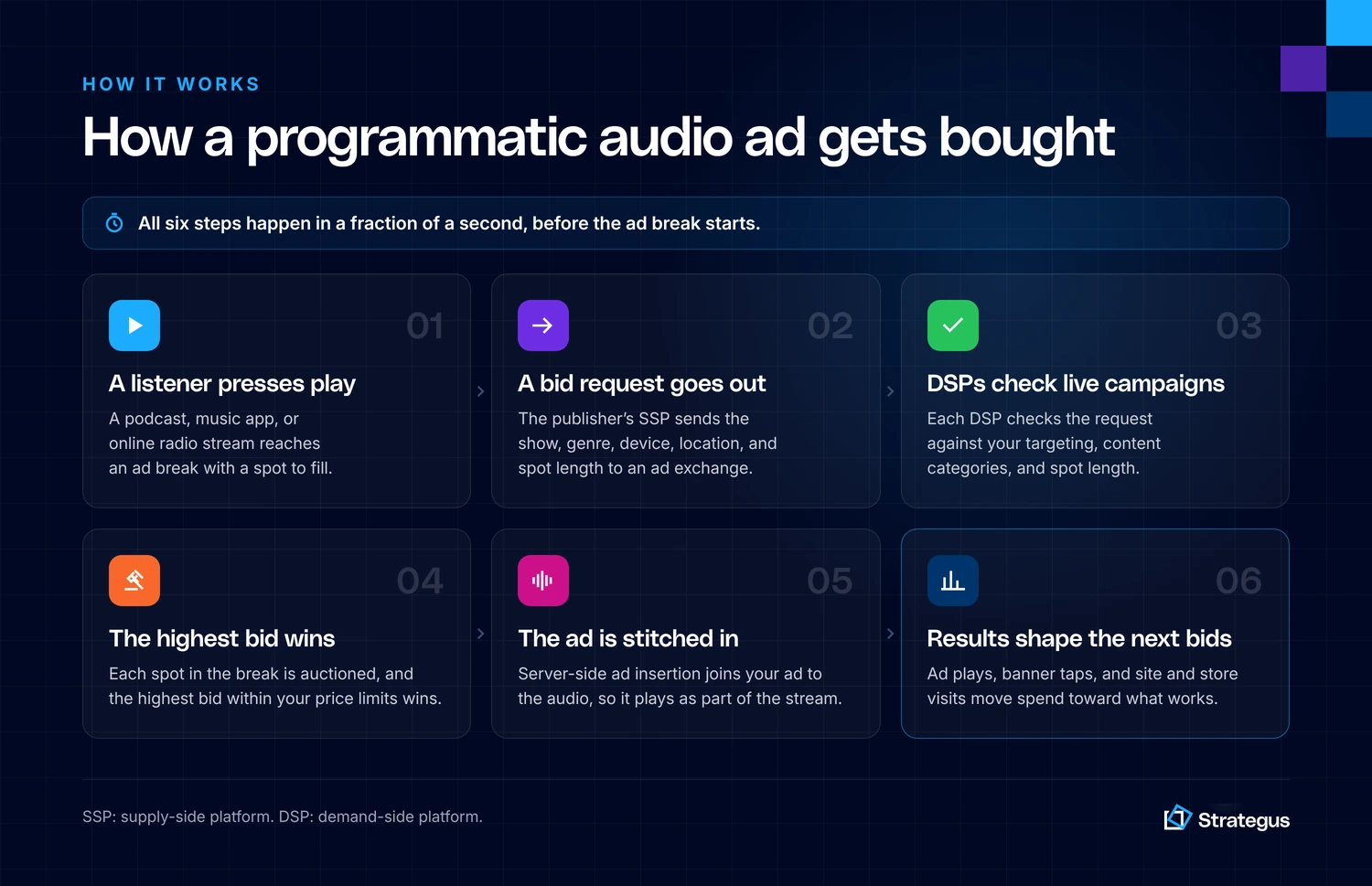
All six steps happen in a fraction of a second, before the ad break starts.
Step 1: a listener presses play
It starts with someone listening to ad-supported audio: a podcast episode, the free tier of a music app, or a radio station’s online stream. As a break comes up, the app or the publisher’s ad server has a spot it still needs to fill.
Step 2: a bid request goes out
The publisher, usually through a supply-side platform (SSP), sends a bid request to an ad exchange. For audio, it describes the show or station and its genre, the device (a phone, smart speaker, car, or computer), the general location, how long the spot can run, and whether a banner can show with it.
Step 3: DSPs check it against live campaigns
Demand-side platforms (DSPs), the software advertisers buy through, compare the request with the campaigns they’re running. In audio, that check covers things a web ad never needs: whether the show or station sits in a category the campaign allows, whether the spot fits the length of the break, and whether the listener’s device can show your banner.
Step 4: the highest bid wins the break
DSPs with a matching campaign bid what that ad play is worth, within the price limits each campaign sets, and the highest bid wins. Audio breaks often hold two or more spots, and each one is sold this way, so your ad may share a break with other advertisers. Our guide to programmatic ad buying covers the deal types that sit on top of this auction.
Step 5: the ad is stitched into the stream
With server-side ad insertion, the publisher’s servers join the winning ad to the audio before it reaches the listener. It plays as part of the stream, the way a commercial plays in a radio broadcast. Podcasts use a version of this called dynamic ad insertion, which our podcast advertising page covers.
Step 6: results shape the next bids
In audio, the signals that come back are ad plays, taps on companion banners, and the site and store visits that attribution ties back to the ad. Those results guide the next round of bids, moving spend toward the shows, stations, and audiences that lead to your goal.
Audio ad formats and where they play
Programmatic audio runs across four kinds of listening, and each one fits ads in at a different moment.
Some apps and devices also show a companion banner, a display ad that sits on screen while your audio spot plays. Banner taps are what audio campaigns count toward click-through rate. Smart speakers have no screen to show one, so write the spot to work on its own.
Who hears your ad
Your targeting is what the DSPs check in step 3. Audio uses most of the same audience options as your other channels, plus a few only audio has, like music genre and podcast category. Our programmatic audio advertising page lists each option, and our targeting page covers how we build the audience.
Deciding where audio fits in your plan? Let’s match the listeners and formats to your goal.

How programmatic audio gets measured
Most of what an audio ad does happens after it plays, so audio is judged by what listeners do next: visiting your site or store, signing up, or buying. Attribution matches those actions to the ads people heard, the same way it works for connected TV. Our attribution page covers how we measure each outcome.
You can check results in our reporting dashboard anytime, and our team walks you through what audio is adding and what to change next.
Audio listening keeps growing
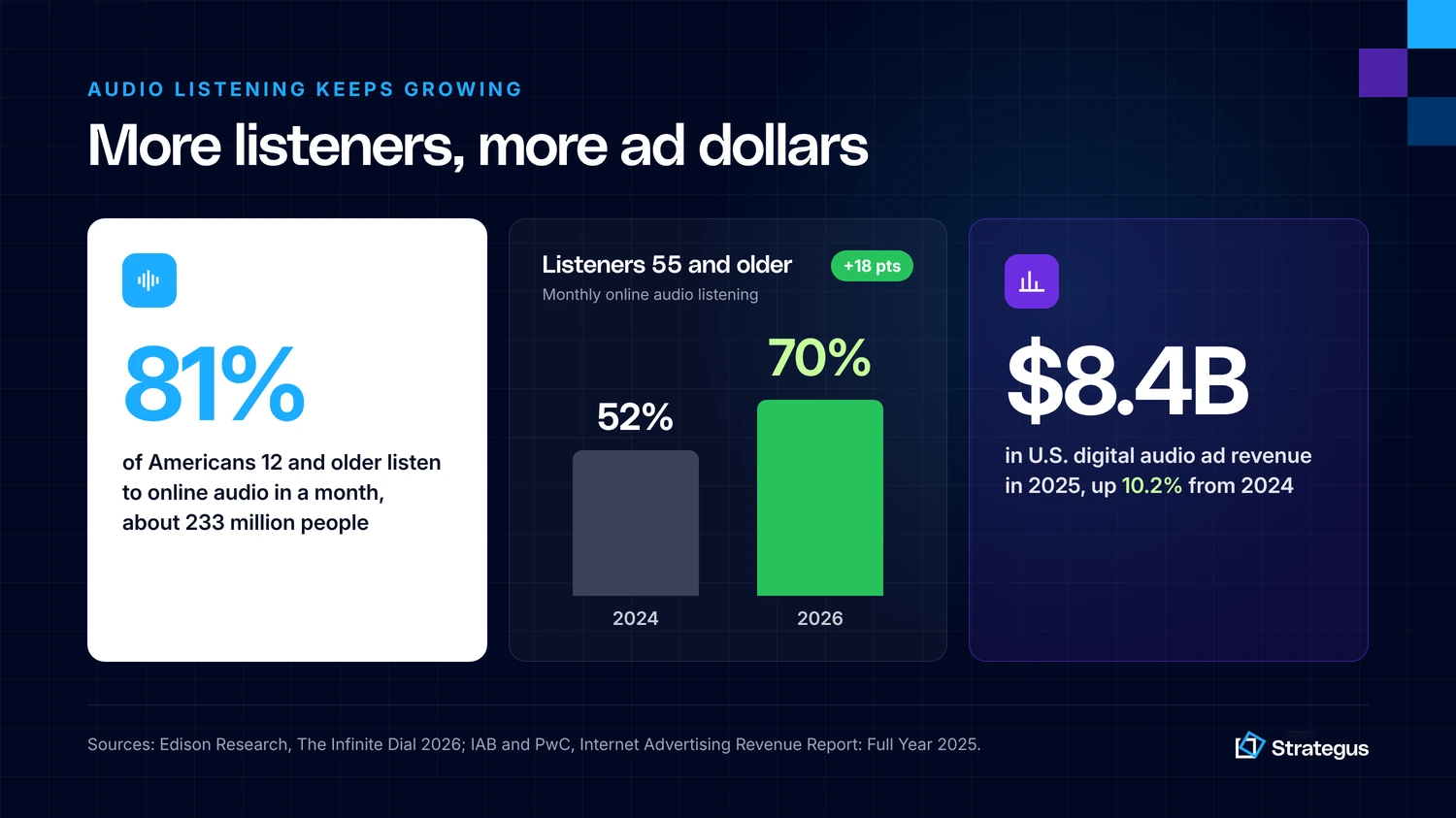
Online audio reached a record 81% of Americans 12 and older in a month, about 233 million people, according to Edison Research’s The Infinite Dial 2026. Listeners 55 and older drove the latest gains: their monthly listening rose from 52% to 70% in two years.
Ad spending is rising with it. U.S. digital audio ad revenue reached $8.4 billion in 2025, up 10.2% from 2024, according to the IAB and PwC Internet Advertising Revenue Report.
Our take: if your customers skew older, streaming audio now reaches far more of them than it did two years ago, which makes it worth a fresh look even if you passed on it before.
Get an audio plan for your brand
Our team can map which kinds of listening reach your customers, the budget it takes to reach them, and the results we’d track. For a longer look at planning audio, watch our fireside chat on where streaming audio fits in your media plan.
Frequently Asked Questions
Is Netflix AVOD or SVOD?
Layer interests, purchase behavior, and viewing habits on top of age and location — so every impression reaches someone who actually matters to your business.
How long does a programmatic audio auction take?
Usually a fraction of a second. The bid request goes out as an ad break comes up, and the winning ad is chosen and stitched into the stream before the break starts, so the listener doesn’t wait.
What is server-side ad insertion?
It’s how the winning ad gets into the stream. The publisher’s servers join the ad to the audio before it reaches the listener, so it plays like part of the show or station. Podcasts use a version of it called dynamic ad insertion.
Do programmatic audio ads play on smart speakers?
Yes, when someone streams an ad-supported music app, podcast, or radio station through one. A smart speaker has no screen, so no banner shows there, and the audio spot has to carry the whole message.
How is programmatic audio different from a direct radio buy?
A direct radio buy books set spots on chosen stations and dayparts, and everyone tuned in hears the same ad. Programmatic audio buys one ad play at a time across many apps and stations, using audience data to pick the listeners.
Who decides how much to bid on each ad?
The DSP’s software bids on each ad play within the limits the campaign sets: the audience, the most it will pay, and the budget. On a managed campaign, our team sets those limits and adjusts them as results come in.
get in touch
Subscribe to our
newsletter
Stay ahead with strategies and insights from streaming advertising experts.
Learn from the field

Talk to an expert
Let's plan your next campaign
Tell us what you're trying to hit and what you have to spend. A strategist will show you which channels fit and how we'd measure success.