





.svg)

















 Tyler Wise
16 minutes read

Linear TV used to be the king of reach.
But its biggest weakness has always been measurement. You can buy the impressions and estimate the reach, but you can’t see who actually watched, what they did next, or how it influenced performance.
At the same time, viewers are shifting to streaming, marketers are under pressure to prove ROI and justify their spending, and media plans require the kind of accountability that linear TV was never designed to provide.
Linear TV still has a place, but not the one it once held.
This guide explains what linear TV is, how it works today, when it still makes sense for advertisers, and why many brands are shifting spend toward CTV for stronger targeting, greater efficiency, and measurable outcomes.
What is linear TV?
Linear TV is essentially the traditional television model.
Programming is broadcast in real time, and viewers must watch content as it airs, with no ability to choose a particular film or episode. Advertising appears in fixed commercial breaks, which are determined by networks and aren’t personalized to a given viewer.
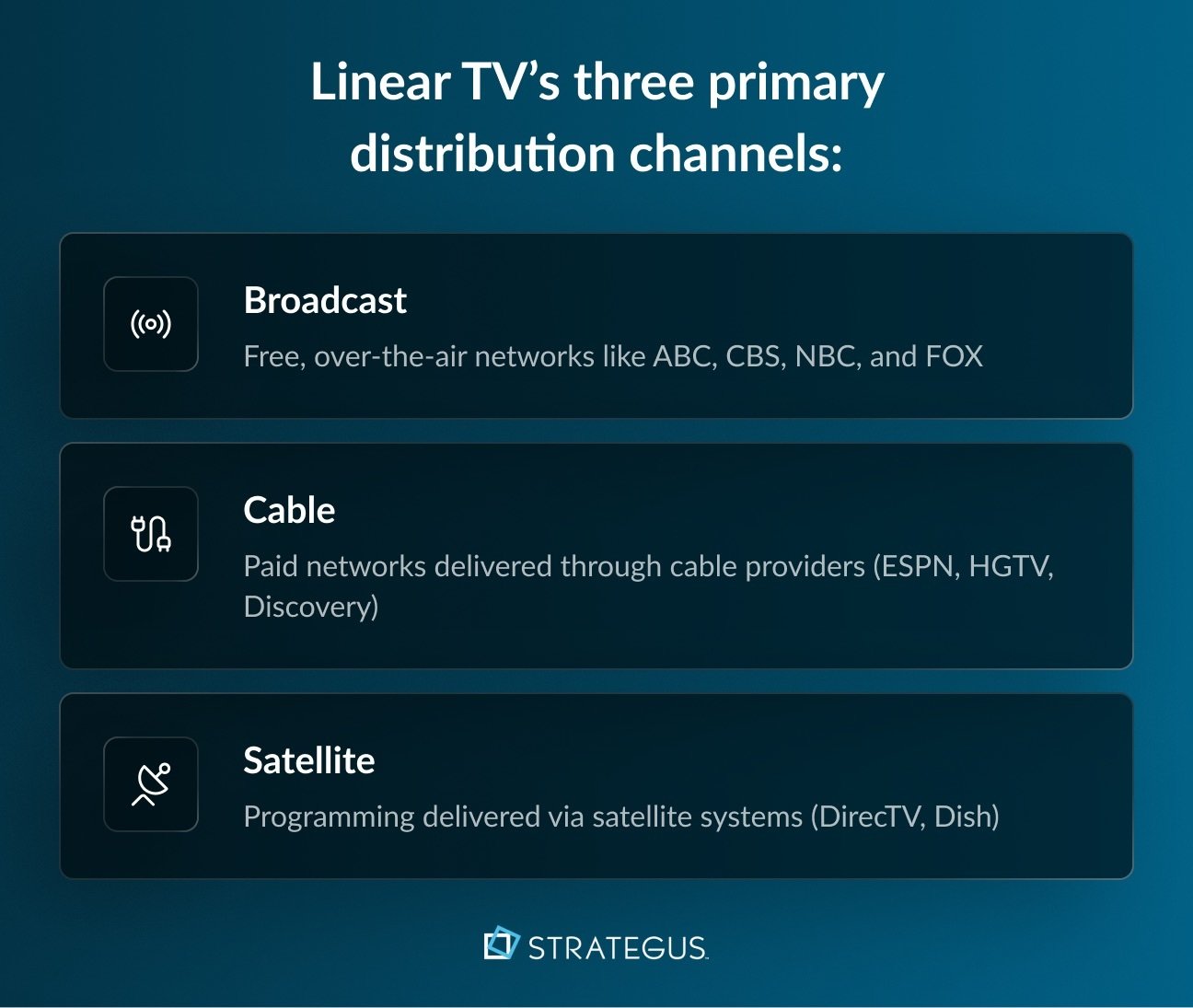
Linear TV covers three primary distribution channels:
- Broadcast: Free, over-the-air networks like ABC, CBS, NBC, and FOX
- Cable: Paid networks delivered through cable providers (ESPN, HGTV, Discovery)
- Satellite: Programming delivered via satellite systems (DirecTV, Dish)
For decades, linear TV was the dominant reach vehicle for many advertisers.
It provided an unmatched national scale, where millions of people would tune in to watch the same program simultaneously, creating shared viewing experiences and cultural moments.
With limited channel options available, audience fragmentation was minimal, so marketers could reach broad audiences efficiently. Thanks to its consistency and predictability, linear TV became a default channel for broad-scale brand-building campaigns.
Streaming, of course, has drastically changed the game for advertisers (more on that soon), but the core linear TV model has remained largely unchanged despite shifts in viewer behavior toward streaming and on-demand content.
While, on the whole, linear TV is far less popular than it was in previous decades, it still holds its own in a few very specific circumstances.
For instance, premium live events (such as national sports or award shows) still pull large audiences to linear channels — in 2023, 96 of the top 100 most-watched TV broadcasts in the U.S. were live sports events.
How linear TV works today
Linear TV advertising works today much as it always has.
Advertisers purchase ad placements through networks, local stations, or national upfronts, and they can do so in one of two ways:
- Upfronts: Bulk buying months in advance, typically at lower CPMs (cost per thousand impressions) but with less flexibility.
- Scatter market: Bought closer to airtime, usually at higher CPMs due to demand volatility.
Pricing is influenced by factors like program popularity, audience demographics, and show ratings.
Targeting
Compared to modern digital advertising, linear TV offers far fewer targeting levers, but it’s not completely untargeted.
Most linear TV campaigns are built around contextual and placement-based targeting, rather than audience-level targeting.
Advertisers primarily target by:
-
Programs and genres (specific shows, sports, news, entertainment)
-
Networks and channels that index higher for certain audiences
-
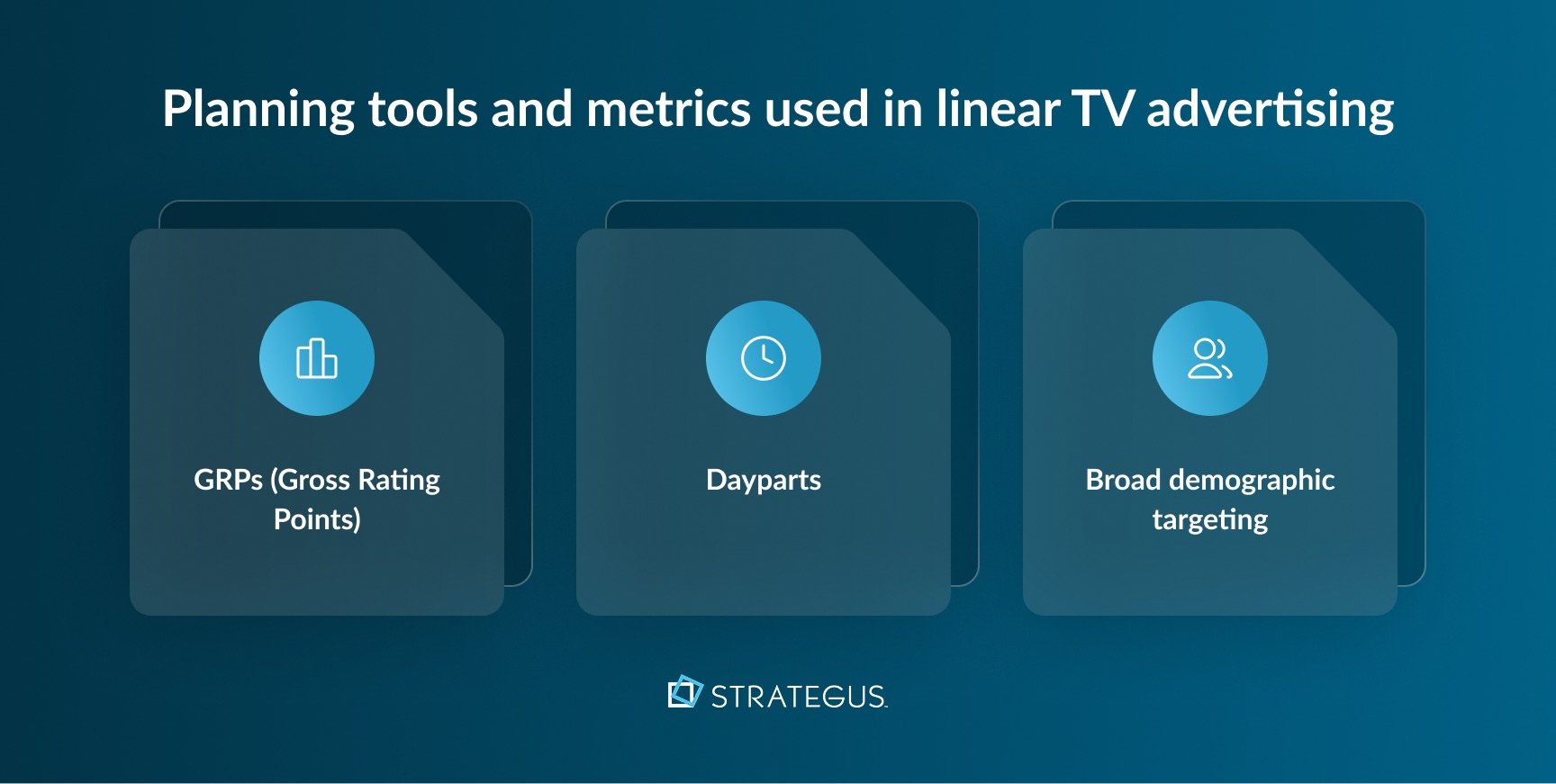
Dayparts (morning, daytime, prime time, late night)
-
Broad geographic regions, such as national, DMA, or regional buys
This approach assumes that viewers of certain programs or networks generally align with desired demographics, which is why linear planning often starts with age and gender buckets like Adults 25–54 or Women 18–49.
While this can be effective for broad awareness and reach, it limits an advertiser’s ability to isolate niche, in-market, or high-intent audiences. Two households watching the same program receive the same ad, regardless of differences in behavior, purchase intent, or past exposure.
As a result, linear TV targeting is less precise and offers limited control over who sees the ad, beyond general audience patterns tied to programming and geography.
Dayparts
Linear TV ad inventory is limited (given that the programming schedule is fixed), and is broken into dayparts such as morning, daytime, prime time, and late night. Each daypart varies in cost, programming, and typical audience composition.
Measurement
Linear TV measurement has traditionally centered on GRPs (Gross Rating Points), which quantify the total exposure an ad delivers to a target demographic.
GRPs are calculated by multiplying:
- Reach (the percentage of a target audience exposed)
- Frequency (the average number of times they were exposed)
For example, reaching 40% of a target demographic with an average frequency of 5 results in 200 GRPs.
This model emphasizes scale and exposure, not individual-level outcomes. It does not inherently show whether a specific viewer took action after seeing the ad.
That said, some advertisers layer in direct-response tactics to gain additional performance signals. These can include:
- Dedicated tracking phone numbers
- Vanity URLs or custom landing pages
- Promo codes tied to linear placements
These methods allow for last-touch attribution, capturing actions that occur immediately after exposure. However, they only measure a fraction of total impact and tend to favor audiences who respond instantly, leaving most upper- and mid-funnel influence unaccounted for.
Overall, linear TV measurement provides strong indicators of reach and frequency, but limited visibility into how advertising exposure connects to downstream actions like website visits, leads, or purchases.
Is linear TV still effective for advertisers?
Despite being the “old model”, linear TV still has value for certain use cases. For others, however, there are many better options.
Scenarios where linear TV still works well
Linear might not stack up against the power and reach of modern advertising channels, but it still has a couple of cards left up its sleeve.
National reach
Its biggest draw is its ability to reach vast audiences fast.
Linear TV remains an effective way to reach large national populations simultaneously, provided you select the right moment.
Major award shows, news events, and especially live sports draw huge viewerships, and it's where national brands can still win big with linear TV. That’s why brands seeking cultural relevance often prioritize these placements, despite being unable to measure their impact effectively.
Brand-building
Linear’s second strength is its brand-building power.
When running mass awareness campaigns that prioritize broad visibility and rapid cultural penetration over precision targeting, linear can still be a winner.
For instance, national QSR (quick service restaurant) promotions, political campaigns, and consumer packaged goods brands can all benefit from well-timed linear TV campaigns.

Older audience segments
Finally, you’ve got older and rural audiences, which lean more heavily toward traditional TV and are less likely to be heavy streamers.
A 2025 report from a media-consumption tracker shows that among U.S. adults aged 55–64, broadcast and cable remain the dominant choice. Nearly two-thirds of their TV-watching time is spent on linear TV. For those over 65, the dominance of linear TV is even more pronounced, with only around 15% of their TV time devoted to streaming.
If you’re targeting an older demographic, linear can still be a great fit.
Scenarios where linear TV becomes less effective
Of course, there are a few important drawbacks to linear TV as an advertising channel, the most important of which is its declining viewership.
Younger audiences
Streaming is steadily eating up more and more of linear’s audience, with younger and digital-first audiences already moving entirely to on-demand.
A 2025 survey found that 41% of Americans under 30 reported not typically watching live TV, compared with far lower rates among older age groups, indicating a clear generational shift away from linear TV.
Real-time optimization
Linear works fine when you know your creative and messaging are on point. However, many brands lack the opportunity to conduct extensive testing before launching an ad campaign to market.
Since linear TV doesn’t allow for real-time adjustments or optimizations based on current performance, it's often a risky play (especially given the cost of prime ad inventory). It doesn’t offer enough control for many marketers.
Tight budgets
Linear TV advertising is notorious for wasted spend, owing primarily to its inability to get granular with audience targeting.
Since they can’t isolate specific geos, interests, or intent-based segments as they can with other advertising channels, advertisers end up paying to reach people outside their ideal audience.
For marketers on tight budgets (so, everyone), this kind of wastage is not tolerable.
High cost, but a lack of clear measurement
The biggest and highest-performing ad spots (e.g., around national sporting events) are demanding higher and higher CPMs, but targeting precision has remained unchanged, and you still can’t track visits or conversions post-impression.
In short, linear is costing more, but not necessarily getting any better.
Operational realities that impact linear effectiveness
Even within the context where linear TV does make sense, there are a few stark realities that limit its effectiveness:
- Actual viewership often fails to match projections, meaning buyers must over-purchase to hit desired impressions.
- Premium programming, like live events and high-demand shows, is in short supply, driving CPMs higher.
- Uneven frequency distribution, with heavy linear viewers absorbing the majority of impressions, leads to diminishing returns and wasted ad spend.
The takeaway for modern marketers
Linear can still play a role in modern marketing programs, but its effectiveness is highly dependent on audience and campaign goals.
As media plans become more data-driven (83% of marketing leaders now consider demonstrating ROI as their top priority), advertisers gravitate toward environments where reach, targeting, and measurement are more predictable.
This creates a natural shift toward connected TV (CTV).
Why many advertisers are moving to CTV
Connected TV refers to smart TVs, gaming consoles, and set-top boxes that stream content through apps and platforms.
Because CTV ads are served programmatically within these data-rich environments, advertisers can target specific audiences, manage ad frequency, and measure verified impressions on the largest screen in the home.
Here’s why a huge portion of advertisers favor CTV over linear.
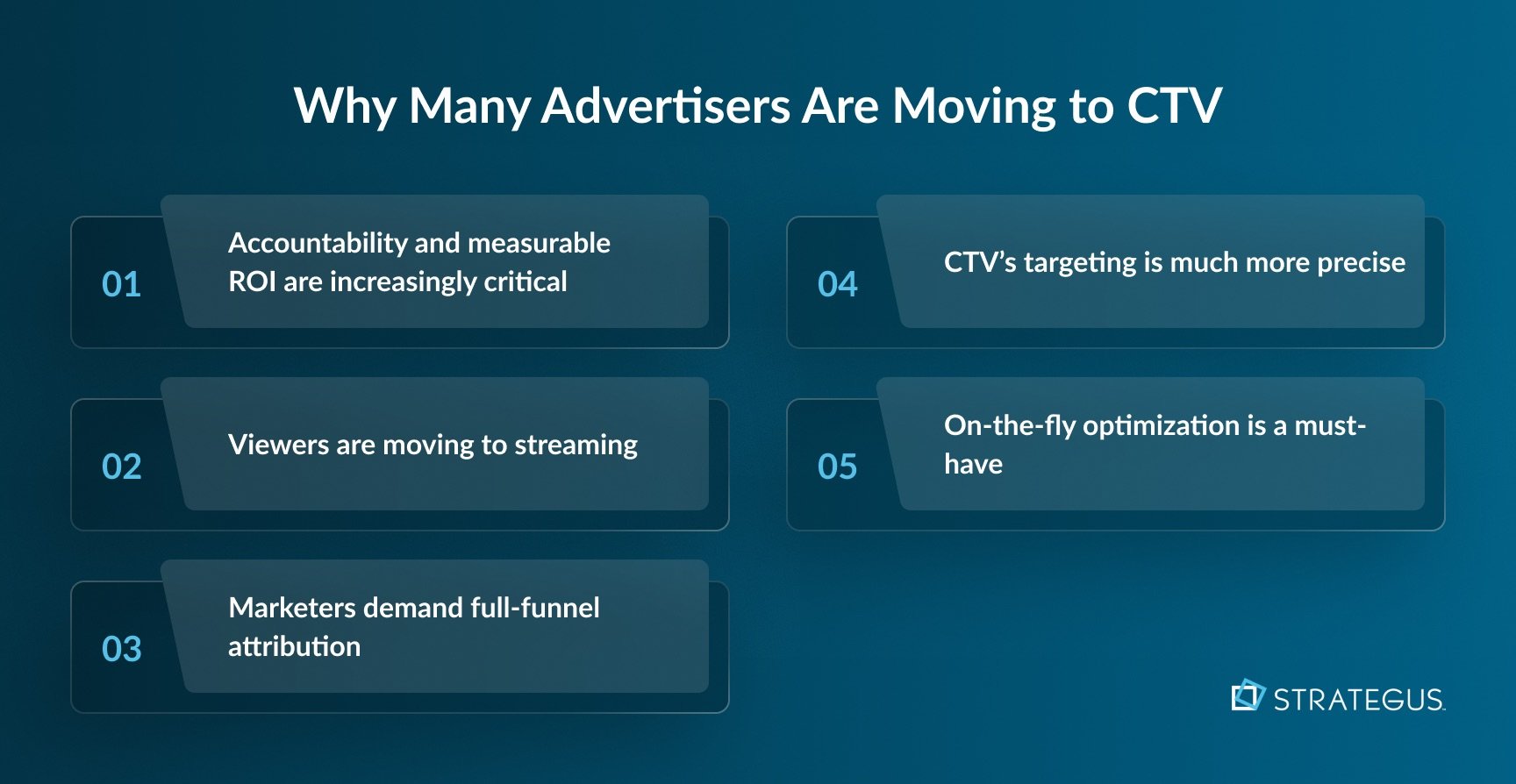
1. Accountability and measurable ROI are increasingly critical
Marketers want channels with transparent reporting, not estimated reach. Linear can’t deliver on that, but CTV can clearly show how ad spend impacts awareness, engagement, and conversions.
2. Viewers are moving to streaming
This one’s pretty cut and dry. If your audience isn’t watching traditional TV, you shouldn’t be advertising there. Today, younger demographics consume content almost exclusively via CTV and apps, and streaming viewership continues to grow across all age groups.
3. Marketers demand full-funnel attribution
CTV enables full customer journey tracking, from ad impression to the website visit or conversion. This gives advertisers what they need: insight into which audiences, creatives, and messaging angles actually drive outcomes.
Learn more about CTV attribution →
4. CTV’s targeting is much more precise
Marketers can build precise audiences using CRM data, browsing behavior, demographic intel, and purchase intent data, reducing waste compared with the broader demographic approach offered by linear. It’s why 70% of marketers say that “precise audience targeting” is CTV’s biggest advantage.
CTV advertising platforms with AI-powered audience modeling can take this a step further, identifying households with a higher likelihood of engaging or converting, thereby increasing program effectiveness.
Learn more about CTV targeting →
5. On-going optimization is a must-have
Social, email, and digital advertising all offer real-time optimization, and marketers require the same level of flexibility in TV ad programs.
Linear can’t offer that, but CTV allows you to adjust campaigns mid-flight based on performance, pause low-performing segments, and A/B test creative to optimize results.

Linear TV vs. CTV: What’s the difference?
|
Category
|
Linear TV
|
CTV (Connected TV)
|
|
Delivery |
|
|
|
Targeting Capabilities |
|
|
|
Measurement and Attribution |
|
|
|
User Behavior and Viewing Experience |
|
|
|
Exposure Efficiency and Control |
|
|
How to choose between linear TV and CTV (or an integrated advertising strategy)
.jpg?width=1728&height=864&name=How%20to%20Choose%20Between%20Linear%20TV%20and%20CTV%20(Or%20an%20Integrated%20Advertising%20Strategy).jpg)
For some ad campaigns, the choice between linear TV and CTV is clear. For others, an integrated approach makes sense.
Here’s how to figure it out.
Step 1: Define your campaign goal
If your ad campaign is designed to grow broad brand recognition or generate top-of-funnel awareness, both linear and CTV can work.
If you need to speak directly to a specific demographic or segment, or if you require influencing mid-funnel engagement (such as through a retargeting program), CTV is the better fit.
Step 2: Evaluate where your audience actually watches content
Many TV media buyers make the decision to side with one channel or the other at this point.
After all, if your audience only consumes content via streaming, shelling out for a linear ad campaign isn’t going to do a lot of good.
Some good old-fashioned audience research should help you determine how much of your target demo still watches linear TV, and whether it's a viable vehicle for reaching them.
Otherwise, demographics are a decent heuristic to use here: older and rural audiences skew linear, while younger and urban and suburban demographics skew heavily toward streaming.
Step 3: Compare targeting and cost efficiency
If cost-effectiveness is a key concern, CTV wins 9 times out of 10.
Linear’s broad demographic buckets drive more waste and provide less control, whereas CTV offers greater accuracy and precision, with behavioral, demographic, and first-party data all available as targeting inputs.
Cost isn’t always the key decider, however.
For Coke, it's not a question about whether an ad spot during an NFL broadcast is cost-effective — it's about whether they can afford not to be the first brand that comes to mind when thinking of the cola category.
Step 4: Consider your measurement needs
If broad reach estimates are a sufficient measurement for your campaign, linear will work. If your campaign goals are conversion-focused or you require more detailed attribution measurement, opt for CTV. It can give you:
- Cross-device tracking
- Real-time performance data
- Verified visits
- Conversion tracking
- Intel on frequency by household
How linear TV fits into a modern media mix
In modern media plans, linear TV is most effective when it is deliberately integrated with CTV rather than planned as a standalone channel. In practice, this typically looks like:
- Using linear TV to generate initial exposure during high-reach moments such as live sports and major events
- Activating CTV immediately after those exposures to extend reach among streaming-first viewers and reinforce messaging across on-demand environments
- Building CTV audiences that capture likely linear-exposed households while also filling gaps where linear never reaches
- Relying on CTV for measurement and attribution, connecting TV exposure to site visits, conversions, or incremental lift instead of post-campaign reach estimates.
In this structure, linear contributes scale, while CTV provides control, optimization, and performance visibility. The value comes from how the two are coordinated, not from either channel in isolation.

Effective linear execution requires the right partner
Running linear and CTV together introduces real execution challenges.
Advertisers still need to manage audience overlap, control frequency across environments, and measure impact in a way that reflects real business outcomes. Without active management and unified attribution, hybrid TV strategies can quickly create waste.
Strategus helps brands close this execution gap. By managing full-funnel CTV campaigns with advanced targeting, active optimization, and outcome-based attribution, Strategus brings control, transparency, and accountability to modern TV advertising.
Reach out today to learn how Strategus can help.


Strategus is a managed services connected TV(CTV) advertising agency with over 60,000+ campaigns delivered. Find out how our experts can extend your team and drive the result that matter most.
What to read next