





.svg)












 Tyler Wise
14 minutes read
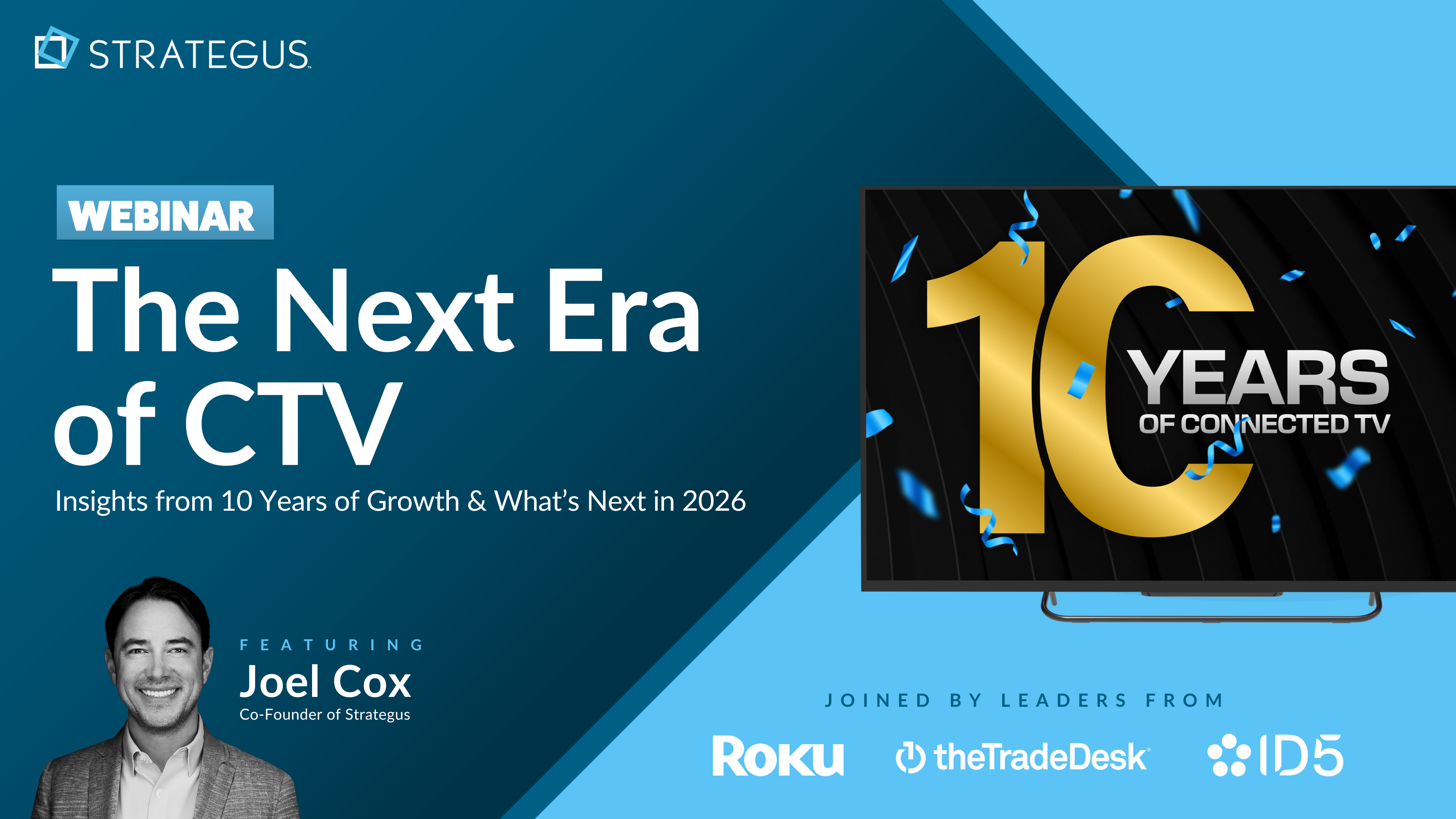
CTV just turned 10.
In that time, it has gone from a niche viewing behavior to the primary way people watch television. Streaming minutes now outpace cable and broadcast, advertisers are pouring in, and the next era will be defined by something much bigger than content alone. It will be defined by the way data, identity, and creative fit together around the viewer.
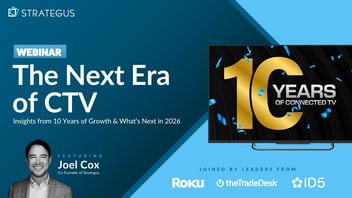
That is where the conversation landed during The Next Era of CTV webinar, featuring:
- Joel Cox, Co-Founder & EVP of Innovation & Strategy, Strategus
- Kendra Allen, Roku
- Lisa Abousaleh, ID5
- Chris Brooklier, The Current, by The Trade Desk (moderator)
Watch the full webinar below:
Below are the 10 themes marketers should carry into 2026 and beyond, with direct perspectives from the panel.
1. Stop Chasing Shows. Start Winning With Data.
The industry still loves to obsess over where ads run. The hottest Netflix series, the buzziest HBO drop, the big NFL broadcast. These placements feel like the closest thing to a “sure bet” in streaming.
But reach is not the same as performance.
“You are not going to win on ad placement in Squid Game and Batman and NFL football,” said Joel Cox, “You are going to win on your utilization of data to identify and reach your audiences with precision and efficiency.”
The shift underway is clear.
Two big data shifts stood out:
- First-party data is becoming the backbone of TV.
Marketers who have clean, organized first-party data will be in the strongest position to target, suppress, model, sequence, and retarget through CTV. The better the data, the more control over who actually sees your ad. - Retail and commerce data are replacing cookie data.
Amazon, Walmart, Kroger, Target, Costco, and others as increasingly valuable sources of audience signal. These commerce datasets are already outperforming legacy third-party cookie segments, despite the ecosystem still being young and fragmented.
The takeaway: content is still important, but it is no longer the primary competitive edge. Data and identity decide who actually sees your ad.

2. Balancing Premium Inventory With Performance
So what is the right balance between “I want to be on Netflix” and “I want performance”?
Joel’s answer: treat content and audience as a “both/and”, not “either/or.”
“We see strong results from audience-based programmatic deals that focus on certain umbrellas of content,” he explained. “You might isolate Disney or Roku inventory so you know it is professionally produced, long-form content, then get selective about who sees the impression inside that pool.”
Identity and data stitching are what make that approach possible.
They enable advertisers to cherry-pick audiences across various apps and publishers without compromising control over targeting or frequency.
Kendra Allen stressed that marketers cannot stop at the big screen itself.
“Viewers are not sitting there just glued to the TV,” she said. “We have our phone or laptop open. You can buy premium placements on Roku or Netflix, then capitalize on co-device behavior to connect that exposure downstream, whether that is an app install, a purchase, or in-store behavior.”
In other words:
- Use CTV for reach and impact.
- Use phones, tablets, and laptops to turn that impact into actions.
- Let identity stitching connect the dots between those devices.
You can still buy into premium environments. But the smartest marketers know they can find the same households across their streaming journey at far more efficient CPMs. You no longer have to win the entire budget in one show or one app.

3. Shoppable CTV: Early, Noisy, And Full Of Potential
Shoppable streaming is entering its experimental phase. Everyone agrees it is early. No one agrees on what the end state looks like.
From Roku’s viewpoint, the next few years will be full of aggressive testing.
“You are going to see more and more shoppable capabilities. We are going to push that hard to see if it works. It might not be that they buy on the television, but they buy through their mobile device, and tying those together will be important.”
Shoppable tools inside CTV ad managers will also expand, bringing something closer to a “social ad manager” experience into TV buying.
Lisa Abousaleh urged marketers to think about fit:
“It is still early. The vertical and the type of product matter. Shoppable might be right for some categories and not others. It goes back to the objective of the campaign and using the right format for the right brand.”
Joel is bullish on performance, but realistic about how people actually shop:
“I do not know that many of us have a huge interest in buying things on our TV,” he said. “We have been trained for decades to convert through search and social. The more compelling opportunity is to understand the linkage between someone seeing a CTV ad, then buying later on their laptop or phone.”
In other words, Shoppable CTV is really about tightening the relationship between exposure and eventual purchase, wherever that conversion happens vs. “shopping on the TV.”
4. Retail Media x CTV: Powerful, But Messy
Retail media is exploding across CTV, but it is far from tidy.
“This is a super nascent ecosystem,” Joel said. “It is in dire need of standardization and aggregation.”
Brands now have access to purchase data from Amazon, Walmart, Kroger, Home Depot, Target, and even stores like 7-Eleven and Chuck E. Cheese. The signal is rich, but the formats are inconsistent.

Different schemas, different classifications, different methodologies.It makes combining or comparing datasets extremely difficult.
Still, the money is flowing.
Brands are moving budget out of traditional in-store promotions and into retail media because the value is clear:
- Richer purchase insights
- True closed-loop measurement
- Incremental reach outside the existing customer base
The smart play today is to start small. Test partners. Validate outcomes. Scale the ones that prove real value. The opportunity is enormous, even if the infrastructure is still catching up.
5. Measurement: Closer Than 10 Years Ago, Not Done Yet
If CTV measurement feels both dramatically improved and still frustrating, that is because both are true.
“I do not think we are there yet,” Lisa said.
She pointed to three big issues:
- Signal fragmentation.
Early CTV measurement leaned heavily on IP addresses. A recent study showed that only about 16 percent of IP-to-email matches are accurate. IP rotation, reassignment, and inconsistent availability make single-signal solutions unreliable. - Inconsistent device IDs.
Device IDs vary by OEM and app environment. Availability is spotty and layered with privacy controls. - Privacy and consent.
Any cross-device identity strategy has to respect consent frameworks and publisher policies, which adds another layer of complexity.
Kendra highlighted the buyer mindset. Many marketers still approach CTV as if it were linear. They want the predictability of TV, but they also want the accountability of digital. Bridging those expectations is the challenge.
Joel reminded the audience how far things have come. Ten years ago, simply proving that someone saw a CTV ad and then visited the website was a breakthrough. Today, advertisers can see which products viewers browsed, whether they visited a store, and even whether they purchased big-ticket items like vehicles. The leap is enormous, even if the workflow is still imperfect.
The more important point is this. CTV does not operate in a vacuum.
It’s value extends far beyond its own ROAS. It lifts search. It lifts social. It lifts conversion paths across the entire funnel. Measuring CTV in isolation hides its true impact.
6. Walled Gardens, Fragmentation, And Optionality
Walled gardens continue to define the CTV landscape.
They have scale, incredible content, and deep user relationships. What they often lack is transparent measurement.
Joel summed up the dynamic clearly. He called the current state “vexing” for programmatic buyers and added:
“We are probably headed toward a future that is heavily dominated by tech-oriented walled gardens, with a sidecar of programmatically available inventory.”
The meaning is straightforward. The major platforms will continue to operate as closed ecosystems that control their own data, identity, and measurement rules. Programmatic access will sit beside them. It will be useful, but it will not change the fundamental incentive structure of the walled gardens, which benefit from remaining closed.
Lisa noted that this mirrors what has already played out across the broader digital web. Her advice is to focus on optionality:
- Accept that a portion of spend will live in walled gardens
- Keep a healthy portion in environments where data is more accessible
This is not a reason to panic. It is a reason to diversify. Use walled gardens for reach and high-quality environments. Use open programmatic for data transparency and stronger measurement. Use partners who can help your plan operate across both without creating blind spots.
7. What Advertisers Underestimate About Streaming
One of the most interesting moments came when Kendra was asked what advertisers underestimate about streaming.
Her answer had nothing to do with tech. It had to do with taste.
“People underestimate how much viewers want to go back to staples,” she said. “We see searches for Landman, Bluey, Laguna Beach, The Office, Seinfeld, Friends. Not everyone wants the newest tentpole show. They want comfort and nostalgia.”
People are not watching only the newest tentpole shows. They are bouncing between new releases and the comfort food of television. Search behavior on Roku makes this obvious.
This matters because those “comfort” environments carry massive viewership but get far less attention from advertisers. They are often more efficient, more consistent, and just as valuable for reaching the right audience.
For marketers, this means:
- Premium environments exist far beyond the “hot show” of the moment
- There is an enormous reach in evergreen and nostalgic programming
- Inventory spreads across hundreds of FAST channels and apps, which makes measurement harder but opens more ways to find your audience
With so many operating systems, business models, and content owners in the mix, a durable identity framework is the only way to make sense of cross-channel behavior.
Streaming is not a single battlefield. The advertisers who understand that will find scale that others overlook.
8. Looking 5–10 Years Ahead: Tech Giants, First-Party Data, And AI
When Chris asked the panel to look 5 to 10 years down the road, Joel did not hesitate.
“We have had front-row seats to a once-in-a-generation shift,” he said. “The question ‘What are you watching on TV?’ has moved from linear and cable into streaming. The next shift is tech supplanting legacy media.”
He expects:
- More consolidation as platforms like Netflix pick up valuable studio assets
- Apple to emerge as a “sleeping giant” with an ultra-premium, closed ecosystem that rivals Amazon
- Old cookie-driven data to give way to robust first and second-party identity graphs
On top of that sits AI.
Kendra focused on creative. Many brands still struggle to turn assets quickly enough for every platform and format.
“AI lets you create and adapt files for social, digital, linear, and CTV much faster,” she said. “It shortens the distance between a concept, a finished asset, and a revision.”
Lisa broke the next decade into three core pillars:
- Identity: Stable, privacy-first IDs that unify publisher and advertiser data.
- First-party data: A direct path to better targeting, suppression, and measurement.
- AI-driven intelligence: Predictive audiences, intent forecasting, lookalike models, and faster planning.
Used well, AI is less “boogeyman” and more automation engine. It’s the ultimate accelerator that makes everything smarter and faster. It frees teams from manual work so they can focus on strategy.
The overarching narrative is clear. The future of CTV is defined by the intelligence behind the screens rather than what’s on them.
9. Live Sports And Real-Time Activation
Live sports remain one of the most valuable environments in streaming and one of the hardest to buy well.
Joel called it one of the “final firewalls” that had to move to streaming before CTV could fully rival linear. He also acknowledged how hard it is to execute programmatically:
- Supply is limited
- Optimization often needs hands-on control during the game
- CPMs are higher and pacing can be tricky
Strategus often takes a broader approach, using automatic content recognition (ACR) data to identify heavy sports-viewing households, then engaging them before, during, and after games across devices.
“Why be one-dimensional and only slam CTV ads during the game at a high cost,” Joel asked, “when you can also hit that fan in their fantasy football app with programmatic display or online video that you know they check every quarter?”
If you know a household watches NFL every week, you can reach those fans throughout the game day experience. And because viewers check fantasy apps, group chats, and score trackers constantly, there are far more touchpoints than just the commercial break itself.
Kendra pointed out that many brands are not official league partners. Data-driven surround tactics let them still be part of the game-day experience without paying for official sponsorships.
The lesson is not to avoid live sports. It is to treat the sports fan as a multi-device journey, not a single ad slot.

10. Strategus POV: How To Build A 2026-Ready CTV Strategy
Across all of these themes, a few clear priorities emerge for teams planning their next era of CTV:
- Your data is now your biggest advantage.
Retail insights, first-party data, and identity stitching are what separate campaigns that “deliver impressions” from campaigns that deliver revenue. - CTV works best when it is not working alone.
The big screen is the starting point. The real power comes when you connect that exposure to phones, laptops, and tablets through cross-device retargeting and smart sequencing. - Measurement is improving, and you need a partner who can make it usable.
Solving ROAS in CTV means connecting exposures to site visits, store visits, and actual sales, then understanding how CTV interacts with search, social, and other channels. Tools exist, but stitching them into a coherent story is the hard part. That is where a managed service partner helps. - Use AI as an accelerator, not a gimmick.
Let AI help with creative variation, audience modeling, and forecasting, while strategy stays firmly in human hands.
At Strategus, we help advertisers bring all of this together. Not as another platform to learn but as a team that turns CTV into something predictable, practical, and performance driven.

Talk With Strategus About Your Next Era Of CTV
If you are planning for 2026 and want a CTV strategy grounded in real outcomes, not buzzwords, we can help. Our team works with brands and agencies to turn data, identity, and cross-device storytelling into measurable results.
Ready to see what the next decade of CTV could look like for your brand? Talk with a Strategus expert →


Strategus is a managed services connected TV(CTV) advertising agency with over 60,000+ campaigns delivered. Find out how our experts can extend your team and drive the result that matter most.
What to read next