





.svg)
















 Tyler Wise
9 minutes read
Marketers have been able to track the cost per acquisition (CPA) across digital channels using tracking pixels and attribution models to determine the cost of acquiring customers for a long time.
Now, connected TV (CTV) extends this level of accountability to television.
CTV provides real-time metrics, including engagement and video completion. With the right attribution tools, you can tie ad exposure to conversions the same way you can in other digital channels.
This guide explains what cost per acquisition is, how it works across marketing channels, and how CTV fits into a modern performance strategy.
What is cost per acquisition (CPA)?
Cost per acquisition measures the average price of acquiring new customers through a specific channel (e.g., search, social media, etc.). Marketers can track CPA to measure the profitability of a channel and make improvements over time.
What counts as an acquisition? A purchase, a lead form submission, an app install, a demo booked, a trial sign-up, or any predefined conversion event.
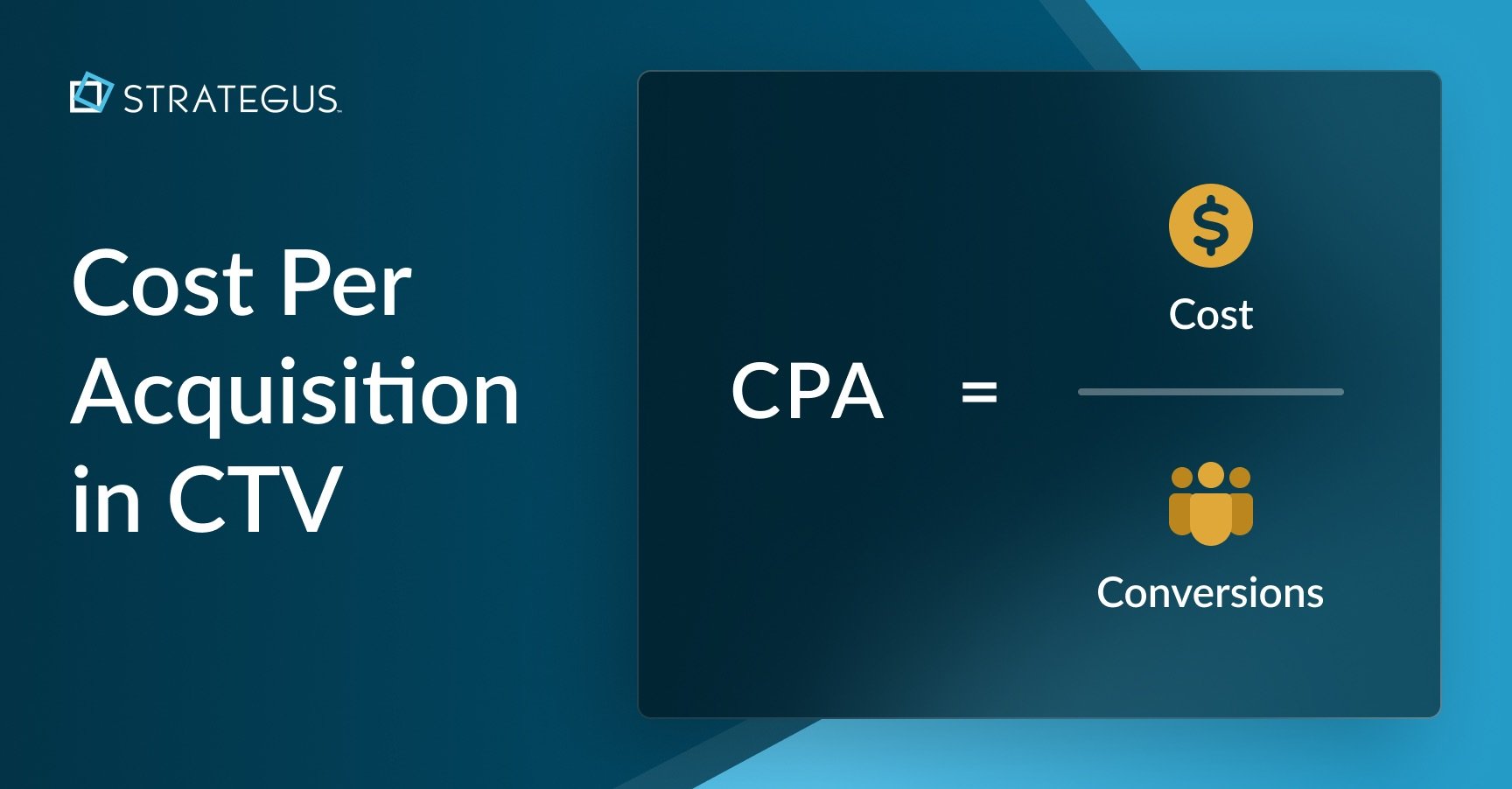
Formula: CPA = Total campaign cost ÷ number of acquisitionsFor example, if you spend $5,000 and generate 100 acquisitions, your CPA is:
CPA = 5,000 ÷ 100 = $50
In most digital channels, CPA is simple to calculate since conversions occur in the same environment as the ad. CTV differs: viewers don’t typically click; they convert later, on another device after seeing a TV ad.
What is cost per acquisition in CTV advertising?
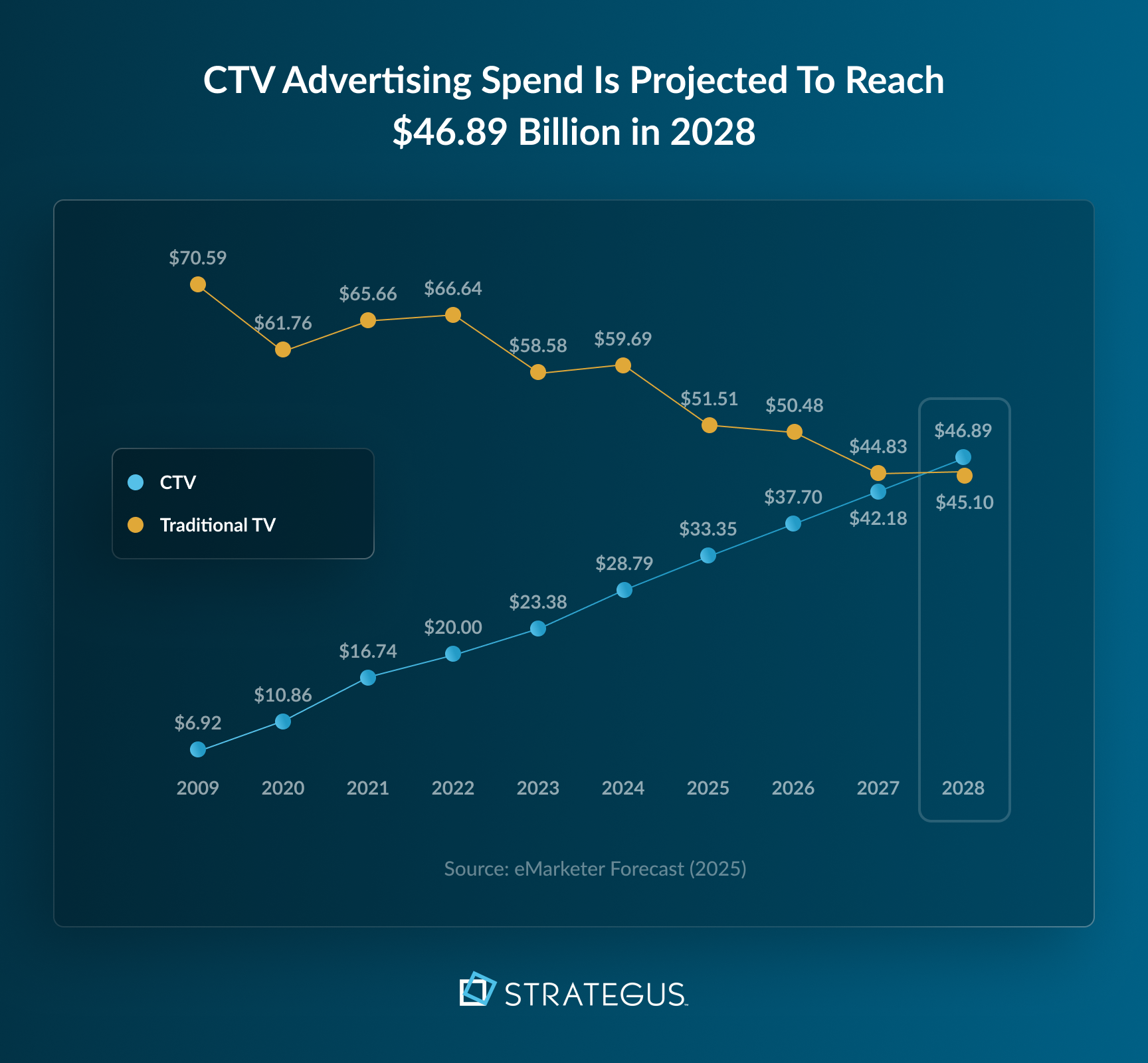
As TV viewing habits shift to streaming, advertisers are following suit — CTV advertising spend is projected to reach $46.89 billion in 2028. As advertisers are increasing their spending on CTV campaigns, accurately calculating your CPA is becoming increasingly crucial for understanding the performance of CTV ads.
CPA in CTV advertising still measures acquisition costs, but the tracking method differs significantly from search or social. Here are important factors for how CPA works with CTV:
- View-through attribution: A viewer sees an ad on TV and then converts on another device later.
- Cross-device identity graphs: Linking TV ad exposure to actions on phones, tablets, or laptops.
- Longer attribution windows: Conversions often happen hours or days after viewing.
- Pixel-based revenue tracking: Capturing purchases after exposure.
The desired actions remain the same — purchases, sign-ups, appointments, app installs — but the path to conversion spans across multiple devices and is longer, which can create attribution challenges. However, advanced attribution tools from Strategus let you measure the impact of your CTV advertising and quantify your ad spend.
Why tracking CPA in CTV advertising is important for performance marketers
For performance marketers, tracking CPA provides accountability for your ad spend. It helps you determine whether your marketing is sustainable — or if you need to adjust your strategy.
Here’s why you should track the CPA for your CTV campaigns.
Prove ROI with concrete customer acquisition costs
Budgets often hinge on ROI.
If you can’t demonstrate measurable returns, you’ll have a harder time getting your budget approved. Tracking CPA ties links your ad spend to real business results — not just views or impressions. With these metrics in hand, you’ll be able to prove ROI and justify marketing budgets.
Optimize campaign performance through data-driven insights
With any campaign, you can’t just “set it and forget it.” That leads to wasted impressions and ad spend.
Tracking CPA across segments, such as demographics, geographic locations, and even creatives, helps you determine which are more likely to convert, allowing you to adjust your ad spend accordingly. For example, you can shift more of your budget to segments with lower CPAs and reduce spending in more expensive ones.
Track and measure CTV ad spend efficiency
Programmatic advertising is a great way to automate and scale ad campaigns, but it’s also rife with wasted spend. The Association of National Advertisers (ANA) estimates that $26.8 billion is lost each year to inefficiencies in the digital supply chain.
CPA reveals the efficiency of your ad spend.
A high CPA indicates you’re spending a lot to acquire customers, which points to inefficiencies in your ads. Either you’re not targeting the right audience or your creatives are underperforming.
Meanwhile, a low CPA means your marketing campaigns are performing well. They’re turning viewers into customers at a profitable rate.
CPA typically starts higher as you set up a campaign, but it decreases as you optimize your ads and placement strategies over time. Tracking CPA establishes a benchmark you can use to track and measure your improvements.
How CPA is measured across different digital channels
CPA is one of the most clear-cut metrics in performance marketing, as it directly connects ad spend to revenue. However, CPA is measured differently across paid search, social media, and email channels.
Let’s take a look.
Paid search advertising
Search advertising platforms, such as Google Ads and Bing Ads, offer a straightforward way to measure CPA. You place a conversion tracking “pixel” on your order confirmation pages.
When users click search ads and make a purchase, the pixel triggers and the conversion is logged in your analytics. From there, you can calculate CPA by dividing ad spend by conversions.
Since specific actions typically occur on the same device within short timeframes, it’s easier to tie revenue to specific ads.
Social media advertising
Social media platforms like Facebook, Instagram, and LinkedIn use pixel-based conversion tracking similar to paid search. You place tracking codes on pages where conversions take place.
Conversion events include purchases, sign-ups, downloads, form submissions, and other custom events. Once your tracking codes and campaigns are set up, you can calculate CPA by dividing your ad spend by the number of customers acquired.
Attributing conversions is a little trickier — visitors may see an ad for a local business on Facebook, but may not convert until later. Advertisers can choose different attribution models, but calculating CPA is challenging when users interact with multiple touchpoints.
Email marketing
CPA in email marketing is measured through tracked links and tagged URLs, which utilize UTM parameters. When a recipient clicks an email link and completes a desired action, the conversion is attributed back to that campaign.
To calculate CPA, you divide the total cost of your email campaign by the number of acquisitions attributed to emails through your tagged links. Attribution is relatively straightforward in email, as clicks and conversions often occur on the same device within a short timeframe.
Each of these channels offers methods for calculating CPA. However, CTV advertising presents CPA tracking challenges with its cross-device nature and longer conversion windows.
How CPA tracking works in CTV advertising
CTV advertising enables a level of targeting that’s not just possible with linear TV. You can target specific demographics, locations, and even viewing habits. But tying ad views to revenue isn’t always easy.
With CTV attribution and revenue tracking tools from Strategus, you can connect the dots between ad views and conversions and calculate your CPA.
“In uncertain times, knowing what’s working — and why — is your biggest advantage. Programmatic CTV provides enough data to justify the investment. Even better, CTV campaigns can be paused, changed, and optimized on the fly, allowing for greater flexibility than linear, which is often bought in the upfronts.” - Joel Cox | Strategus Co-Founder
Here’s how it works.
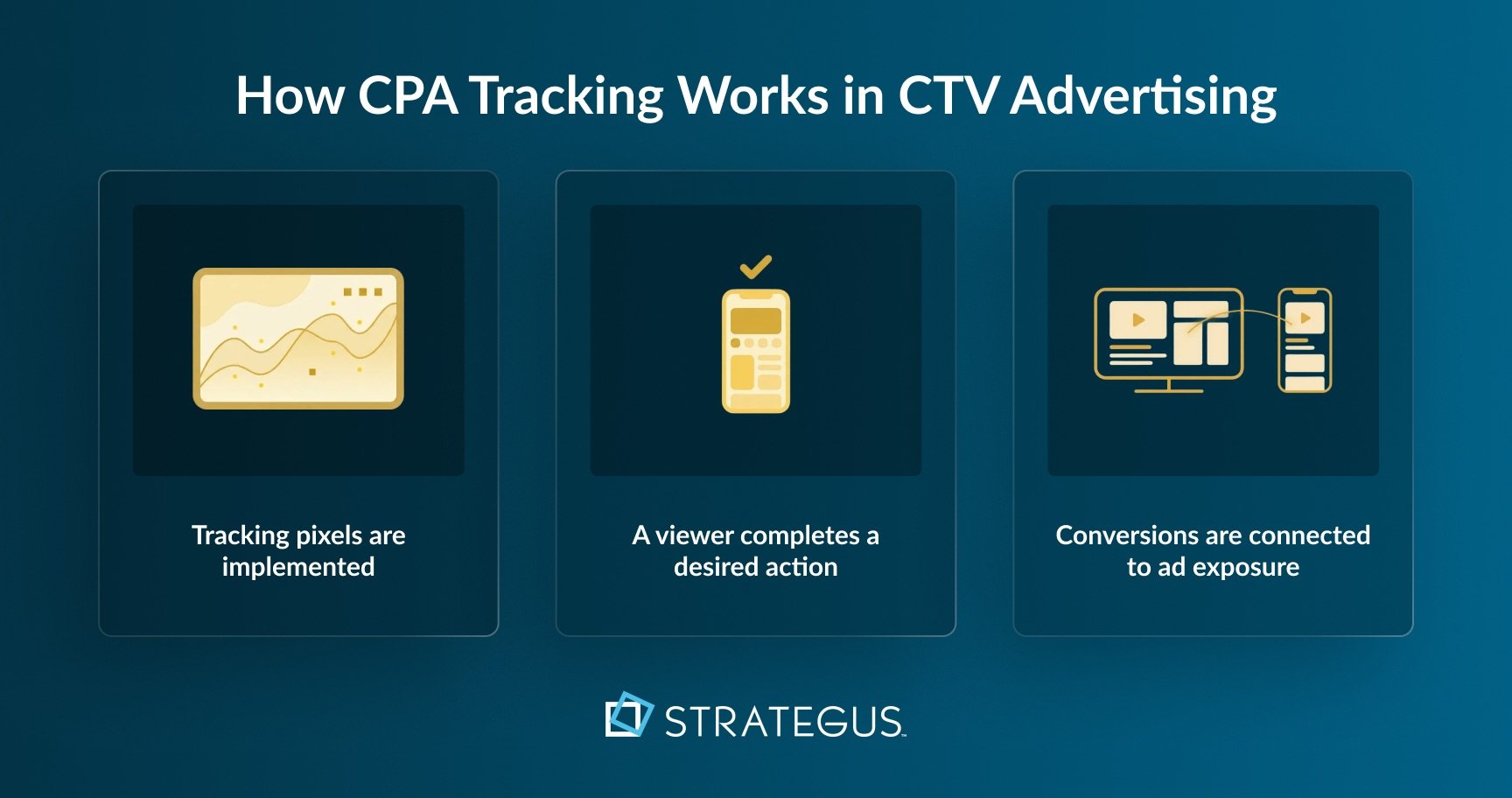
Tracking pixels are implemented on order confirmation pages
Companies often miss opportunities to optimize their campaigns because they don’t properly track conversions. As a result, they struggle to understand which ads are driving results.
Tracking pixels are placed on key pages, like purchase confirmation pages or appointment booking confirmations. These pixels “fire” when customers complete a desired action, capturing the conversion event.
Our specialized revenue pixels go a step further. These capture the conversion event and the dollar amount of each purchase, enabling precise tracking of sales revenue. Our team works with you to implement these pixels on your pages.
A viewer completes a desired action
More consumers are discovering new products on TV. A report from Shopsense AI found that TV drove an estimated $144.9 billion in U.S. retail sales.
Your ad reaches viewers on CTV devices through streaming platforms like Netflix, Hulu, and Amazon Prime Video. Our platform then logs those ad impressions.
Our attribution platform uses device graph technology to link ad exposure to purchasing activity on other devices, including smartphones and tablets. This cross-device mapping is critical since viewers may not convert until they’re on a mobile or desktop device later.
A viewer sees your CTV and then takes an action, such as making a purchase, signing up for a trial, or booking an appointment. The tracking pixel fires and logs the conversion.
An attribution model connects conversion to ad exposure
Our platform attributes conversion events and revenue to the original CTV ad exposures and then surfaces those insights in your reporting dashboard.
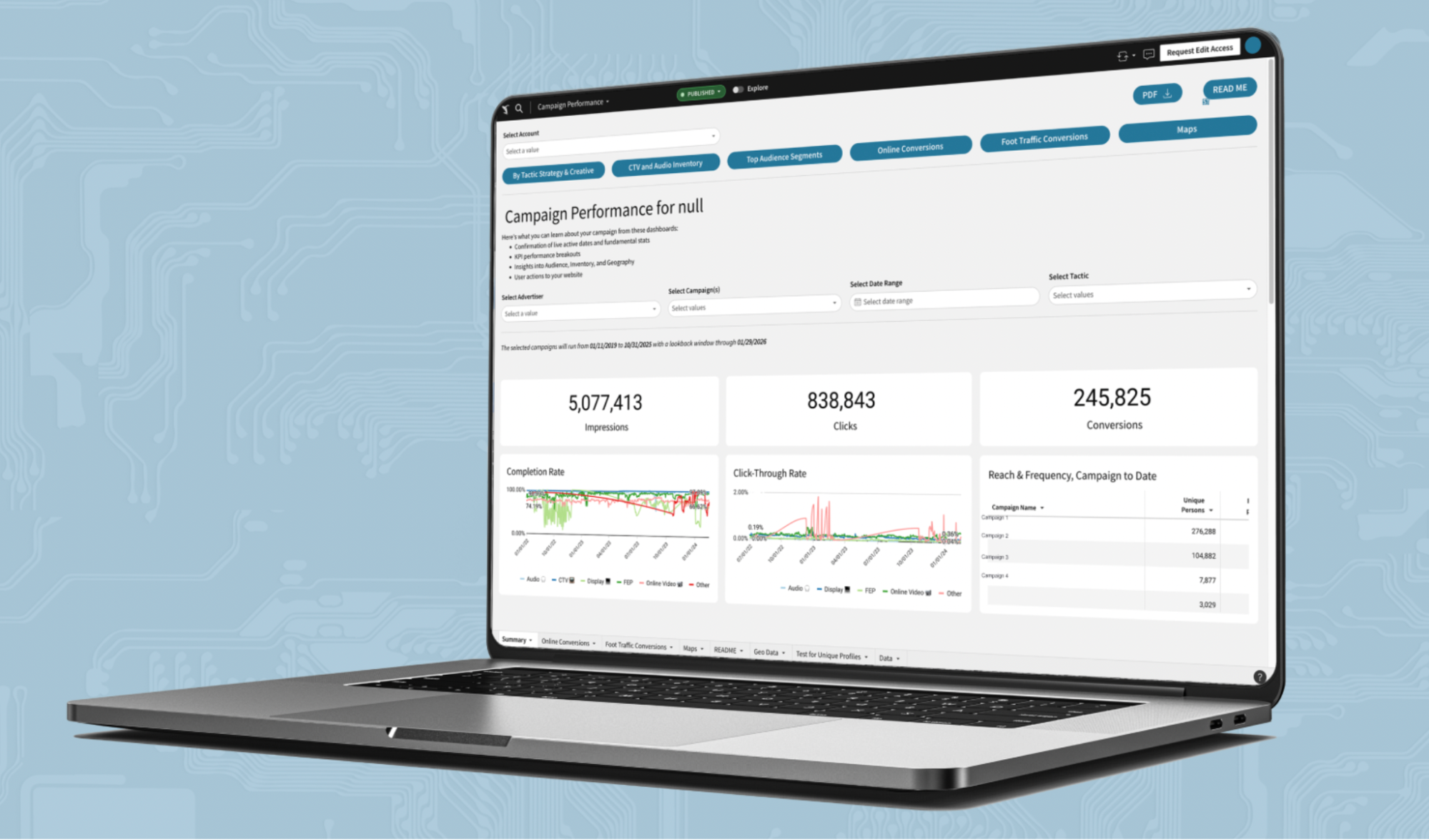
The dashboard lets you track KPIs like:
- Impressions
- Video completion rates
- Clicks
- Click-through rate
- Conversions
- Conversion rates
From there, you’ll be able to calculate your CPA. Of course, data on its own isn’t enough — you need to interpret it and know what to do next.
With Strategus as your CTV partner, our advanced attribution tools allow you to measure your CTV advertising and use those insights to improve your campaigns.
“Working with Strategus, we’re now able to report data showing how many people saw our spots, how many took the next step and went to our website, and what percentage of those engagements resulted in transactions. This has really helped quantify our ROI.” - Brian Bowsher | University of Washington Associate Athletic Director
Start tracking your CPA in your CTV advertising
Measuring CPA has always been a challenge with linear TV, where connecting ad views to conversions relied on guesswork.
With CTV ads, performance marketers can track customer acquisition costs with precision and optimize campaigns in real-time. However, you need the right attribution tools and measurement frameworks in place.
Strategus can help.
We offer fully managed CTV campaigns with advanced attribution capabilities. Our team handles everything from CTV setup to ongoing optimization. We also work with you to create a custom attribution framework that tracks your CPA and other marketing metrics that matter to your business.
Ready to see which of your CTV ads are delivering measurable outcomes? Contact a Strategus expert today to get started.
Frequently asked questions
What’s the difference between CAC and CPA?
Customer acquisition cost (CAC) is the total cost of acquiring a paying customer, while cost per acquisition (CPA) measures the cost of specific actions (e.g., leads, sign-ups, etc.). Think of CAC as a holistic business metric and CPA as a campaign-specific performance metric.
How is CPA calculated in CTV campaigns?
CPA in CTV is calculated by dividing total ad spend by the number of conversions. Use identity graphs or device-matching tools to connect ad exposure on CTVs to purchases made on other devices, such as phones or laptops.
What’s the difference between CPA and CPM in CTV advertising?
CPA measures the average cost per conversion for each customer acquired. Cost per mille (CPM) refers to the amount you pay for 1,000 ad impressions on streaming devices. The main difference is that CPM, unlike CPM, ties your ad spend to real business outcomes, while CPA is a metric that ties your ad spend to business outcomes.
How can I lower my CPA in CTV campaigns?
Strategies to lower your CPA include refining your targeting, testing different creatives, and shifting your budget towards top-performing segments. You can also incorporate cross-device retargeting campaigns to re-engage viewers who have viewed your CTV ad with additional online video.


Strategus is a managed services connected TV(CTV) advertising agency with over 60,000+ campaigns delivered. Find out how our experts can extend your team and drive the result that matter most.
What to read next