ACR TV Targeting to Deliver Contextually Relevant Ads

Table of Contents
Picture this: Lisa and her roommate pop some popcorn on a Friday night, excited to watch a new indie film that was just released to streaming. They settle in for a night of easy-watching and are immersed in the slow-paced drama.
The movie pauses for a commercial break, and an ad for Monday Night Football blares into their living room. The tranquil vibe is ruined in an instant, with both roommates searching for the channel changer to turn down the volume.
Not only is the Monday Night Football ad unappealing to the roommates, it’s also a poor fit for the content that it accompanies. And to make matters even worse, Lisa had already seen the ad several times that day.
We’ve all been there. But does it have to be this way? What if, instead, the ads we saw actually aligned with the content we were consuming?
Cue in automatic content recognition (ACR) data targeting.
What Is ACR TV Advertising?
Imagine seeing a trailer for the next big blockbuster before watching an action film, or an ad for a new gaming headset while watching The Last of Us. This is the promise of ACR data targeting, which allows advertisers to target ads based on what people are watching.

Under the hood, ACR is a chipset technology built into many Smart TVs to detect what content is being consumed. This makes it possible to understand someone’s viewing habits — including their favorite genres and shows, which networks and apps they use, and even which ads they’ve seen. ACR can also provide insight into different behaviors like binge-watching or cord-cutting based on the data it captures.
How Does ACR Targeting Work?
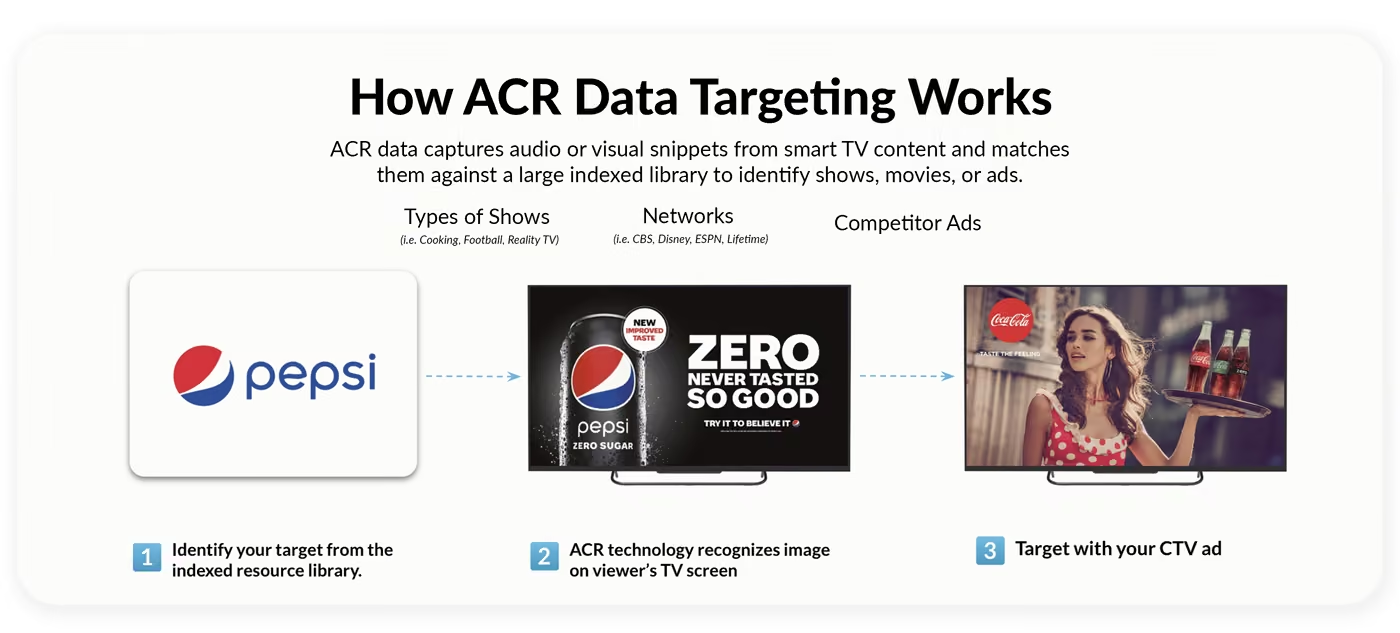
With ACR, Smart TVs capture tiny visual and audio snippets of the content on screen through a process called video fingerprinting. The technology continuously captures video fingerprints whenever programming or commercial content is displayed and across every source (broadcast, cable, streaming, apps, and video games).
The captured snippets, or fingerprints, are then compared to a vast library of known content. When a match is found, ACR determines exactly what that household is watching. This data can then be used to deliver more relevant ads.
The households from which ACR data is collected have opted in. From there, this data is modeled to reach a wider audience using the habits of a smaller group to infer those of a larger one.
Types of ACR Audience Segments
Serving sports fans ads related to the big game is an obvious use case for ACR targeting. But it can be used for so much more than that.
Here's a look at the key audience segments that can be activated with this data:
1. Viewership Habit Targeting
Reach users based on their preferred streaming platforms or network content.
Examples
- Binge Viewers: Target viewers who consistently watch multiple episodes of a show in a single session. For instance, a food delivery app could promote easy-to-order meals and snacks to this audience, catering to their desire for convenience during long viewing sessions.
- Movie Lovers: Target viewers who frequently watch movies across different genres. For example, a furniture retailer could target movie lovers with ads showcasing home movie theater furniture.
- Active Gamers: Target viewers who spend a significant amount of time watching gaming content or playing video games on their TVs. For example, an energy drink brand could target active gamers with ads promoting their product as a way to enhance focus and reaction time during extended gaming sessions.
- News Junkies: Target viewers who regularly watch news programs. For example, an auto dealer could target news junkies with ads for a fuel-efficient vehicle, appealing to their interest in current events and potentially higher gas prices.
2. Viewership Genre Targeting
Target viewers of specific show categories with messages that align with their interests.
Example:
- NFL Watchers: Target households that watch NFL games, including live broadcasts, pre-game and post-game shows, and related content. For example, a sports apparel brand could target NFL watchers with ads featuring their favorite players or team merchandise.
- Reality TV Junkies: Target viewers who frequently watch reality TV shows. For instance, a travel and tourism brand could target viewers who watch reality TV shows set in exotic locations.
- Home Improvement Buffs: Target viewers who regularly watch home renovation or DIY shows. For instance, a home organization brand could target this audience with ads for storage solutions and organizational products to help them manage their living spaces.
3. Custom Viewership Targeting
Create highly tailored audiences based on custom inputs.
Example:
- Dallas Cowboys Game Watchers: Target households that specifically watch Dallas Cowboys football games. For example, a sports bar in Dallas could target these viewers with ads for game-day specials and promotions.
- Live Music Enthusiasts: Target households that have watched live streams or on-demand content from specific music festivals. For example, a local brewery could target these viewers with ads for their craft beers, aligning with their interest in local music and events.
4. Linear TV Extension Targeting
Target connected TV (CTV) viewers who haven't seen your linear TV ad, or exclude those who have. This tactic enables advertisers to optimize their reach without risking ad fatigue.
Example:
- Show CTV ads to viewers who missed your ad on cable: Say a fast-food chain aired a commercial during the local Football broadcast. Using ACR, the brand could target viewers who didn't see it with a CTV ad the following day.
- Exclude CTV viewers who have already seen your ad on cable: A car manufacturer running a campaign on a popular cable show could use ACR to avoid showing the same ad to those viewers when they stream content on their CTV devices, preventing ad fatigue and optimizing ad spend.
Benefits of ACR TV Advertising
We've looked at specific examples of how ACR can be used. But what are its benefits more generally? Here are some of the key advantages from our point of view.
- Relevant User Experience: Serving ads that align with what someone is actually watching leads to a much better experience for the viewer. It's less disruptive and more likely to capture their attention.
- Cookieless Tactic: As the industry moves towards a more privacy-focused approach and cookies become less reliable, ACR offers a robust, privacy-conscious way to target relevant audiences on TV.
- Increased Reach Without Fatigue: Linear TV Extension is a prime example of using ACR data to scale your audience without risking oversaturation. This technology makes it possible to reach new viewers on CTV who missed your linear ad campaign, thereby avoiding bombarding viewers with the same ad across both platforms.
- Brand Suitability: By understanding viewing habits and the content audiences are engaging with, ACR data helps ensure your ads are shown in environments that align with your brand's image and values.
Contextual Targeting vs. Audience Targeting
You might be asking yourself: Is this technology really all that new? Haven’t ads aligned with the content they accompany for years?
The answer is yes and no.
Traditional broadcast TV ads have long been purchased using a content-specific approach, where advertisers guess which channels their buyers are tuning into and transact on that inventory. This often necessitates a “spray and pray” model,where brand broadcast generic messages to large groups in hopes of reaching a handful of prospects.
When CTV advertising entered the picture, advertisers got the audience-targeting capabilities of digital display advertising. While certainly an improvement, early iterations of this (and many options on the market today) still rely on broad demographics and third-party data. For instance, a car company might target suburban families aged 25-44.
Advertisers shifting their budget to CTV with a linear mindset struggled with this. Lacking transparency into where these ads ran and questions about brand suitability made some reluctant to go all-in on audience-based targeting.
Contextual targeting has emerged as a potential solution. Instead of targeting viewers, it targets content. While some saw this as a step back, modern contextual targeting is much more sophisticated than traditional dayparting. It considers a wide range of data points, including the mood and tone of the scene right before the ad break
But what if it didn’t have to be an either-or decision? Can’t we all agree that using the two in tandem would be the best possible approach?
That’s certainly our Co-Founder Joel Cox’s take on the matter.
Why I prefer audience-based targeting over content-based targeting | Joel Cox posted on the topic | LinkedIn

Co-Founder and EVP of Innovation @ Strategus | High-Performance CTV Advertising From a Hands-On Partner
1y
Content-based targeting is in vogue right now, largely due to the industry’s move toward privacy-first tactics.
Also called contextual targeting, content-based targeting places ads based on the content on the screen rather than the people watching it. This makes it more compliant than some audience-based targeting tactics because it doesn’t build off cookies or personally identifiable information.
There are a ton of use cases where content-based targeting makes sense. If I'm selling basketball sneakers with Nikola Jokić as my spokesperson, I’d absolutely want some NBA and Nuggets exposure.
But when asked to choose one — content-based or audience-based targeting — I’m still going with the latter.
Why? 𝐁𝐞𝐜𝐚𝐮𝐬𝐞 𝐯𝐢𝐞𝐰𝐞𝐫𝐬 𝐚𝐫𝐞𝐧'𝐭 𝐧𝐞𝐜𝐞𝐬𝐬𝐚𝐫𝐢𝐥𝐲 𝐛𝐮𝐲𝐞𝐫𝐬.
A person watching a car show might be a casual enthusiast with zero purchase intent, while someone binge-watching cooking competitions could be actively shopping for a new vehicle online.
Moreover, 𝐩𝐫𝐢𝐯𝐚𝐜𝐲-𝐜𝐨𝐦𝐩𝐥𝐢𝐚𝐧𝐭 𝐚𝐮𝐝𝐢𝐞𝐧𝐜𝐞 𝐭𝐚𝐫𝐠𝐞𝐭𝐢𝐧𝐠 𝐢𝐬 100% 𝐩𝐨𝐬𝐬𝐢𝐛𝐥𝐞:
→ First-party data activation remains powerful and privacy-friendly→ Retail media data provides deterministic insight without relying on cookies→ Some contextual targeting solutions can even identify users who've shown purchase intent through browsing and social media activity
At Strategus, we're helping brands combine these approaches to find the perfect balance between precision and scale. This layered approach combines the power of content-based relevance with audience-based accuracy to maximize campaign performance.
𝐈𝐭 𝐝𝐨𝐞𝐬𝐧’𝐭 𝐡𝐚𝐯𝐞 𝐭𝐨 𝐛𝐞 𝐚𝐧 𝐞𝐢𝐭𝐡𝐞𝐫-𝐨𝐫 𝐝𝐞𝐜𝐢𝐬𝐢𝐨𝐧. And the most effective strategies are those that intelligently layer various data signals to understand and reach the right people with the right message.
…more
Play Video
Video Player is loading.
Loaded: 0%
PlayBack to start
Stream Type LIVE
Current Time 0:00
/
Duration -:-
1x
Playback Rate
Show Captions
Mute
Fullscreen
````
By 33`````````````` 2 Comments
Share
li.protechts.net
li.protechts.net is blocked
This page has been blocked by an extension
- Try disabling your extensions.
ERR_BLOCKED_BY_CLIENT
Reload
This page has been blocked by an extension

Get the Best of Both Worlds: Layering for Precision and Scale
While ACR data provides a powerful lens into TV viewing habits, the most effective advertising strategies often involve layering it with other valuable data sources. And with Strategus, advertisers can combine the power of content-based targeting with that of audience-based targeting to balance campaign precision and scale.
Say you want to target recent website visitors who are also avid sports viewers. By layering your website retargeting data with ACR segments identifying sports enthusiasts, you could pinpoint a highly engaged and relevant audience. This not only increases precision, ensuring your message reaches the right people, but also allows for greater scale than relying on a single data source.
At Strategus, we believe in the power of this layered approach. By strategically combining various targeting tactics, including ACR data, we help brands break free from the limitations of single-source targeting and achieve campaigns that are both incredibly precise and reach a significant audience. This allows for optimized ad spend, reduced waste, and ultimately, better results.
Ready to learn what more precise TV targeting can do for you? Contact our experts today to explore how ACR data and layered targeting strategies can elevate your campaigns.
Frequently Asked Questions
Is Netflix AVOD or SVOD?
Layer interests, purchase behavior, and viewing habits on top of age and location — so every impression reaches someone who actually matters to your business.
What is ACR TV Targeting to Deliver Contextually Relevant Ads?
Picture this: Lisa and her roommate pop some popcorn on a Friday night, excited to watch a new indie film that was just released to streaming. They settle in for a night of easy-watching and are immersed in the slow-paced drama.
What Is ACR TV Advertising?
Imagine seeing a trailer for the next big blockbuster before watching an action film, or an ad for a new gaming headset while watching The Last of Us . This is the promise of ACR data targeting, which allows advertisers to target ads based on what people are watching.
How Does ACR Targeting Work?
With ACR, Smart TVs capture tiny visual and audio snippets of the content on screen through a process called video fingerprinting. The technology continuously captures video fingerprints whenever programming or commercial content is displayed and across every source (broadcast, cable, streaming, apps, and video games).
What are the types of ACR Audience Segments?
Serving sports fans ads related to the big game is an obvious use case for ACR targeting. But it can be used for so much more than that.
What is viewership Habit Targeting?
Reach users based on their preferred streaming platforms or network content. Binge Viewers: Target viewers who consistently watch multiple episodes of a show in a single session.
get in touch
Subscribe to our
newsletter
Stay ahead with strategies and insights from streaming advertising experts.
Learn from the field
.webp)
.webp)
.webp)
.webp)
.webp)
.webp)
.webp)
Book a demo
Talk to an expert
Tell us what you want to achieve and we'll map the media strategy to get you there — no self-serve dashboards, just a partner who does the work.