Ad Frequency Capping: How to Set the Right Caps

Table of Contents
If you’ve ever seen the same ad three times during one movie, you know how fast a good ad wears out its welcome. By the third time, you’re probably reaching for the remote. Frequency capping is how you keep your own ads from becoming that ad.
For an advertiser, those extra plays cost you twice. You pay for impressions that have stopped working, and the household you paid to win over ends up a little annoyed with you.
Setting a cap sounds simple, but connected TV and programmatic campaigns can run across dozens of apps and more than one ad platform, so the right cap depends on your goal, your audience, and how the media is bought.
Key takeaways
- A frequency cap sets the most times one household can see your ad in a set window, like a day or a week.
- Repeats wear thin fastest on connected TV. Omnicom Media’s 2026 research found more than half of consumers would pay a premium to avoid seeing the same ads in one streaming session.
- Set caps based on your goal, audience size, and budget, and pair a daily cap with a weekly or flight cap.
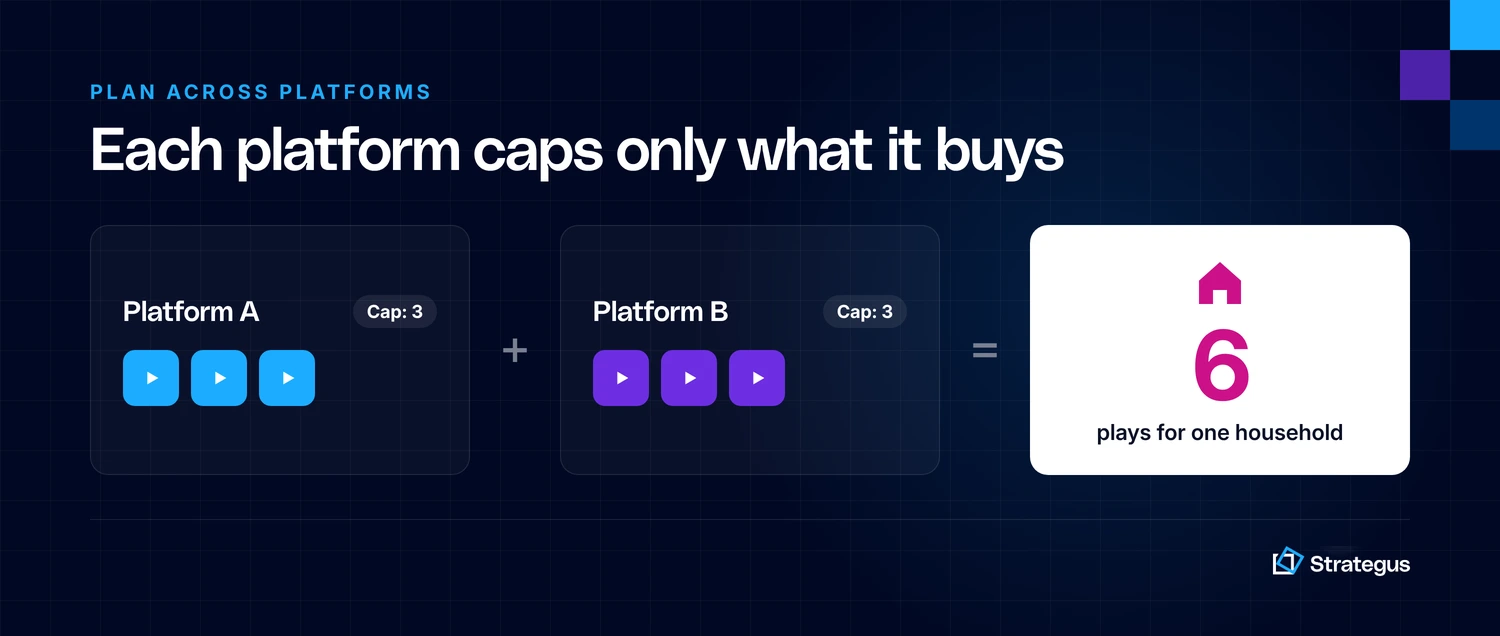
- Each platform caps only the impressions it buys, so plan frequency across the whole buy.
- Check frequency by app once the campaign is live, and rotate creative so repeats feel fresh.
What is frequency capping?
Every frequency cap has three parts: a number, a time window, and what’s being counted. A cap of three per household per day means one home can see your ad up to three times in a day, and then it’s off the list until the window resets.
On connected TV, what’s being counted is usually the household, because the TV is a shared screen. So a household cap of three means that home sees your ad three times, whether one person is on the couch or the whole family is.
How a cap works in a programmatic buy
Programmatic platforms decide impression by impression whether to bid. Before each bid, the platform checks how many times that household has already seen your ad in the current window, and once it hits the cap, the platform passes and moves on to the next one.
That check is what makes caps reliable inside one platform. It’s also why they get trickier once your campaign runs on more than one, which we’ll get to in the steps below.
Why frequency capping matters on connected TV
Repetition hits harder on a TV screen. A banner that shows up too often is easy to ignore, but a 30-second spot that plays again during the same show gets the viewer’s full attention, for better or worse.
Just ask anyone who watched March Madness in 2025. GEICO brought back a spot from 2010 where a narrator asks whether switching could really save you 15%, then follows up with “Did the little piggy cry ‘wee, wee, wee’ all the way home?” Cut to Maxwell the pig, squealing out a car window for the whole ride.

It was a fun ad in 2010. But it ran so often during the tournament that viewers were fed up within a day, with one posting that it was “already driving me insane and it’s only day one of the tourney.” The ad didn’t get worse. People just saw it too many times. GEICO can absorb a few groans, but most brands don’t have that cushion. On linear TV, nobody controls how often one home sees a spot. On connected TV, you set that number yourself.
Omnicom Media found repeats within a single session are most pronounced on streaming platforms, and more than half of consumers said they’d pay a premium to avoid seeing the same ads again and again in one streaming session. Omnicom calls the result “negative reach,” the point where repeated impressions frustrate people and make an ad less effective instead of more.
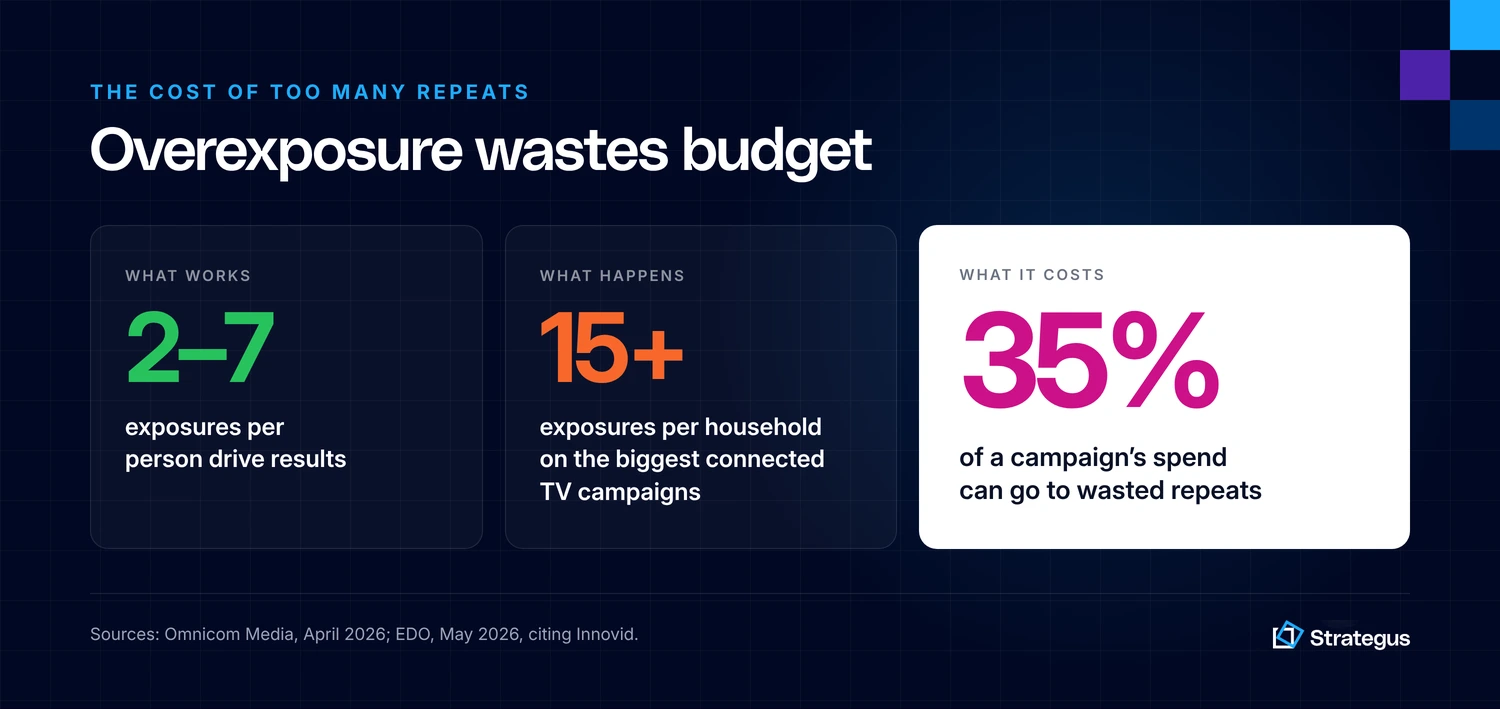
Overexposure costs money, too: In a May 2026 analysis, TV measurement company EDO found the biggest-spending connected TV campaigns average 15 or more exposures per household, and that wasted spend can run as high as 35% on a single campaign.
Say you own a furniture store in Tampa and put $10,000 into connected TV this month. If even a fifth of it goes to homes that have already seen your ad plenty, that’s $2,000 that could have introduced your store to people who’ve never heard of it.
Types of frequency caps
Most ad platforms let you set caps at more than one level, and each one solves a different problem.
| Cap | What it limits | When it helps |
|---|---|---|
| Daily cap | Exposures per household in one day | Keeps one evening from piling up repeats |
| Weekly cap | Exposures per household in a week | Keeps steady pressure through a longer flight |
| Flight cap | Exposures per household over the whole campaign | Short promotions, events, and small audiences |
| Campaign cap | One count across every ad in the campaign | Several spots running to the same audience |
| Creative cap | Exposures of one ad | Rotations and sequences |
| Publisher cap | Exposures within one app or publisher | Keeps one app from piling up repeats |
Some publishers add caps of their own on top of yours, so ask your media partner what’s already in place before you pick a number.
Frequency capping best practices: How to set your caps
Step 1: Size your audience against your budget
Your goal decides whether the plan leans toward reach or frequency, and our reach and frequency guide covers how to choose. The cap then has to fit the budget, because the two pull against each other. Put a tight cap on a small audience, and the platform runs out of households it’s allowed to reach, so part of your budget sits unspent. Put a loose cap on a big budget, and the impressions pile onto the same homes.
That’s why the math belongs before launch. Ask your media partner how many households your audience holds in your market, then divide the impressions your budget buys by that number. If the result comes close to your cap, the budget is bigger than the audience can absorb, so widen the audience or the area before you raise the cap.
Step 2: Layer a daily cap under a weekly one
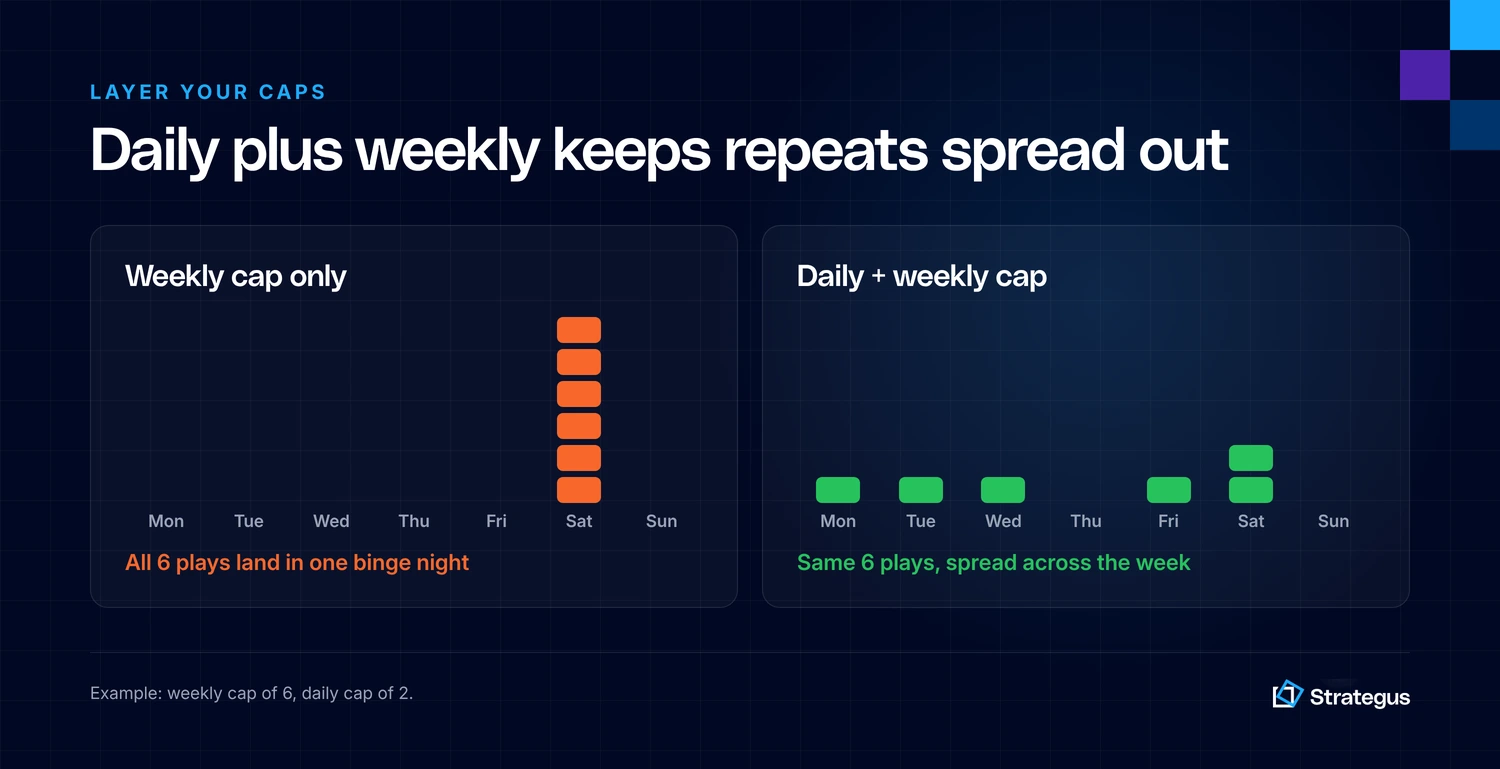
One cap on its own leaves a gap: With only a weekly cap, a household can get the whole week’s exposures in one Saturday night binge, and with only a daily cap, it can hit the daily max every day for a month.
Using both closes the gap, since the daily cap handles the same-evening repeats people notice and the weekly or flight cap keeps the total where you planned it.
Step 3: Plan frequency across every platform in the buy
Each ad platform can only count the impressions it buys. If the same audience runs through two platforms, or through a platform and a direct deal with a publisher, each one caps on its own, and a household can reach the cap in both.
That’s also why total reach and frequency can be hard to pin down for a plan that spans several platforms, especially when some publishers share only limited data. The practical fix is to buy each audience in as few places as you can and set each cap with the others in mind.
The good news is that Omnicom’s research found people are far more tolerant of seeing an ad across different platforms than seeing it again and again in the same place, so the repeats to watch most closely are the ones inside a single app or session.
Step 4: Ask for frequency by app once you’re live
Once the campaign is live, ask for frequency by app or publisher along with the campaign total. As EDO points out, two publishers can charge the same price and still wear out your audience at very different speeds, so an app that’s piling up repeats usually needs its own cap or less budget while the rest of the plan stays as it is.
A good media partner lets each change run long enough to read the results before making the next one and judges it by site visits or sales per dollar along with reach. With a big enough budget, they can also split the audience and test two caps side by side.
Want to know what frequency caps would fit your audience and budget?

Rotate creative so repeats feel fresh
Caps decide how often people see you, and creative decides whether the third exposure feels like a reminder or a rerun.
If you run more than one version of your spot, your cap settings decide how the rotation plays out. A campaign cap holds each household’s total across every version, and a creative cap on each version keeps one spot from taking most of the plays. Set only creative caps, and a household can see every version up to its own limit, which adds up fast.
You can take it a step further with sequential messaging, where each household sees your ads in a set order, like an introduction, then proof, then an offer, and caps keep each step from running too long before the next one starts. Our post on ad creative fatigue covers the warning signs that a spot has worn out and how often to refresh it.
Common frequency capping mistakes
Even well-planned campaigns trip over the same few habits.
- Setting it and forgetting it: Audiences, prices, and available inventory shift during a flight, so a cap that fit in week one may not fit in week four.
- Using one cap for every audience: A retargeting audience of past site visitors is small and close to buying, while a prospecting audience is large and new to you, so they need different caps.
- Ignoring impressions that can’t be capped: Not every app or publisher passes the signal a platform needs to count households, so those impressions run without a cap. Ask your media partner how much of your buy that is and whether to leave it out.
- Overcorrecting: Caps can be too tight, too. If most homes see your ad only once, it may not stick by the time they’re ready to buy.
How we manage frequency at Strategus
Getting caps right takes planning before launch and attention every day after, which is a lot to ask of a busy marketing team. At Strategus, frequency is part of the plan from the start: Blueprint forecasts what your budget can deliver in your markets, and our team sets caps to fit the size of your audience and your goal, whether that’s brand awareness, site visits, or sales.
We buy through several major platforms, so we plan caps across the whole buy. That’s the day-to-day work of our managed programmatic service: A strategist checks delivery every day and adjusts caps, budget, or creative when repeats start to pile up in one place, and we’ll walk you through what we changed and why.
Get a second opinion on your caps
If you’re already running connected TV, send us a recent frequency report, and we’ll show you where repeats are cutting into your reach and what we’d change. If you’re planning your first campaign, we’ll map caps to your goal and budget before launch.

Frequently Asked Questions
Is Netflix AVOD or SVOD?
Layer interests, purchase behavior, and viewing habits on top of age and location — so every impression reaches someone who actually matters to your business.
What is frequency capping in advertising?
Frequency capping is a setting in your ad platform that limits how often the same household or person can see your ad, such as three times a day or 10 times a week. Once someone reaches the limit, the platform stops bidding to show them the ad until the period resets.
What is a good frequency cap?
One that fits your goal, audience size, and budget. Awareness campaigns usually use lighter caps across more households, while retargeting and sales campaigns can carry more. Pair a daily cap with a weekly one, and have your media partner adjust both as results come in.
Do frequency caps work across different ad platforms?
Not automatically. Each platform counts only the impressions it buys, so if your audience runs on two platforms, a household can hit the cap on each one. Keeping each audience in as few places as possible, and setting caps with the whole buy in mind, keeps the total close to plan.
What are frequency capping best practices for retargeting?
Retargeting audiences are small, so they reach caps quickly. Use a daily cap to stop same-evening repeats, a flight cap to keep the total in check, and more than one version of your ad so the reminders don’t feel like reruns.
Can a frequency cap keep my budget from spending?
Yes. If the audience is small and the cap is tight, the platform runs out of households it’s allowed to reach, and delivery slows. Widening the audience or the area usually fixes it better than raising the cap.
get in touch
Subscribe to our
newsletter
Stay ahead with strategies and insights from streaming advertising experts.
Learn from the field
Talk to an expert
Let's plan your next campaign
Tell us what you're trying to hit and what you have to spend. A strategist will show you which channels fit and how we'd measure success.