





.svg)











 Emily Sears
13 minutes read
As part of our thought leadership series, we're sharing perspectives from leaders across Strategus who shape how the company operates and grows.
This installment comes from Emily Sears, our Director of Ad Operations. She oversees campaign execution and optimization across Strategus's managed services portfolio, working closely with account teams and clients to make sure campaigns continually improve performance.
Have you ever sat through a campaign recap where the agency walked you through a deck full of green arrows and left you with no real sense of what they actually did that month?
It happens constantly in programmatic. A campaign launches, the platform does its thing, impressions accumulate, and somewhere, on a Zoom call a month later, someone calls it optimization.
The platforms deserve credit here. They are genuinely good at keeping a campaign running. Pacing, bidding, delivery — the technology handles the basics well enough that you can set up a campaign, walk away, and come back to results that look acceptable. That's not a secret, and it's not nothing. But it's also the floor, not the ceiling.
The gap between a campaign that runs and one that actually improves is where the real work happens. Reading what the data is telling you week over week. Catching a frequency problem before a client notices it. Knowing which audience segment is quietly outperforming and shifting budget before the month is over. Showing up to a check-in with a recommendation instead of a status update.
Clients have gotten better at asking for this. They want a partner who's thinking ahead, not just reporting back. And the agencies that can actually deliver on that are fewer than the pitch decks would suggest.
This is what that work looks like from the inside.
"Optimization" Is Bigger Than Most People Think
Ask a client what optimization means, and most will say something like swapping a creative or adjusting a bid. One tweak, maybe two, and the campaign is "optimized." The word has been used so loosely for so long that it's started to mean almost nothing.
In practice, it's a continuous set of decisions across multiple variables, and it starts before a single lever gets pulled. The first question isn't what to change. It's what you're actually trying to accomplish.
Every adjustment flows from the campaign's primary objective. When that objective isn't clearly defined upfront, things go sideways fast. Conflicting KPIs are one of the most common and least talked about problems in programmatic. Push too hard toward one metric, and you create pressure somewhere else in the campaign. It's like asking a car to go as fast as possible while burning as little gas as it can. Something has to give, and it usually does.
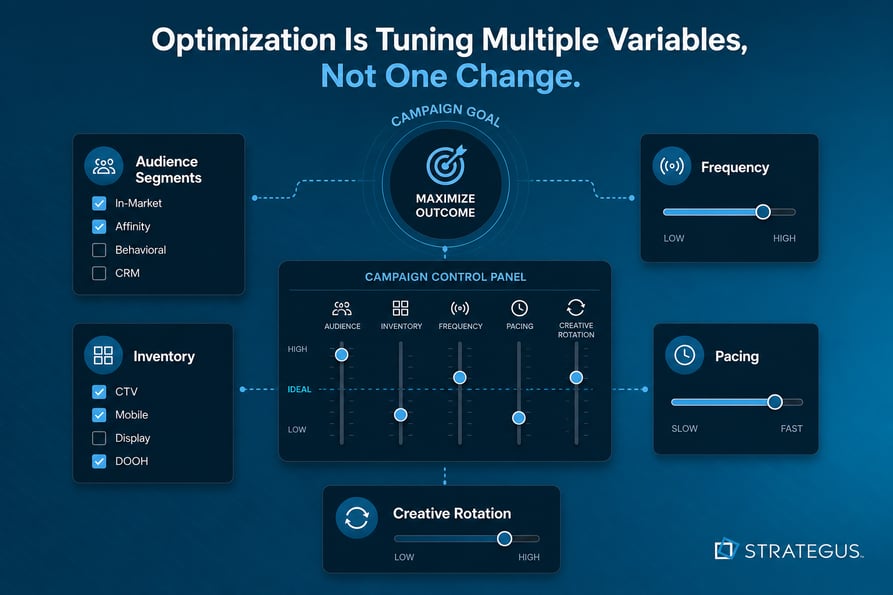
Once the objective is locked, the work becomes about watching the right variables and knowing what to do when they move.
- Audience segments: A segment can look like it's performing well simply because most of the budget is concentrated there. Pull back the data, and you might find little downstream activity. Meanwhile, a smaller, less obvious audience is quietly converting at a higher rate, and nobody's shifted budget toward it yet.
- Inventory: Not all impressions are equal. Some publishers and apps deliver real exposure to engaged viewers. Others inflate impression counts cheaply and don't move the needle on anything that matters.
- Frequency: If the same small pool of households is absorbing a disproportionate share of impressions, that's wasteful. The goal is reaching the right people enough times for the message to register, without burning through reach on an audience that's already seen the ad a dozen times.
- Pacing: A campaign that spends too fast loses inventory access and optimization flexibility later in the flight. One that spends too slowly can never build enough frequency to have an impact. Getting pacing right is an active, ongoing process.
- Creative rotation: Is one asset fatiguing while another goes untested? You shouldn’t blindly refresh the asset just to do it. Understand when a specific message is losing steam in a specific environment, and make a change before fatigue starts showing up in the numbers.
None of this is a single action. It's a set of overlapping decisions that have to be made together, constantly, with one eye on the objective and the other on what the data is actually saying.
The Signals We Watch, and What They're Actually Telling Us
A campaign dashboard can show you a lot of things. Most of them don't require a reaction. Part of the job is knowing which numbers actually mean something, which ones are noise, and how long to watch a trend before it earns a decision.
- Completion rates: CTV runs high by nature. It's a non-skippable, lean-back environment, so viewers finish ads at rates you'd never see on other channels. When completion drops meaningfully, something is worth investigating.
- Frequency distribution: If a small group of households is absorbing a disproportionate share of impressions, that's not a performance story. That's a targeting or frequency cap issue, and it needs to be addressed before it becomes waste.
- Site visit lift trends: Are post-exposure actions holding steady, growing, or falling week over week? This is one of the cleaner reads on whether the campaign is actually moving people.
- Audience segment performance: Which behavioral or demographic cuts are converting versus just accumulating impressions with no downstream signal?
- Geo performance: Are certain markets or zip codes driving stronger lift than others? If so, that's a budget reallocation conversation worth having.
What we're watching depends entirely on what the campaign is trying to do. The metrics that matter for an awareness campaign are different from the ones that matter for a conversion campaign, and optimizing toward the wrong signals is one of the quieter ways campaigns underperform.
|
Campaign Goal
|
What We're Optimizing For
|
|
|
|
|
|
|
|
|
|
Pulling traffic levers on a conversion campaign, or chasing CPM efficiency when the client needs actions, creates the illusion of progress without the results. It also creates a very uncomfortable quarterly review.

Proactive vs. Reactive: How Agencies Approach Optimization
There's a version of optimization that's really just damage control. Something slips, the client notices, and the agency responds. That's reactive management, and while it's better than nothing, it's not what good campaign stewardship looks like.
Proactive optimization means catching the frequency problem before the client sees it in the dashboard. It means noticing that a particular market is generating stronger site visit lift and bringing a budget reallocation recommendation to the next check-in rather than waiting to be asked. The client shouldn't have to be the one spotting these things.
The other half of proactive work is communication. Changes made without explanation don't build confidence. They build questions. Sharing what shifted, why it shifted, and what we expect it to do is what turns optimization from a black box into something a client can actually trust.
That said, proactive doesn't mean impatient. One of the most common client requests is optimization updates in the first week or two after launch. The honest answer is it's almost always too early. A campaign needs time to accumulate data before patterns become meaningful. Acting on incomplete information can destabilize what's working before it's had a chance to work. Knowing when to move is just as important as knowing what to move.
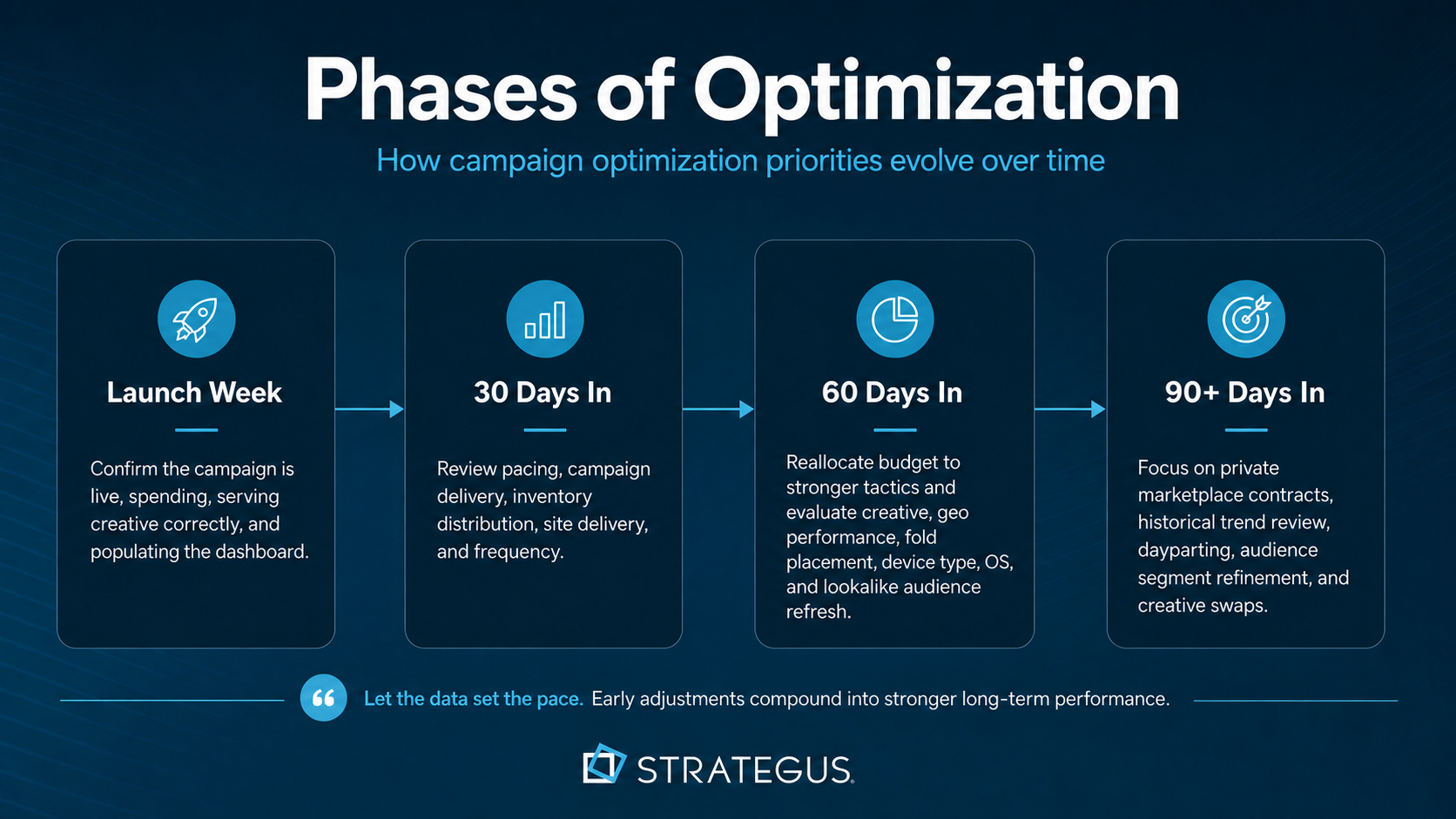
We think about this in phases:
|
Phase
|
What We're Focused On
|
|
|
|
|
|
|
|
|
|
|
|
|
If meaningful data shows up earlier, we'll act earlier. The goal is always to let the data set the pace vs. a rigid calendar.
The campaigns that improve the most are the ones where each month's adjustments build on the last. It compounds, the same way interest does. The biggest performance gains tend to come after month three or four, and they come because the early work was done carefully and without shortcuts.
What Good Ad Ops Actually Looks Like
Most agencies will tell you they're proactive. Fewer actually show up to a monthly check-in with findings instead of just answers. Here's a practical way to evaluate what you're actually getting.
|
❇️ Green Flags
|
🚩 Red Flags
|
|
Optimization actions explained, not just implemented |
Changes made with no explanation |
|
Check-ins that arrive with data-backed recommendations |
Status updates with no point of view |
|
Issues flagged before you spot them in the dashboard |
No communication unless you initiate it |
|
Creative rotation driven by fatigue signals in the data |
Creative swaps on a calendar schedule regardless of performance |
|
Budget reallocation based on what's working in-flight |
Budget allocation frozen to the original plan |
|
AI and machine learning informing decisions, not making them blindly |
Over-reliance on automated signals with no human judgment applied |
The work itself is rarely glamorous. But an ad ops partner worth keeping is one who can tell you what levers they're pulling, why they're pulling them, and what they expect to happen as a result. That level of transparency is what separates a vendor executing a plan from a team that actually owns the outcome.

What Optimization Can't Fix
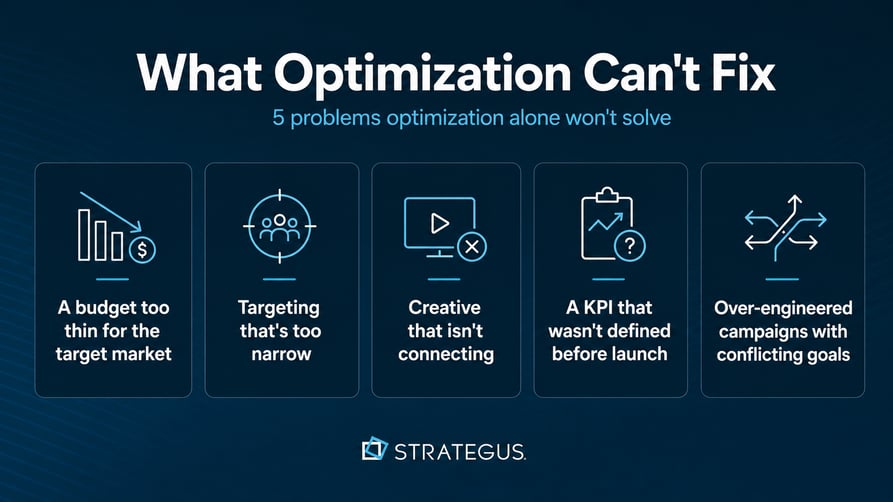
Optimization is powerful, but it works downstream of strategy. When the foundation has problems, no amount of in-flight adjustment fixes them.
A few things that fall outside what optimization can solve:
- A budget too thin for the target market.
If there isn't enough spend to generate meaningful frequency with the intended audience, the campaign will technically run and deliver very little. That's a planning problem, not an ops problem. - Targeting that's too narrow.
A hyper-restricted audience pool burns out fast. When reach is exhausted in the first few weeks, frequency spikes on the same small group of households and the campaign has nowhere to grow. - Creative that isn't connecting.
High completion rates with flat downstream activity is a creative signal. The ad is being watched and nothing is happening afterward. Optimizing delivery around weak creative just gets more people to ignore it more efficiently. - A KPI that wasn't defined before launch.
Campaigns without a clear objective get optimized toward whatever looks good in the moment, which is rarely what the client actually needed. - Over-engineered campaigns with conflicting goals.
More tactics and more targets do not automatically mean better performance. Sometimes the complexity is the problem.
One more thing worth saying: Programmatic is actually good at surfacing surprises. The audience a client assumes is their “ideal customer profile” can often turn out to be a different one entirely. Let the tactics compete. Let the data decide which segment wins. Clients who stay open to that tend to end up with stronger campaigns than the ones who came in certain that they already had the answer.
The Campaign Is Only Part of the Job
The clients who see the best results over time tend to share one thing in common: the communication runs as consistently as the campaign itself. They know what's being watched, why a decision got made, and what we're focused on heading into next month.
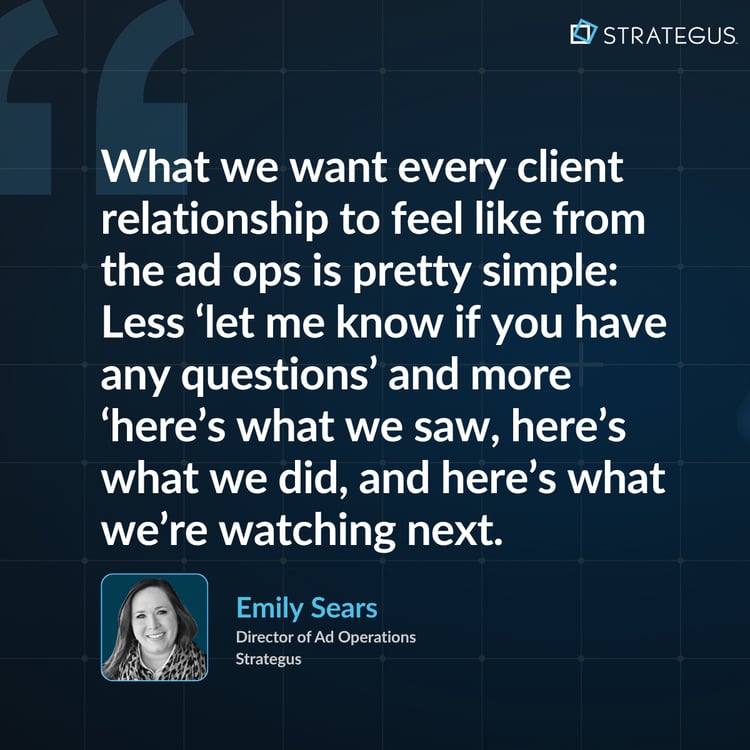
What we want every client relationship to feel like from the ad ops side is pretty simple: less "let me know if you have questions" and more "here's what we saw, here's what we did, and here's what we're watching next."
Good optimization produces results you can see in the numbers and confidence you can feel in the relationship. That comes from knowing a real person is paying attention, asking the right questions, and making thoughtful calls on your behalf. The art and the science matter. So does the person balancing them.
If you're evaluating whether your current programmatic partner is doing this work, or want to see what it looks like when they are, we're happy to walk you through how Strategus approaches it.



Strategus is a managed services connected TV(CTV) advertising agency with over 60,000+ campaigns delivered. Find out how our experts can extend your team and drive the result that matter most.
What to read next