





.svg)












 Tyler Wise
11 minutes read
Buying streaming inventory is easy. Making it perform predictably is not.
Many teams add OTT to the media mix, expecting incremental reach and measurable outcomes. But OTT performance depends on a tightly coordinated strategy across targeting, identity, measurement, creative, and optimization.
Miss any one of these, and performance quickly becomes inconsistent, hard to diagnose, and difficult to scale.
In this guide, you will learn the strategic framework high-performing teams use to make OTT perform predictably, so it becomes a reliable driver of reach, consideration, and performance.
What Is OTT and Where Does It Fit in the Modern Media Mix
OTT, or over-the-top, refers to video and streaming content delivered directly to viewers over the internet, bypassing traditional cable or broadcast TV providers.
For most brands, OTT is how they reach TV viewers, as audiences continue to move to streaming. In May 2025, Nielsen reported that streaming accounted for 44.8% of all U.S. TV viewership.
OTT vs. CTV
The terms OTT and CTV (Connected TV) are often conflated, but they aren’t quite the same thing.
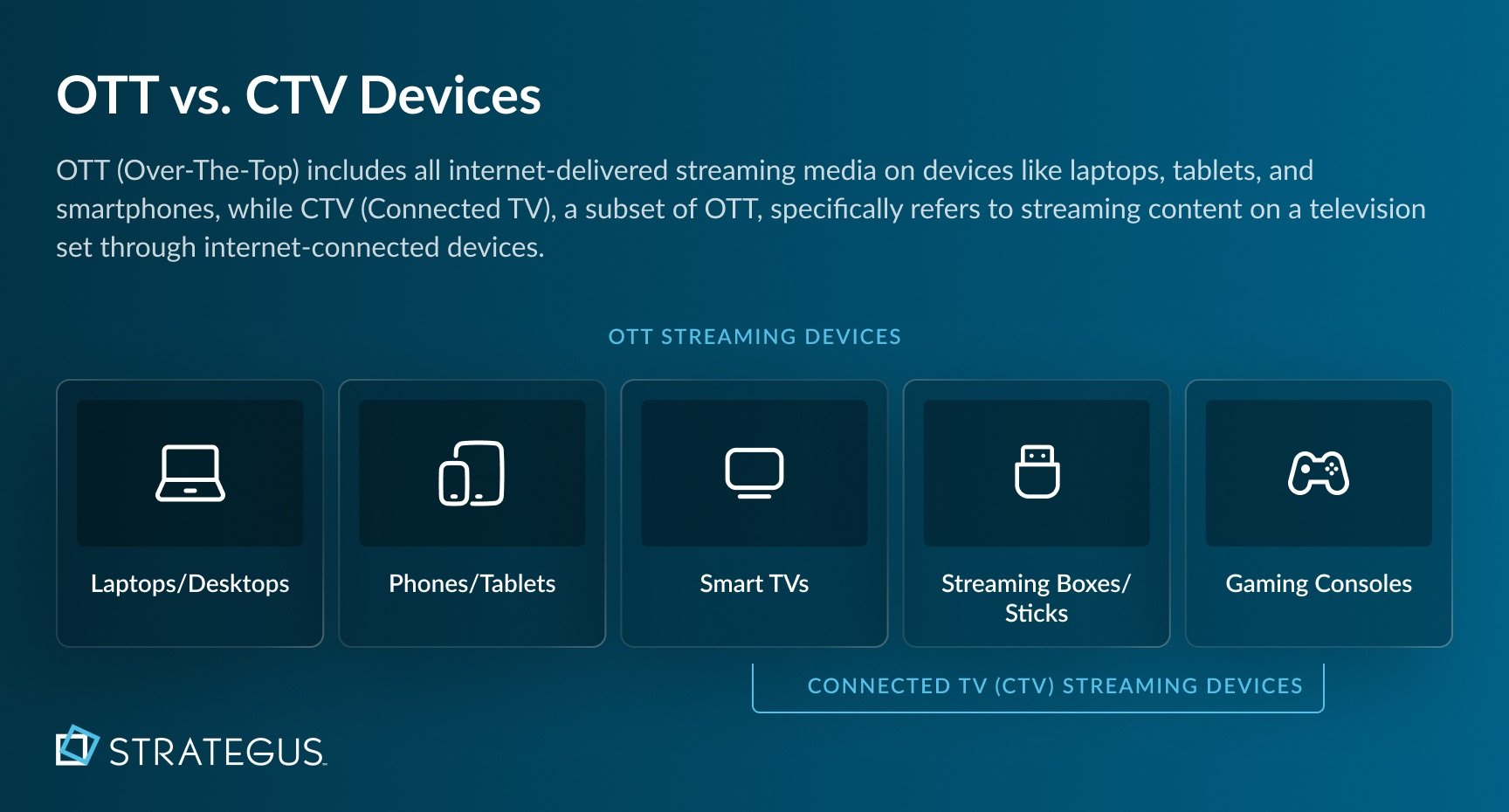
OTT refers to video content delivered over the internet directly to the viewer, bypassing traditional cable and broadcast networks. It describes the delivery method.
Connected TV, or CTV, refers specifically to streaming TV delivered OTT to a smart TV or to a device that connects to a television, such as a set-top box, gaming console, Roku, or Amazon Fire TV Stick.
In other words, CTV is a type of OTT. All CTV is OTT, but OTT content can also be viewed on mobile devices, tablets, and desktops.
Compared to traditional TV advertising, OTT offers much stronger targeting and optimization abilities. For example, advertisers can target households or individuals based on location, viewing behavior, device type, and even past ad exposure, then adjust creative, frequency, and spend in near real time based on performance.
How OTT Fits Within a Modern Media Mix
In many modern media campaigns, OTT complements, rather than replaces, linear TV.
It extends advertising reach to cord-cutters and light TV viewers missed by linear TV programs.
Since OTT advertising allows faster optimization and more control over timing and frequency than traditional TV buying, many brands use linear for broad-strokes brand-building campaigns and rely on OTT for product launches, promotional pushes, and performance-oriented campaigns that require tighter audience control and faster optimization.
OTT can also be a powerful channel to support paid social and digital video advertising. It gives access to audiences outside social media’s walled gardens and boosts digital ad performance. Research shows that when a TV or CTV ad runs before a digital ad, unaided brand recall can increase by 125% and purchase intent can rise by 18% compared with digital ads alone.
OTT tends to perform best in top and mid-funnel marketing programs.
As an awareness channel, OTT can provide high-impact reach in premium, brand-safe environments. At the consideration stage, it reinforces messaging and drives site visits and engagement through repeat household exposure.
However, reach alone is not a strategy. Performance depends on how OTT is structured, targeted, and integrated with other channels.
Building an Effective OTT Marketing Strategy
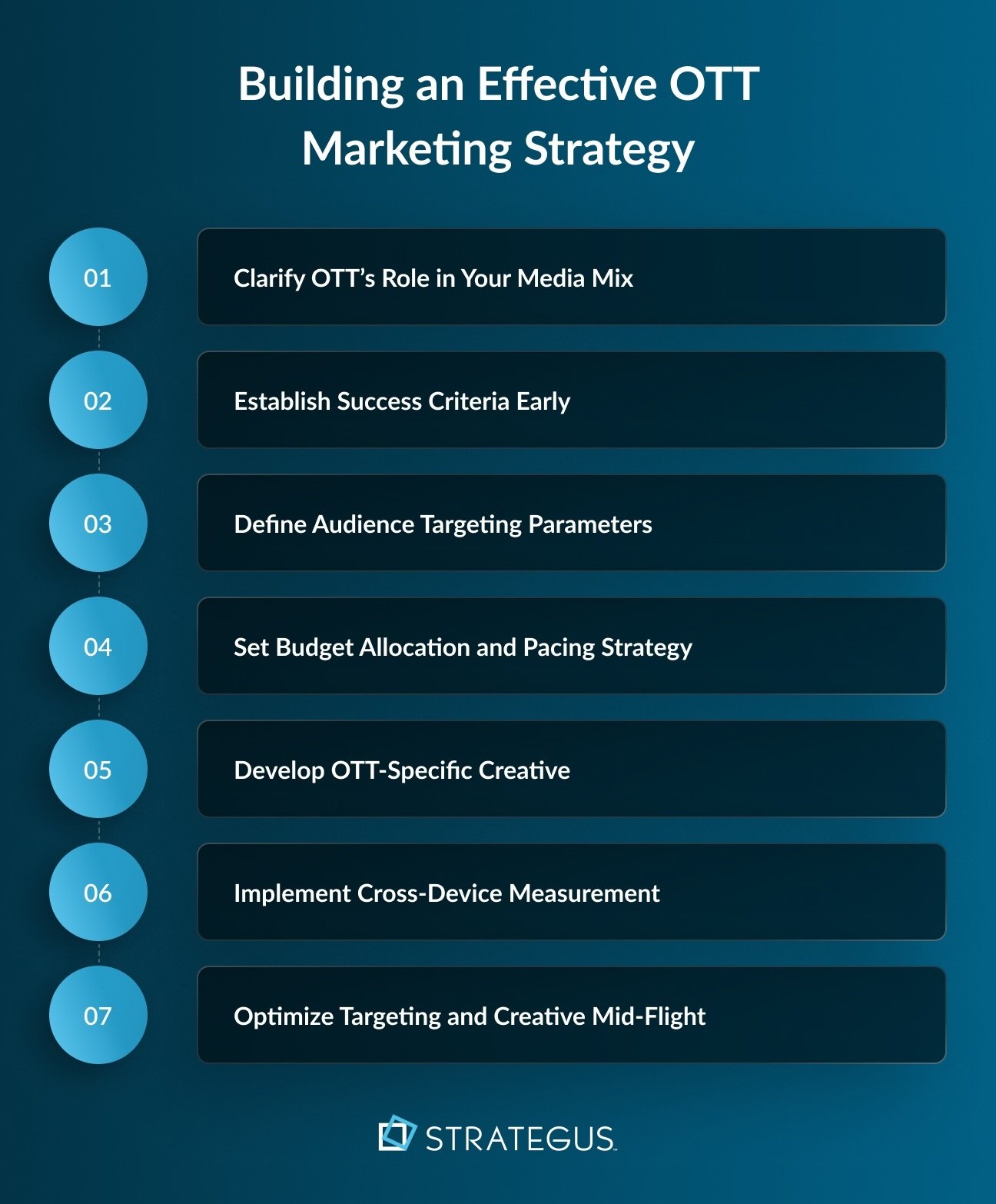
OTT performance comes from a well-defined strategy, not just access to ad inventory. Here’s how to build an OTT marketing strategy that performs.
1. Clarify OTT’s Role in Your Media Mix
Don’t rest your entire strategy on OTT’s shoulders.
Instead, assign OTT a single job for each campaign, such as:
- Reach extension
- Consideration support
- Performance contribution
Then define and document how OTT’s success will differ from that of other channels, such as linear TV or paid social campaigns.
For instance, paid social is often responsible for driving immediate interaction, while OTT plays a supporting role by reinforcing messaging and priming households for later engagement. In this context, OTT is not meant to compete with paid social on clicks, but to strengthen downstream performance by keeping the message present across key audiences.
2. Establish Success Criteria Early
Once you’ve determined what defines success for OTT, assign a tangible, measurable metric for tracking.
For example, if OTT’s primary role is to support purchase consideration, you might choose site visits after ad exposure as your success metric.
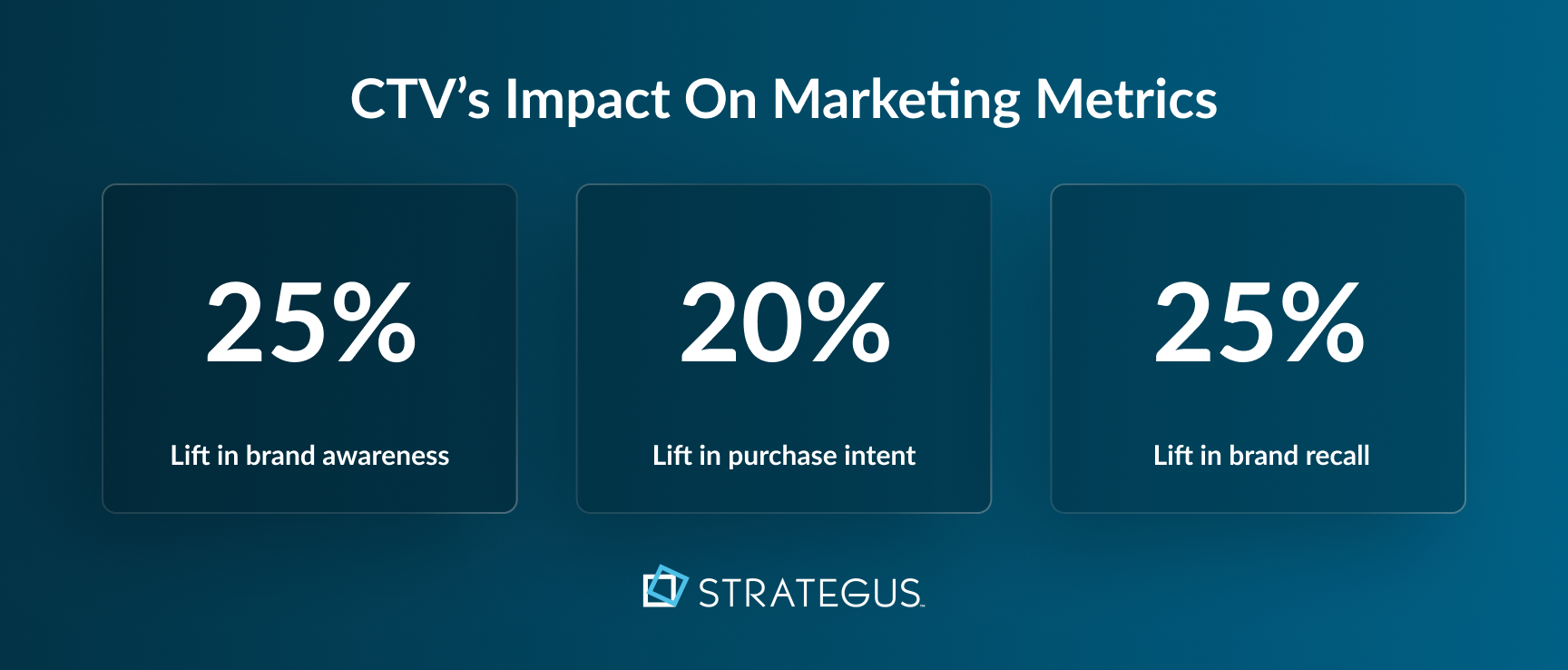
Or, if you’re using OTT to drive reach and awareness, a suitable metric may be unique households reached or lift in brand awareness. These are a good fit for OTT, with investigations into impact on brand lift showing that CTV advertising generates an uplift of 25% in brand awareness, 20% in purchase intent, and 25% in recall.
Next, decide when and how results will be reported and reviewed upon the campaign's end. Most teams review OTT performance weekly during the campaign to confirm that pacing, reach, and frequency are tracking as planned.
You’ll then want to run a final performance review 7–14 days after the campaign ends (or longer for awareness-focused campaigns), once post-exposure impact has had time to materialize.
3. Define Audience Targeting Parameters
Here’s where you start building your OTT audience. Use your campaign goal to determine who your audience will be made up of.
For example, if retention or re-engagement is the campaign goal, you’ll likely use first-party CRM data to build your audience. If, on the other hand, your OTT campaign is awareness-focused, you’ll be building an audience based on parameters such as:
- Geographic location
- Household or demographic characteristics
- Content or viewing behavior
- Device or platform usage
- Lookalike or modeled audiences based on existing customers
Make sure each audience is large enough to deliver consistently (200,000 to 300,000 households per audience segment is a good practical floor), then lock in OTT targeting for the first phase so results are clean and comparable.
4. Set Budget Allocation and Pacing Strategy
Budget allocation is about more than deciding how much to invest in each platform. You need to decide how to split that total budget across audiences.
This allocation should be refined as performance data comes in. For example, you might begin by splitting the budget evenly across age segments, then progressively shift more spend toward the 25–34 segment if it consistently delivers stronger results.
Beyond budget allocation, set daily or weekly pacing rules (such as capping weekly spend to roughly 15–20% of total budget on a multi-week campaign to avoid early peaks) and put basic guardrails in place for frequency, so ads don’t saturate the same households.
Initially, you might:
- Limit exposure to 2–3 impressions per household per week to ensure consistent reach without overserving the same homes.
- Set a total household frequency cap of 8–10 impressions over the full campaign to avoid fatigue in streaming environments.
- Allow slightly higher frequency in the first two weeks to establish message awareness, then taper exposure to maintain reach across new households.
5. Develop OTT-Specific Creative
OTT creative works best when each ad focuses on one clear idea (think clarity over density).
Before producing anything, decide on a single message and CTA for each asset, rather than trying to squeeze multiple ideas into the same spot.
Use your previously defined objective and frequency limits to determine the optimal ad length.
For awareness campaigns centered on reach and initial exposure, keep frequency intentionally low. In this scenario, a 30-second ad is often the right choice, as the longer format allows space for brand storytelling and message clarity without relying on repetition to land the idea.
But when a campaign must drive downstream action, such as site visits or conversions, teams typically run at a higher frequency because the audience is smaller. In these cases, use 6 to 15-second ads to reduce fatigue while keeping the message present across repeated exposures.
Strategus used this approach to fuel a Nissan dealership campaign, serving CTV ads to retargeted, high-intent households, resulting in a 250% increase in website traffic.

Relying on concise ad creatives designed for repeated exposure allowed the campaign to reinforce messaging across a limited audience while supporting sustained site engagement.
Finally, plan for iteration from the start. Launch with multiple creative versions to provide a meaningful basis for comparison, and expect to adjust or refresh creative while the campaign is live.
In our experience, teams that treat ad creative as a variable to optimize rather than a fixed asset that stays unchanged tend to achieve better results with OTT.
6. Implement Cross-Device Measurement
Cross-device measurement ties OTT exposure to actions that may occur later on desktop, mobile, or in-store, giving you a fuller picture of how households respond after seeing an ad.
Start by deciding upfront what actions matter after someone sees the ad.
For awareness or consideration campaigns, this might be a site visit or viewing a key website page.
For performance support campaigns, it may be deeper engagement, such as form fills, sign-ups, or conversions.
Defining these outcomes clearly ensures you measure what actually aligns with your campaign’s objective, rather than defaulting to basic view counts.
Then, set a consistent post-exposure window during which actions will count toward your OTT results. For example, you might count site visits or conversions that occur within 7–14 days of an OTT exposure, depending on your sales cycle and typical user behavior.
Cross-device attribution solutions can connect those events back to the OTT impression, regardless of the device used to take action, so you can see not only that an ad was watched, but also how it influenced later behavior.
7. Optimize Targeting and Creative Mid-Flight
Set regular check-in points during the campaign, typically weekly, to evaluate whether delivery, reach, and post-exposure signals are tracking as expected.
Use these reviews to make deliberate adjustments, such as:
- Reallocating spend toward the audiences that are generating stronger engagement or downstream actions
- Pausing or replacing ads that are failing to hold attention or drive the intended response
- Refining targeting or frequency to improve efficiency and reduce wasted exposure
Mid-flight optimization is also about learning, not just correcting.
Document which audiences, messages, and formats perform best so each campaign starts with stronger assumptions than the last. Over time, this turns OTT from a one-off execution into a system that improves with every launch.
How Strategus Delivers Measurable Full-Funnel Results
OTT campaign performance depends on many moving parts working together. For many in-house teams, the challenge is not intent but capacity and specialised expertise.
Getting it right requires tight coordination across targeting, creative, measurement, and pacing. When that coordination breaks down, performance becomes inconsistent, hard to interpret, and difficult to scale.
Strategus removes that execution burden by managing OTT as a full funnel system. Strategy, buying, targeting, creative optimization, and measurement work together from day one, with clear accountability for outcomes at every stage.
With this approach, teams achieve more consistent execution, clearer performance signals, and campaigns that improve over time instead of resetting with every launch. This is the model that drove a 250% increase in website traffic for a Nissan dealership and $200k in revenue for an e-commerce beauty brand.
If you’re looking to make OTT a repeatable, performance-driven part of your media mix, Strategus can help you get there.
Talk to a Strategus expert today.
FAQ
What Is OTT vs. CTV?
OTT refers to the delivery of video content and ads over the internet, bypassing traditional cable or broadcast TV. CTV refers to the device, an internet-connected television used to stream content through apps.
In practice, OTT advertising is delivered to viewers via CTV devices and other screens.
What Is an Example of OTT Advertising?
An example of OTT advertising is a video ad served to households watching streaming content on OTT platforms like Hulu or Peacock. The ad is targeted to specific audiences and measured based on exposure and downstream actions such as site visits or conversions, rather than ratings alone.
What Is OTT Called in the USA?
In the USA, OTT is commonly referred to as OTT advertising or streaming TV advertising. Many marketers also use the term CTV advertising when discussing OTT campaigns delivered specifically to connected television.


Strategus is a managed services connected TV(CTV) advertising agency with over 60,000+ campaigns delivered. Find out how our experts can extend your team and drive the result that matter most.
What to read next