TV Marketing Campaign Examples for Modern CTV Success

.webp)
Table of Contents
The best TV marketing campaigns look effortless on the surface.
You see strong creative. You see a clear message. But what you don’t see is the technical and operational machinery working underneath to make that performance possible.
What used to be a relatively straightforward video buy now spans multiple demand-side platforms, fragmented premium inventory, and growing scrutiny around measurement. Managing frequency, data alignment, and attribution has become a heavy operational lift for even sophisticated marketing teams.
Looking closely at how leading brands structure and extend their TV campaigns starts to reveal what goes on behind the scenes to drive ad performance.
In this guide, we break down real TV marketing campaign examples and show how modern brands are evolving their approach to drive measurable CTV performance.
Why TV Marketing Campaigns Still Matter in the CTV Era
There’s one question leaders ask any time Marketing suggests a TV advertising campaign:
Is anyone even watching TV anymore?
The answer depends on what you mean by TV.
Television in the traditional sense, known as linear TV, is definitely declining in viewership. In the US, nearly half of all TV viewership happens via streaming, and it's happening on connected television (CTV).

Traditional TV still has its place, of course. Major national events like the Super Bowl still draw huge audiences, and linear TV still commands high trust and strong brand impact.
But market shifts like audience fragmentation across streaming platforms and rising pressure for marketers to prove ROI mean traditional TV marketing just isn’t enough for many campaigns.
As a result, the highest-performing brands are running a hybrid approach.
Linear TV owns broad brand exposure and awareness. CTV, with its more advanced targeting, detailed measurement and attribution, and cross-device reach, is employed for lower-funnel performance.
The fundamentals of great TV advertising still apply, but top brands now execute them more consistently through measurable CTV.
What Makes a TV Marketing Campaign Successful Today

A good TV marketing campaign today needs to go beyond linear TV, incorporating CTV, display, and other channels where modern buyers do their research. Key elements include:
- Audience targeting precision: Focus on high-intent segments, not broad demographics. Use first-party and third-party data to reach people actively considering a purchase.
- Cross-device reach: Audiences move across mobile, tablet, and desktop. Effective campaigns follow them, linking ad exposure to downstream actions like site visits and conversions.
- Creative relevance: Match messaging to funnel stage. First-time viewers get brand-building ads; return visitors get targeted follow-ups with specific offers.
- Measurable outcomes: Anchor performance to real business goals. Refresh creative regularly and optimize targeting based on actual results, not just impressions.
- Attribution clarity: Use deterministic attribution (exact ID matches) and probabilistic attribution (statistical modeling) together, then confirm results with lift testing.
TV Marketing Campaign Examples and Key Takeaways
These three TV marketing campaigns illustrate the principles outlined above—the precise reason they found success.
Shopify “Let’s Make You a Business”
YouTube
Shopify’s “Let’s Make You a Business” was its first fully integrated brand campaign, launched across:
- TV
- Digital video
- Out-of-home
- Radio
- Social media
The goal was clear:
Expand awareness beyond existing merchants and inspire new entrepreneurs to see Shopify as the platform to start their journey. It was about more than the product. Shopify’s TV marketing campaign was about the concept of starting that business.
And that’s exactly what Shopify leaned into with ad creative.
Instead of focusing on product features, it led with emotional relevance, meeting potential business owners at the moment of aspiration rather than the moment of purchase.
Creative like "Let's make your mom's 'famous' recipe actually famous" speaks directly to a scrappy, passion-driven audience, which is exactly the kind of high-intent segment that the best TV campaigns are built around.
Running across five channels ensured the message reached aspiring entrepreneurs wherever they were, balancing broad brand-building with a clear push to drive new merchant acquisition.
And because the campaign extended into targetable digital environments, someone who had searched for small business tools or visited a competitor's site could be served a relevant follow-up message across devices, connecting awareness to action.
Key takeaways for advertisers
- Lead with emotional relevance, not product features. Meet your audience at the moment of intent, not just the moment of purchase
- Define your audience by behavior and mindset, not broad demographics
- Use cross-device orchestration to follow high-intent viewers across channels and drive them toward conversion
TurboTax “All People Are Tax People”
YouTube
TurboTax's "All People Are Tax People" was a brand campaign anchored by a Super Bowl spot and supported across broadcast TV, digital, streaming, social, and audio.
The goal was straightforward: use peak tax season to drive broad awareness, reduce anxiety around filing, and bring more filers into the TurboTax ecosystem.
What made it work was the smart combination of channel choice and timing.
Traditional TV was used for exactly what it does best: delivering massive reach during a cultural moment that happened to fall right at the start of filing season.
That ad placement activated awareness, but TurboTax didn’t leave it there.
Instead, they built a cross-channel campaign that spanned streaming, social, and digital to keep TurboTax present throughout the full consideration window, delivering more than 3 billion cross-channel impressions.
By connecting video exposure to completed returns rather than impressions, TurboTax could see which channels and placements were actually driving filers to convert.
Key takeaways for advertisers:
- Use tentpole TV moments to generate rapid scale, then reinforce with targeted video across digital and streaming
- Align campaign timing with periods of peak consumer intent
- Maintain consistent messaging across devices to strengthen recall and consideration
- Layer CTV targeting and attribution to connect video exposure to real conversion outcomes
Zillow “Finding Home”
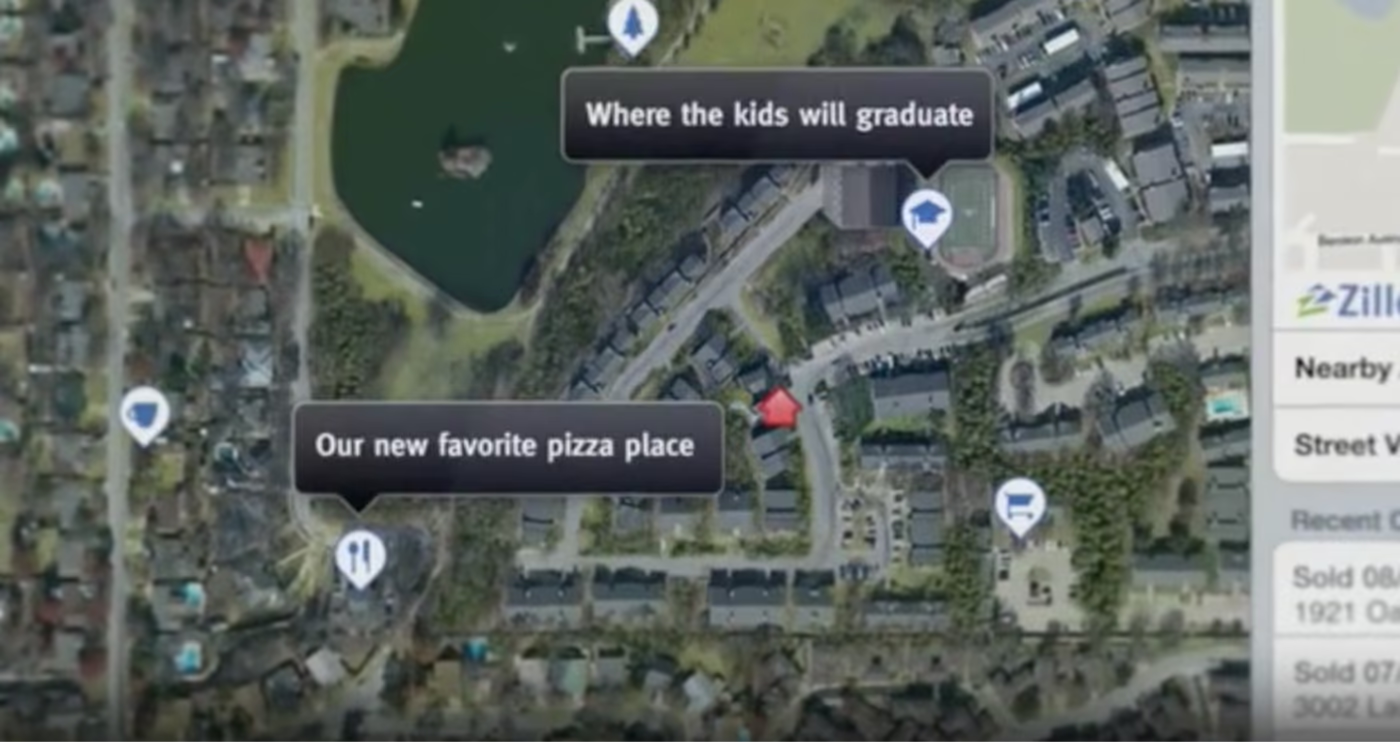
Zillow's "Finding Home" had a clear objective:
Position Zillow as the default starting point for home search, and connect emotionally with the diversity of modern buyers navigating one of the biggest decisions of their lives.
What made it work was how deeply it was grounded in real consumer insight. Every story in the campaign was inspired by real Zillow users, reflecting the actual diversity of today's home buyers:
- A millennial buying his first home
- A young family making a fresh start
- A multi-generational household searching together
That specificity is what separates effective audience targeting from broad demographic guesswork. Zillow wasn't speaking to "adults 25 to 54". It was speaking to people actively in the middle of a major life transition, exhibiting the specific behaviors that signal an active home search, like repeated listing views or mortgage calculator use.
The results reflected that precision:
Brand awareness grew from 9% to nearly 40%, making Zillow the most widely recognized brand in the real estate category.
Key takeaways for advertisers:
- Build campaigns around real-life-stage signals, not demographic buckets, and let audience insight drive creative, so messaging feels relevant rather than generic
- Use consumer research to identify the specific moments when your audience is most receptive
- Measure what matters: brand awareness lift and downstream engagement, not just impressions
How Strategus Helps Brands Turn TV Campaigns Into Measurable Growth
The TV marketing campaign examples above share a common thread:
Great creative alone didn't drive results.
What made each one work was the groundwork behind it, from strategic targeting to cross-device coordination that drove conversions, not just impressions.
But managing all of that can be a heavy lift for even sophisticated in-house teams.
Strategus is built to carry that weight as a fully managed CTV partner, handling everything from campaign execution to performance reporting, including:
- Managed service expertise that handles campaign execution end-to-end
- Cross-device orchestration that controls reach and frequency across CTV, mobile, display, and desktop
- Premium CTV supply across major streaming platforms
- Performance-focused reporting that ties video investment to real outcomes, not just impressions
Two recent campaigns show what that looks like in action:
Hospital Foundation Donor Campaign
A Seattle-based hospital foundation partnered with Strategus to drive donations for cancer research, with a clear constraint:
Strict HIPAA requirements ruled out traditional pixel tracking, making attribution a significant challenge from the start.
Strategus ran a full-funnel video strategy anchored by CTV and supported by display and online video. Targeting focused on prior donors, charitable interest segments, and modeled audiences built from first-party data refined across multiple previous campaigns.
CTV did the heavy lifting on awareness, replicating the big-screen impact of traditional TV while providing the precise audience targeting that linear TV can’t. Cross-channel display and online video then reinforced messaging and nurtured donors further down the funnel.
With pixels off the table, Strategus used matchback attribution instead.
Rather than tracking individual site visits, matchback compares a list of people exposed to the ads with the foundation's CRM records to identify donors who converted after seeing the campaign, without ever needing a pixel to make that connection. That meant full outcome visibility while staying within HIPAA constraints.
The campaign generated millions in donations on a relatively modest media investment, demonstrating that modern performance TV can deliver both scale and provable return, even in regulated industries.
Key takeaways for advertisers
- Build audiences from first-party data refined over time, not broad demographic segments
- Pair big-screen CTV with cross-device reinforcement to move audiences through the funnel
- Use matchback attribution when pixel tracking is restricted
- Treat CTV as a performance channel capable of driving measurable revenue, not just awareness
Beauty Brand E-Commerce Campaign
A Los Angeles-based beauty brand partnered with Strategus to drive online sales and reach a highly specific audience: women aged 25 to 54 who were actively in-market for premium cosmetics and skincare.
That meant every impression was served to someone already shopping for exactly what the brand sold, not just broadly interested in beauty.
Strategus shifted linear TV budget into a CTV-first model that preserved the big-screen, living room environment they were used to, but with more precise targeting and cross-device reach.
CTV drove upper-funnel awareness, then online video and display retargeting picked up high-intent shoppers and moved them toward conversion, keeping the brand present across devices throughout the full purchase journey.
Advanced attribution connected video exposure directly to online purchases, tracking not just who saw the ads but who bought as a result. That gave the brand a clear line from ad spend to revenue, moving reporting beyond impressions and into outcomes that actually mattered to the business.
Over three months, the campaign generated more than $200,000 in online revenue, over 4,000 purchases, and more than 40,000 post-view site visits.
Key takeaways for advertisers:
- Shift linear TV budgets into CTV to preserve visual impact while adding targeting precision
- Lead with in-market audience segments to improve efficiency over broad demographic buys
- Pair big-screen awareness with cross-device retargeting to capture purchase intent
- Use full-funnel attribution to connect video investment directly to revenue
See what a CTV program built around your audience can do. Talk to a Strategus expert today.
Frequently Asked Questions About TV and CTV Campaigns
Are TV marketing campaigns still effective?
Yes, TV campaigns can still be effective, especially for building brand awareness at scale.
Linear TV remains strong for reaching broad audiences during major events and prime-time programming. However, its limitations in targeting and measurement mean many advertisers now combine it with Connected TV.
CTV provides more precise audience targeting, cross-device tracking, and clearer performance insights, so it's better suited for driving measurable outcomes.
How much does a 30-second ad cost on TV?
Costs vary widely depending on audience size, timing, and placement.
Prime-time national ads can cost hundreds of thousands of dollars, with local placements coming in much cheaper.
Frequently Asked Questions
Is Netflix AVOD or SVOD?
Layer interests, purchase behavior, and viewing habits on top of age and location — so every impression reaches someone who actually matters to your business.
What is TV Marketing Campaign Examples for Modern CTV Success?
The best TV marketing campaigns look effortless on the surface. You see strong creative.
Why TV Marketing Campaigns Still Matter in the CTV Era?
There’s one question leaders ask any time Marketing suggests a TV advertising campaign: Is anyone even watching TV anymore?
What Makes a TV Marketing Campaign Successful Today?
A good TV marketing campaign today needs to go beyond linear TV, incorporating CTV, display, and other channels where modern buyers do their research. Key elements include:
What is tV Marketing Campaign Examples and Key Takeaways?
These three TV marketing campaigns illustrate the principles outlined above—the precise reason they found success.
How Strategus Helps Brands Turn TV Campaigns Into Measurable Growth?
The TV marketing campaign examples above share a common thread: Great creative alone didn't drive results.
get in touch
Subscribe to our
newsletter
Stay ahead with strategies and insights from streaming advertising experts.
Learn from the field
.webp)
.webp)
.webp)
.webp)
.webp)
.webp)
Book a demo
Talk to an expert
Tell us what you want to achieve and we'll map the media strategy to get you there — no self-serve dashboards, just a partner who does the work.