






.svg)
















 Strategus
17 minutes read

Data management platforms (DMPs) have long been a core part of digital advertising, used to collect and organize audience data for targeted campaigns.
But the way DMPs are used today has changed.
As third-party cookies disappear and cross-site tracking becomes less reliable, DMPs are no longer where audience strategy starts. Advertisers now build their strategy around first-party data, then use DMPs to extend audience scale beyond known users and activate those audiences across channels like connected TV, mobile, and display.
This is especially important in CTV, where targeting happens at the household level, and campaigns need to stay coordinated across devices. DMPs support this by preparing audiences for activation, managing overlap, and improving the efficiency of reach.
This guide explains how DMPs fit into that workflow, when they’re worth using, and how to apply them to improve targeting and campaign performance.
What Is a Data Management Platform (DMP)?
A data management platform (DMP) is a centralized database that collects, organizes, and activates audience data from various sources. It acts as a hub for all your data, bringing together information from your website, apps, CRM, and other touchpoints.
DMPs process and organize this data to provide valuable insights into your audience segments. By analyzing user behavior, demographics, interests, and more, a DMP can help you identify and reach audience segments more efficiently and create more effective advertising campaigns.
How does a DMP work?
A DMP works by gathering, organizing, and activating data from various sources to create targeted audience segments for advertising.
It starts with data ingestion, where first-party (e.g., CRM and website data), second-party (partner-shared data), and third-party data (external sources) are collected and centralized within the DMP. First-party data plays an increasingly important role here, as advertisers lean on owned data to anchor their audience strategy. This data is then categorized and organized based on attributes like demographics, behaviors, and preferences.
Once organized, the DMP serves as the audience intelligence layer, building, refining, and segmenting audiences so that when they're passed to a DSP for activation, they're already optimized for the campaign's goals. This includes prioritizing high-value prospects and suppressing existing customers so the budget is focused where it's most likely to drive results.
From there, the DSP executes media buying across CTV, mobile, and display, using those segments to place ads programmatically.
In CTV specifically, DMP audiences enable household-level targeting, moving beyond broad demographics to reach the right households across connected devices. This supports more precise frequency management, reducing overexposure while improving overall reach efficiency across screens. As CTV campaigns run, performance data feeds back into the DMP, refining audience segments and improving the accuracy of future targeting.
DMPs in a Privacy-First Environment
Digital advertising has shifted toward privacy-first by necessity.
Third-party cookies are being deprecated across major browsers, and mobile ID availability is tightening as Apple and other companies restrict access to device-level identifiers. As a result, cross-site tracking has become significantly less reliable, and since DMPs have historically relied on those signals to build and match audience segments, their ability to track users across the open web has diminished.
That doesn't mean DMPs are disappearing, but it does represent a real shift in how they can and should be used.
Modern DMPs are increasingly relying on first-party data enrichment and modeled audiences. Rather than relying on third-party cookies and device IDs to track users across the web, they use the data that brands already own to build audience profiles, then model outward from those to find similar users at scale.
This means activating data through channels and environments where consent is established and identity is verified, rather than inferred.
This shift is also accelerating interest in CTV and other authenticated environments, where targeting doesn't depend on third-party cookies. In these channels, DMPs can still play a meaningful role in audience preparation and activation, just within a framework that prioritizes consent, data quality, and deterministic identity over open-web tracking.
Examples of DMPs
Some of the most well-known DMPs in the industry include:
- Adobe Audience Manager: Adobe's DMP solution integrates with its Experience Cloud suite, offering robust data management and activation capabilities.
- Salesforce Audience Studio: Formerly known as Krux, Salesforce's DMP focuses on delivering personalized experiences across channels.
- Oracle BlueKai DMP: Oracle's DMP provides advanced data management, audience segmentation, and activation features for marketers.
Types of Data Collected by DMPs
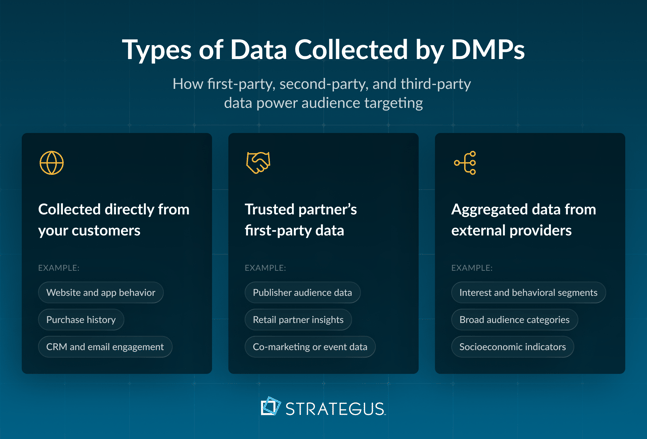
As brands and advertisers strive to deliver targeted, high-impact campaigns, DMPs collect and categorize data across three types, with first-party data increasingly serving as the foundation.
First-party data
First-party data is the information collected directly from a brand’s customers through owned channels, offering insights specific to its audience. This data is highly reliable since it’s sourced directly from user interactions and provides valuable details about existing customers or prospects. Examples include:
- Customer Demographics: Basic details like age, gender, location, and job title
- Purchase History: Records of transactions, product preferences, and buying frequency
- Website and App Behavior: Data on pages viewed, clicks, time spent on site, and conversion rates
- Email and Engagement Metrics: Information on open rates, click-through rates, and user responses to marketing emails
First-party data allows brands to build precise audience profiles, personalize their messaging, and engage with users based on proven preferences and behaviors.
Second-party data
Second-party data is essentially first-party data shared by a trusted partner, such as a publisher or a company within a relevant industry. This data can help advertisers reach new audiences that closely align with their target demographics, leveraging the data owner’s unique insights. Examples of second-party data include:
- Publisher Data: Viewing habits, genre preferences, and user engagement metrics shared by streaming platforms or media companies
- Retail Partner Data: Details on customer demographics and product interests shared through partnerships with complementary brands
- Event Engagement: Information on attendees’ interests, behaviors, and demographics from co-hosted events or webinars
Second-party data extends the reach of first-party data and enhances targeting by connecting brands to new but relevant audience segments.
Third-party data
Third-party data is gathered by external providers from a variety of websites, apps, and platforms and offers a broader, less specific view of market audiences.
While less precise, it provides a larger dataset to identify general patterns or uncover new segments. That said, as third-party data becomes harder to access due to tightening privacy regulations and increasing tracking restrictions, many advertisers are using it only to supplement, rather than anchor, their audience strategy.
Examples of third-party data include:
- Audience Segments: General categories like “outdoor enthusiasts” or “luxury shoppers”
- Interest and Behavioral Data: Insights on hobbies, online behavior, recent web searches, or purchase patterns
- Socioeconomic Data: Information on income brackets, education levels, and general lifestyle indicators
Together, these types of data provide DMPs with a well-rounded set of insights, allowing advertisers to build informed, targeted campaigns that reach audiences in impactful ways, with first-party data playing an increasingly central role.
Why advertisers are shifting toward first-party data and CDPs
Privacy regulations and the erosion of third-party signals have pushed advertisers to rely more heavily on data they actually own—according to IAB's State of Data 2024, nearly 90% of ad buyers have already shifted their data mix to favor first-party data.
First-party data is more reliable, more durable, and increasingly the only data that works consistently across channels.
Customer data platforms (CDPs) have become the go-to tool for managing that data, giving brands a single, unified view of their customers across every touchpoint. Today, the two tools increasingly work together rather than compete. CDPs own the customer relationship, DMPs handle audience activation for media.
That division of labor matters because matching users across devices, browsers, and CTV environments has become significantly harder. Marketers can no longer assume a cookie or device ID will reliably connect a user across touchpoints.
Instead, they're focusing on continuity across devices and households. Probabilistic matching uses behavioral signals to infer connections between devices, while deterministic matching uses confirmed identity data, like a logged-in email, to make those connections with certainty. Together, they help maintain audience accuracy even as individual signals become less reliable.
Getting this right means ads reach the right household at the right frequency, campaigns can be measured accurately across screens, and budget isn't wasted on duplicate or misattributed impressions.
Clean rooms have become an important part of how advertisers work safely with data. Rather than sharing raw user-level data directly, brands and media owners work within a secure, neutral space where data from both sides can be analyzed together without either party seeing the other's underlying records.
Major platforms and publishers are increasingly supporting clean room infrastructure, enabling the generation of audience insights, measurement of campaign overlap, and validation of performance without compromising compliance. For advertisers running cross-screen campaigns, clean rooms are becoming less of a nice-to-have and more of a baseline expectation.
DMP vs. CDP: What’s the Difference?
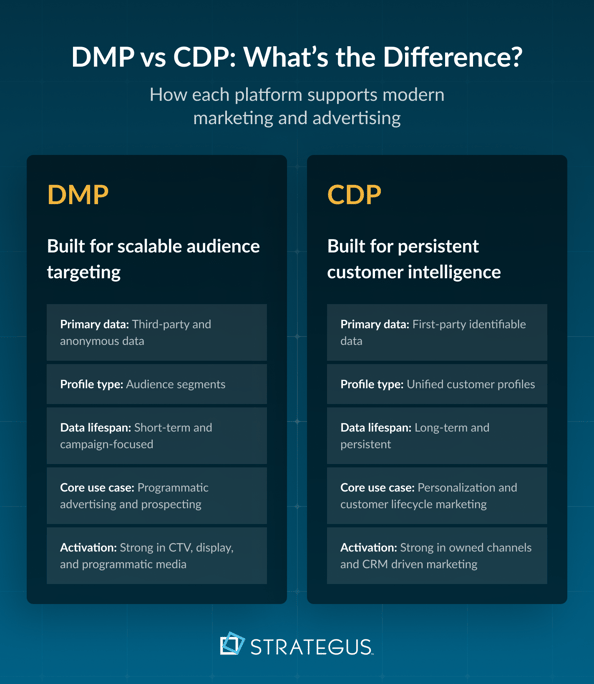
A DMP and a Customer Data Platform (CDP) both handle data for targeted marketing, but they serve different functions and use cases. DMPs gather, categorize, and activate audience data across first-, second-, and third-party sources for advertising campaigns, though third-party data is playing a diminishing role as privacy restrictions tighten. This data is often used for broad-based targeting and programmatic advertising.
On the other hand, a CDP is designed to handle first-party data collected directly from a brand’s customers. It creates persistent customer profiles by integrating data from multiple touchpoints (e.g., CRM, website behavior, transactions), allowing marketers to personalize campaigns and engage customers across channels.
Key differences include:
- Data Type: DMPs work across first-, second-, and third-party data for media activation and audience scaling; CDPs focus on first-party, identifiable data for persistent customer profiles.
- Data Storage: DMP data is typically temporary, while CDP data is retained for long-term use.
- Purpose: DMPs support targeted advertising, whereas CDPs focus on building and nurturing customer relationships.
Benefits of Using a DMP in Advertising
A DMP offers several practical advantages for advertisers looking to improve targeting, personalization, and campaign efficiency. Here's a breakdown of the key benefits.
Improved audience targeting
One of the primary benefits of using a DMP is the ability to create highly specific audience segments based on demographics, interests, and behaviors. By analyzing data from various sources, a DMP can help you identify and target the most relevant audiences for your campaigns. This level of granularity allows you to reach the right people with the right message, increasing the likelihood of engagement and conversion.
Enhanced ad personalization
With a DMP, you can deliver tailored ad experiences across multiple channels, such as display, social media, mobile, and CTV. By leveraging insights from audience data, you can create personalized ad content that resonates with each user. This level of personalization can lead to higher ad relevance, improved click-through rates, and ultimately, better campaign performance.
Increased campaign efficiency
A DMP helps you optimize your ad spend by targeting the right audience at the right time. By focusing your efforts on the most valuable audience segments, you can reduce wasted impressions and improve the overall efficiency of your campaigns.
Additionally, a DMP can help you identify and suppress audiences that are less likely to convert, further streamlining your advertising efforts and maximizing your return on investment.
Better data management
Managing audience data from multiple sources can be daunting. A DMP centralizes and organizes all your audience data in one place, making it easier to access, analyze, and activate.
This consolidated view supports faster, more informed decisions across your advertising stack. Moreover, a DMP can help you maintain data privacy and compliance with regulations like GDPR and CCPA by providing tools for data governance and consent management.
When Using a DMP Is a Smart Idea (and When It Isn’t)
DMPs remain a valuable tool in the right context, but they're no longer the default starting point for audience strategy. Knowing when to use one, and when not to, matters more than it used to.
DMPs still add strong value for:
- Scalable audience activation across programmatic and CTV campaigns
- Prospecting and reach expansion beyond your known customer base
- Cross-device audience extension and suppression
If your goal is to find new audiences at scale and activate them efficiently across screens, a DMP is well-suited to the task.
Where DMP reliance is declining is in long-term customer profile management, deep personalization based on known user data, and workflows that depend heavily on third-party cookies. For those use cases, a CDP is better suited, offering persistent, identity-resolved customer profiles built on first-party data.
Most modern stacks use CDPs and DMPs together rather than choosing one over the other, with the CDP owning the customer relationship and the DMP handling media activation. The right balance depends on your campaign goals, data maturity, and channel mix.
How to Implement a DMP in Your Advertising Strategy
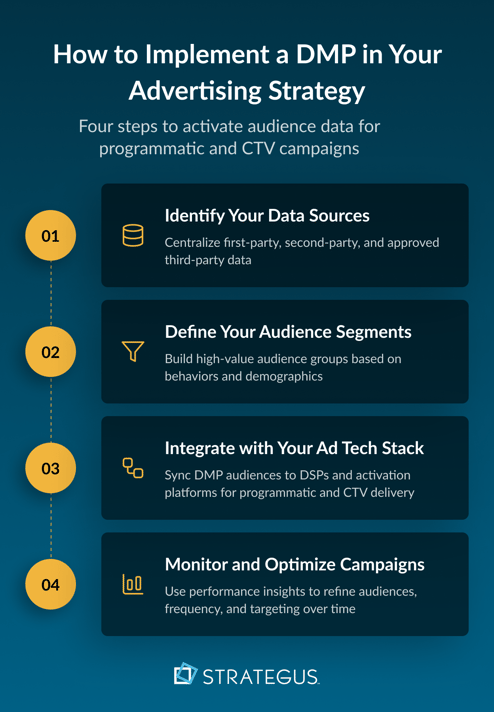
Implementing a DMP in your advertising strategy requires careful planning and execution. Follow these steps to ensure a successful DMP integration:
1. Identify your data sources
Determine which data sources you want to integrate into your DMP, including first-party data from your website, mobile apps, and CRM system, as well as second- and third-party data from partners and data providers. Prioritize data sources that provide valuable insights into your target audience's behaviors, interests, and demographics.
2. Define your audience segments
Once you have integrated your data sources, use the DMP's segmentation tools to create audience segments based on specific attributes and behaviors. For example, you might create segments based on age, gender, location, purchase history, or website interactions. These segments will serve as the foundation for your targeted advertising campaigns.
3. Integrate with your ad tech stack
To activate your audience data, you need to connect your DMP with other platforms in your ad tech stack, such as demand-side platforms (DSPs) and supply-side platforms (SSPs). This integration allows you to seamlessly transfer audience segments to your chosen advertising channels, enabling targeted ad delivery across display, mobile, social media, and CTV.
DSPs automate the ad buying process, allowing you to bid on ad inventory in real time based on your audience targeting criteria. SSPs, on the other hand, help publishers manage and optimize their ad inventory. By integrating your DMP with these platforms, you can ensure that your ads reach the right audience at the right time.
4. Monitor and optimize campaigns
As your campaigns run, use your DMP's reporting and analytics features to monitor performance and gain valuable insights. Analyze metrics such as click-through rates, conversion rates, and audience engagement to identify areas for improvement. Based on these insights, refine your audience targeting, personalize your ad creative, and adjust your bidding strategies to optimize campaign performance.
DMPs provide valuable performance data that can inform decisions across your advertising strategy. Regularly review campaign results to identify new audience segments, uncover emerging trends, and adapt your campaigns accordingly. By feeding those insights back into your DMP and broader ad tech stack, you can maximize your advertising ROI and achieve better results over time.
Tips for Maximizing DMP Effectiveness
Implementing a DMP is just the first step in enhancing your advertising strategy. If you’re looking to maximize your ROI, here are some steps you can take.
Go hands off with Strategus
Implementing and maximizing a DMP effectively can be challenging. From integrating diverse data sources to building precise audience segments, fine-tuning targeting, and continuously optimizing campaigns, the process requires specialized skills and resources.
For brands aiming to get the most from their data without the burden of in-house management, a hands-on partner like Strategus is the ideal solution.
Strategus offers a fully managed, data-driven CTV advertising service that expertly handles every aspect of your DMP strategy. With access to over 400 data and media partners, Strategus crafts detailed audience profiles that align with your unique campaign goals. We manage the entire workflow, from strategy and data activation to real-time performance tracking and multi-device retargeting, ensuring ads reach the right audiences at the right times. Strategus also provides transparent, in-depth reporting, giving you clear insights into campaign ROI.
Talk to our experts at Strategus today to see how our managed DMP solution can elevate your CTV advertising outcomes.
Ensure data quality
The accuracy and reliability of your DMP's insights depend on the quality of the data you feed into it. Regularly clean and update your data to remove any duplicates, inconsistencies, or outdated information. This will help you maintain a high level of data integrity and ensure that your audience segments and targeting decisions are based on accurate information.
Leverage first-party data
First-party data is the most reliable and durable asset in your DMP strategy. Prioritize collecting and analyzing data from your own sources, such as your website, mobile apps, and CRM system. Third-party data can still be useful for expanding reach and prospecting, but it should supplement your first-party foundation rather than replace it.
Combine DMP with a DSP
Integrating your DMP with a programmatic demand-side platform (DSP) is what turns audience intelligence into media activation. A DSP automates the ad buying process, allowing you to bid on inventory in real time across CTV, mobile, and display based on the segments your DMP has prepared.
Measure and attribute performance
Measuring the impact of your DMP on campaign performance is crucial for understanding its effectiveness and identifying areas for improvement. Implement robust CTV measurement and attribution solutions to track key metrics, including reach, engagement, and conversion rates. This will help you assess the ROI of your DMP investment and make data-driven decisions to optimize your advertising strategy over time.
Final Thoughts: Is a DMP Worth the Investment for Your Business?
DMPs are no longer the primary data foundation they once were, but that doesn't make them any less useful.
As an audience intelligence and activation layer, they still play a meaningful role in how modern advertisers plan and execute campaigns, particularly for programmatic CTV and cross-device targeting.
Where DMPs deliver the most value today is in preparing and activating audiences at scale, enabling household-level reach, managing frequency across screens, and feeding performance data back into targeting to improve results over time.
But getting there requires more than just having a DMP. It requires integrating it with the right stack, activating audiences through the right channels, and continuously optimizing based on real campaign performance.
Strategus manages the full workflow from audience preparation and data integration to programmatic CTV execution and measurable outcomes across screens. Talk to our team today to see what that looks like for your campaigns.


Strategus is a managed services connected TV(CTV) advertising agency with over 60,000+ campaigns delivered. Find out how our experts can extend your team and drive the result that matter most.
What to read next