





.svg)

















 Tyler Wise
13 minutes read
Traditional TV advertising was a black box. You’d run a campaign, the media plan would look solid, and then… you’d wait.
Maybe site traffic ticked up. Maybe sales lifted. Maybe nothing happened.
But you could never prove which impressions drove what. Meanwhile, your CFO was asking the same questions every marketer hears:
“Did TV actually do anything?”
“Which part of the campaign worked?”
“Should we spend more, or cut it?”
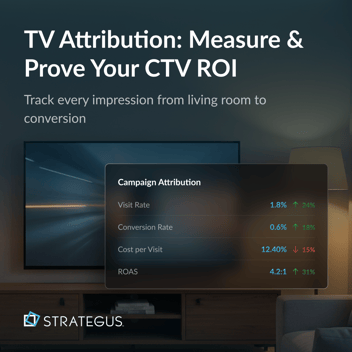
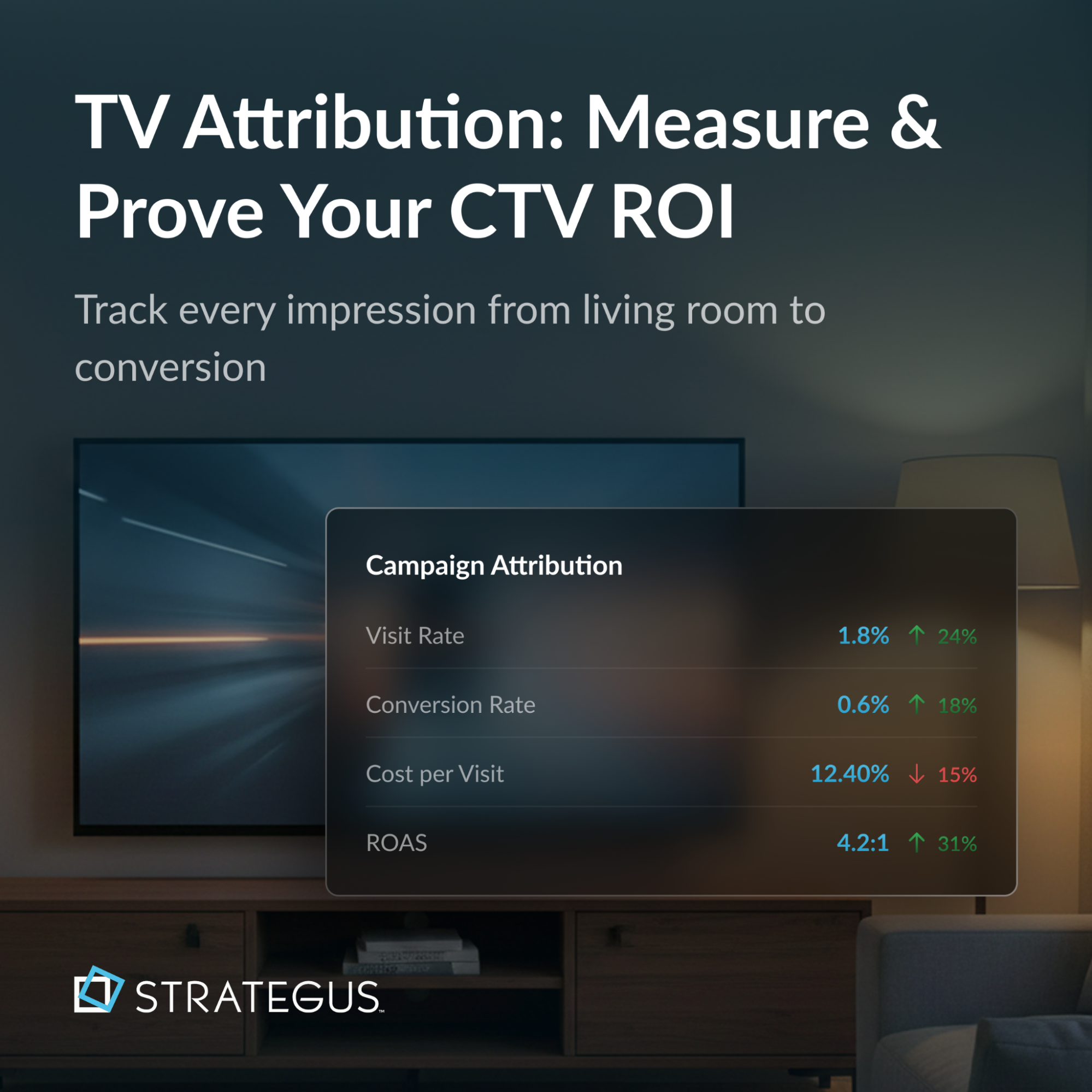
TV attribution has always been the tool to answer those questions and show what happened after someone saw your ad. But on its own, traditional TV analytics attribution doesn’t cut it anymore.
In the age of CTV, where 94% of viewers watch TV with their phones in hand, people shift screens instantly. Their next step might happen on mobile, desktop, or in-store. And traditional measurement can’t keep up.
Find out how TV attribution has evolved, how it works in the CTV era, which models to use, and how to implement attribution strategies that prove ROAS.
What Is TV Attribution?
TV attribution is the process of measuring how TV advertising influences the actions people take after seeing your ad.
Did they visit your website? Search for your brand? Make a purchase?
It answers a decades-old blind spot in TV advertising by finally showing whether a campaign reached the right audience and whether it drove real conversions.
For years, this was almost impossible to measure. Linear TV could tell you how many people might have watched, but not what those people actually did afterward. You were left with spikes in traffic or sales and no clear way to link them back to your ad spend.
TV attribution fills that gap. It ties real viewer behavior back to the impression, so you can understand which campaigns drove outcomes and which didn’t.
Traditional TV offered estimates, while streaming-based attribution provides measurable, verifiable data.
Because viewers constantly shift between screens, TV analytics attribution now tracks the whole journey across devices and moments. Someone might see your ad on Hulu at night, look you up the next morning, and make a purchase later that week. CTV attribution connects those steps into a single story.
How TV Attribution Has Evolved With Connected TV
CTV has redefined how to measure the effectiveness of TV advertising. What used to rely on panels, projections, and probability now runs on device-level signals that reveal how exposure leads to action.
Before CTV, you could estimate reach, but you couldn’t connect ad exposure to behavior. Reporting often took weeks, and even then, you were working with directional insights, not proof.
With CTV advertising, every impression on a connected device generates traceable viewing data. It opens a new world of proof points marketers have never had before, including:
- Device-level signals showing which households were exposed
- Real-time reporting instead of delayed post-campaign summaries
- Cross-device conversion tracking that follows viewers from TV to mobile to desktop
- Deterministic identity matching through IP signals, device graphs, and household IDs
- Seamless integration with analytics platforms, CRM systems, and automation tools
No more guessing whether TV moved the needle. You can see the impact, quantify ROAS, and optimize around it.
Key TV Attribution Models Explained
Attribution models answer the same question: What influence did TV advertising have? But they answer it in very different ways.
Depending on your goals and the attribution model you use, you can interpret the same customer journey in different ways.
And with roughly 35% of live event CTV inventory now sold programmatically, marketers have more signals than ever flowing in from these touchpoints. The real challenge isn’t access to data. It’s choosing the right attribution model to make sense of it.
Let’s look at some of the core attribution models used in TV and CTV campaigns, what they reveal, and where they fall short.
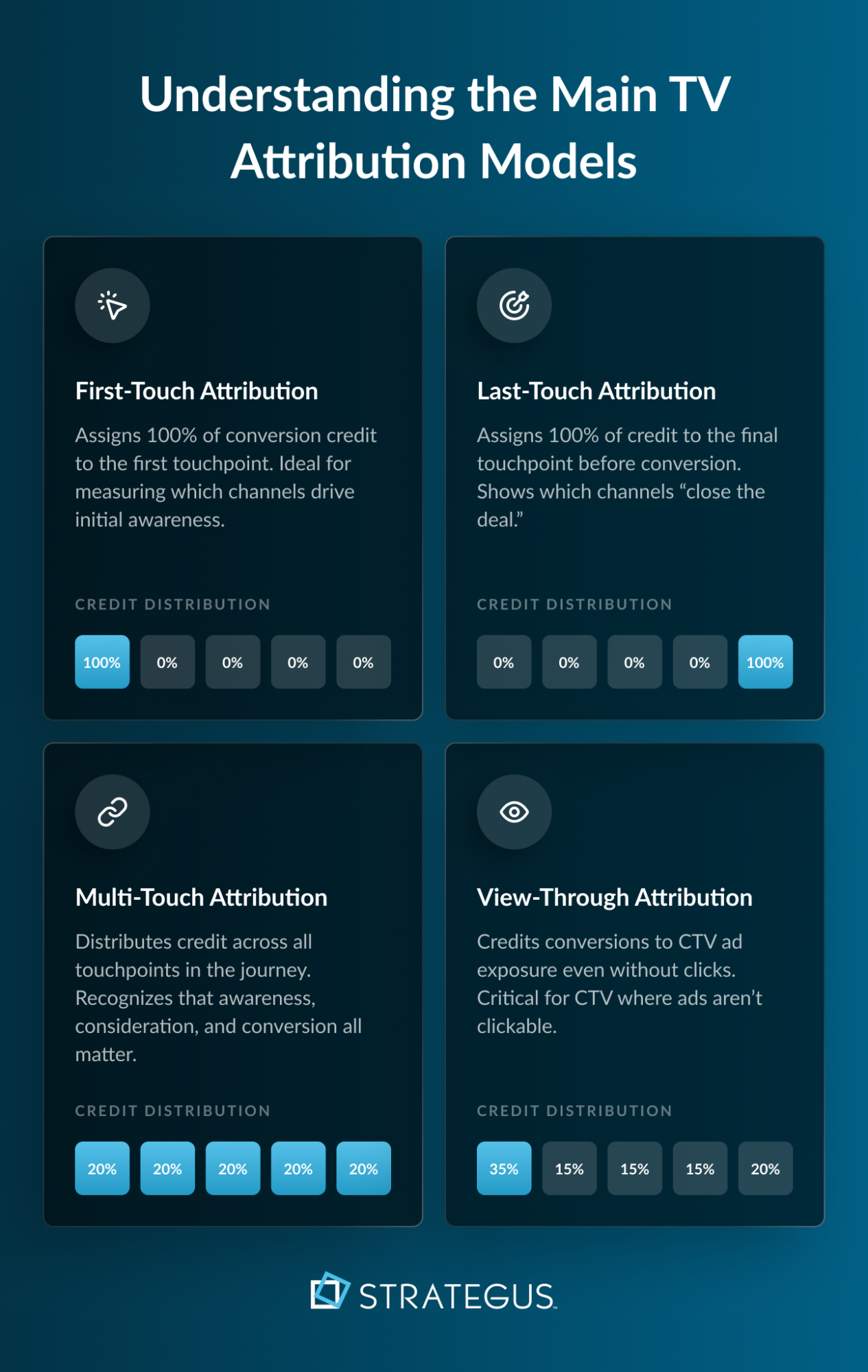
First-Touch Attribution
First-touch gives all the credit to the very first interaction someone has with your brand. If your CTV ad drives the initial visit, first-touch treats that moment as the sole driver of the conversion.
This attribution model demonstrates how effectively a campaign sparks awareness, but overlooks everything that happens afterward.
If someone needs retargeting or multiple ad exposures before making a purchase, first-touch won’t accurately reflect that. It’s good for spotting discovery, but it’s a narrow view. It doesn’t account for all the after-ad influences that push people further down the funnel.
Last-Touch Attribution
Last-touch takes the opposite view, giving full credit to the final interaction before a conversion.
Imagine a viewer sees a CTV ad for a travel booking site earlier in the month. But they only convert after clicking a remarketing email promoting a limited-time flight deal. Last-touch credits the email entirely, even though the CTV ad planted the idea long before.
This model is simple, intuitive, and often used for direct-response or retargeting campaigns where a single step closes the deal.
However, last-touch attribution can overemphasize that final touchpoint and undervalue the early exposures, especially the awareness and mid-funnel influence that CTV often drives. In many journeys, the last touch reflects only the final step rather than the complete set of contributing interactions.
Multi-Touch Attribution
Multi-touch attribution distributes credit across all interactions that contribute to a conversion. Most decisions take more than one touch, and MTA reflects that.
MTA works best for longer sales cycles and high-consideration categories, such as banking, insurance, or purchasing a car. People take their time, explore across multiple channels, and require several prompts before making a decision.
The limitation is data quality. MTA only works when you can accurately connect each touchpoint. If the data is messy, the model becomes less dependable.
View-Through Attribution
View-through attribution measures what people do after seeing your TV ad, even if they don’t click anything.
Because CTV ads aren’t clickable, view-through is the most accurate way to measure the impact of CTV. It connects exposure on the TV screen to behaviors that occur later on other devices, such as site visits, searches, app activity, and purchases.
For example, someone sees your CTV ad for a grocery delivery service while cooking dinner. They don’t search your brand or click anything. Three days later, they open the app store on their phone, install your app, and place their first order.
View-through attribution connects the CTV exposure to the app install and order, even though the action happened days later and inside a mobile app.
| Why Strategus Leads in CTV Attribution • Connects CTV exposure to real actions across devices • Measures post-view website visits, foot traffic, and sales • Uses identity resolution to track the full customer journey • Delivers real-time insight through a 24/7 reporting dashboard • Backed by a hands-on team that proactively optimises performance |
How TV Attribution Works: Methods and Technologies
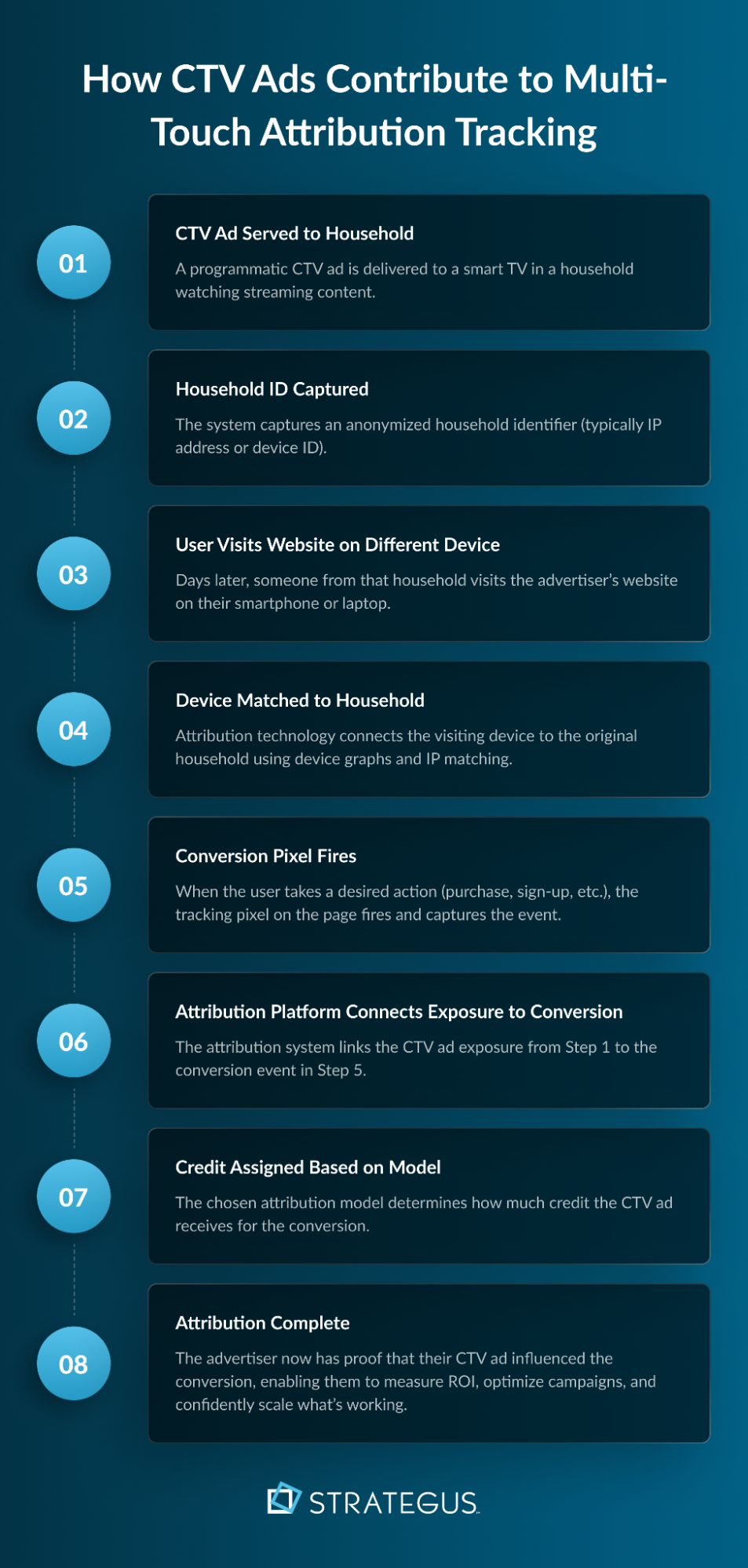
Each TV impression activates a set of technologies that make attribution possible. Here are the core components behind that process.
Household-Level Tracking
CTV attribution typically starts in people’s homes. When a CTV ad is served, it carries core information, including the IP address, device type, and timestamp.
Device graph technology uses these signals to identify which phones, tablets, and desktops are connected to the same home network and belong to the same household. This household-level data creates a unified view of how people inside that household move between screens.
Accurate household matching relies on clean data, serving as the foundation for all other attribution.
Cross-Device Attribution
The ad may be viewed on the TV, but the conversion can happen on a phone, tablet, or laptop. Modern attribution maps that downstream cross-device activity back to the original CTV impression.
For example, a shopper sees a CTV ad for Nike shoes and later converts through a retargeting Instagram carousel ad on their phone. Cross-device attribution links the social media conversion back to the initial TV ad exposure.
Deterministic signals (logins, email addresses, account IDs) provide precision, while probabilistic signals (behavior patterns, location) add scale. Most marketers use a blend of both.
Pixel-Based Tracking
Pixels are small pieces of code placed on your website that track what people do after they arrive.
When a visitor loads a page, the pixel captures actions such as add-to-cart steps, page views, and on-site engagement. This data helps compare exposed vs. unexposed audiences.
For pixels to work correctly, they need accurate placement, well-defined attribution windows, and ongoing QA.
Incremental Lift Studies
While attribution models show correlation, incremental lift studies measure causation. They compare exposed and unexposed groups to show the additional activity generated by your CTV campaign.
Reliable lift analysis requires well-matched audiences, enough data, and controls for seasonality to ensure accurate results. Combined with attribution models, brand lift studies confirm whether CTV drove the outcomes you’re seeing.

Best Practices for Implementing TV Attribution
Most marketers want a unified view of ROAS that connects both online conversions and real-world foot traffic. But turning those signals into a single source of truth is challenging. Only 32% of global marketers measure their spend across digital and traditional channels in one place.
It’s not because they don’t care, but because pulling all the data together is genuinely difficult.
TV attribution helps solve that challenge, but only with the right technology and thoughtful planning. Here’s how to build a framework that delivers clear, reliable insights.
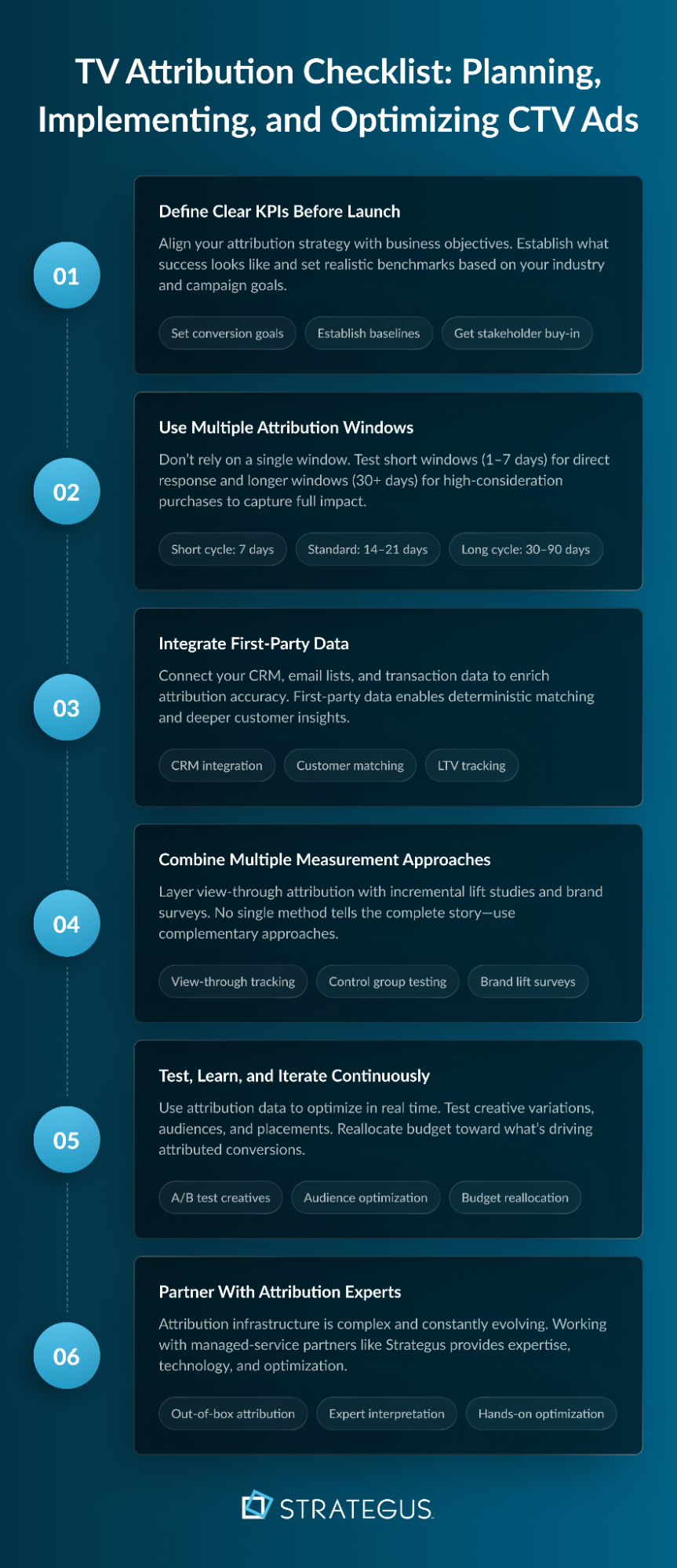
Define Clear KPIs Before Launch
Attribution only works when you know exactly what you’re trying to measure. Start by matching your KPIs to the stage of the funnel you want to influence.
- For awareness: site visits, video completions, branded search volume
- For consideration: time on site, page depth, product views, demo activity
- For conversion: purchases, lead submissions, email sign-ups
Setting specific advertising KPIs before launch establishes clear performance expectations. Without them, results are hard to interpret.
For example, if you’re an e-commerce brand, you might set a target of staying under a $50 CPA and seeing at least a few percentage points of view-through conversions in the first two weeks.
Combined CPA, VTC, and ROAS targets provide a clear read on what’s working and what needs adjustment.
Use Multiple Attribution Windows
Customer journeys vary in length. Multiple windows help reveal how TV exposure leads to outcomes.
- Short windows (1–7 days): Best for quick-purchase categories like food delivery, apparel, and other fast-moving consumer goods.
- Mid-range windows (14–21 days): Ideal for products that require some comparison, such as home goods, electronics, or subscriptions.
- Long windows (30–90 days): Needed for high-consideration categories like insurance, financial services, healthcare, education, or automotive.
Integrate First-Party Data
First-party data is the backbone of high-quality attribution. When you connect your CRM, email, loyalty, and transaction data, you get:
- Deterministic matching through CRM or login data
- Richer customer insights you can actually act on
- LTV and repeat-purchase analysis
- CRM-powered retargeting
When these datasets are connected, CTV can influence and measure outcomes far beyond the first conversion.
Use Multiple Measurement Approaches
No single method captures the entire impact of TV. A strong framework layers several techniques to give you a balanced view:
- View-through attribution to track cross-device behavior
- Incremental lift studies to measure causation
- Revenue tracking to tie CTV exposure to ROAS
- Brand surveys to reveal perception and awareness shifts
- Retail media attribution to link CTV exposure to verified retail sales
Let’s say that the campaign shows strong view-through conversions (attribution model), the incremental lift study confirms a 2.3x increase vs. the control group (causation proof), and brand survey reveals an 18-point lift in aided awareness (brand impact).
Together, these signals clarify what drove outcomes and how CTV exposure contributed to ROAS.
Test and Iterate Continuously
Attribution isn’t a “set it and forget it” system. Insights should drive ongoing optimization, such as:
- Audience refinements
- Creative adjustments
- Placement and frequency tuning
- Channel mix optimization
Continuous learning keeps campaigns efficient and responsive to real behavior.
Partner With Experts
Attribution infrastructure is complex, and many marketing teams lack the in-house skills to manage identity matching, pixel QA, modeling, and interpretation. Managed-service partners like Strategus can help.
Our team brings:
- Access to multiple attribution partners and methodologies from day one
- Expert analysis of what the data means
- Hands-on optimization across publishers, DSPs and SSPs
- Real-time reporting in a single, coherent view
- Early access to innovations, such as Experian-based identity integrations.
- Integrated cross-device retargeting to extend reach
Building this internally is costly and time-intensive. Partnering with specialists improves performance and ensures attribution is both reliable and actionable.

Get a Clear View of ROAS With Connected TV Attribution
CTV has transformed TV from a guessing game into a measurable, data-informed channel. But attribution is only as strong as the team interpreting it.
Strategus has been at the forefront of programmatic CTV since running the industry’s first programmatic campaign in 2015. Since then, we’ve continued to innovate.
Our AI-powered targeting and Experian identity attribution help our partners cut noise, improve matching, and measure ROAS with confidence
If you want to understand how CTV drives revenue, connect with a Strategus attribution expert. Let’s prove what your media is delivering.
Frequently Asked Questions
What Is TV Attribution?
TV attribution measures what viewers do after seeing your ad, such as visiting your site, searching for your brand on Google, or making a purchase. It connects the TV impression to real actions so you can see the campaign’s actual impact.
What Does Attribution Mean in Digital Media?
Attribution means identifying which marketing touchpoints contributed to a desired action. It indicates whether the action originated from a display ad, search click, email, CTV impression, or a combination of these interactions.
What Is the Fundamental Attribution Error in TV?
It’s the mistake of assuming TV exposure caused a specific outcome simply because the two happened close together. In other words, it’s the mistake of treating correlation as causation.
What Is an Example of TV Advertising Attribution?
Someone sees your CTV ad for a local pizza chain while watching a live sports stream. The next day, they open Uber Eats, type in your restaurant name, and place an order from their tablet. Attribution indicates that the CTV ad influenced the order, even though the conversion occurred on a delivery platform.


Strategus is a managed services connected TV(CTV) advertising agency with over 60,000+ campaigns delivered. Find out how our experts can extend your team and drive the result that matter most.
What to read next