






.svg)
















 Tyler Wise
11 minutes read

Programmatic display advertising is a staple for most marketers.
It's familiar, widely used, and often the default choice in digital campaigns.
But despite its widespread adoption, it can underperform, leaving marketers frustrated with wasted spend and inconsistent results.
The issue isn’t that programmatic display doesn’t work. It's that it's frequently asked to do too much, often without the right context or strategy.
Instead of generating demand or driving immediate conversions, display should be used to reinforce and drive action after initial awareness has been established. When properly sequenced alongside more impactful channels like CTV, display can be an incredibly effective tool for nudging users down the funnel.
In this guide, you’ll learn when programmatic display delivers real value, why it often breaks down, and how to activate it strategically alongside CTV to maximize impact and turn awareness into measurable action.
What Programmatic Display Advertising Is (And What It Isn’t)
Programmatic display is an automated way to buy and place digital display ads, like these ads from Bitdefender and Capital One.

Advertisers access ad inventory through specialized software known as demand-side platforms (DSPs) and leverage a combination of first and third-party data to target specific audience segments.
Programmatic advertising is a buying method applied to display inventory, not a marketing strategy in itself. In treating it like one, many marketers develop the notion that programmatic display advertising doesn’t work.
The truth is that they’re often just using it wrong.
When Programmatic Display Breaks Down
Display ads have a notoriously low click-through rate (CTR), clocking in at around 0.06% in 2025.
That’s because many audiences are being served displayed ads cold, with no context for the brand, product, or value proposition. When programmatic display is used without prior intent or awareness building upstream, it underperforms.
A lack of alignment with awareness channels exacerbates this inefficiency. If display runs independently, instead of reinforcing prior messaging, it competes for attention and for budget.
In this context, display advertising can quickly become a source of waste, especially when automation replaces strategy.
Automated buying can create the illusion that campaigns can run effectively without active management, but without effective guardrails in place, display can lean toward prioritizing cheap impressions over meaningful exposure.
Rather than relying on it as an automated awareness or intent builder, programmatic display advertising often works best after awareness has already been established through channels like CTV.
Why Marketers Use Programmatic Display and When It Works Well
In 2024, 91.3% of US display advertising spend was purchased programmatically.
This makes it by far the dominant mechanism for buying digital ad space and suggests that programmatic display is solving important advertising challenges for marketers.
The Problems Programmatic Display Solves
Many modern media strategies are built around high-impact awareness channels like connected TV (CTV), digital audio, and out-of-home networks.
These channels are effective at generating attention and shaping perception, but some of them are limited when it comes to controlling what happens after awareness is created.
Many marketers turn to programmatic to extend campaign reach beyond walled gardens and maintain persistent visibility.
Instead of disappearing when a user leaves a single platform or publisher, display ensures the brand continues to show up across the broader web experience, where most of the buying journey takes place.
With programmatic display, the same person can be reached across sites, devices, and sessions with sequenced messaging that reinforces proof, answers objections, and protects against competitive interception.
Where Programmatic Display Works Best in Modern Campaigns
Programmatic display is most effective when it is used as a reinforcement and conversion layer rather than a primary demand creation channel.
Once awareness is established through a high-impact channel like CTV, buyers begin researching, comparing options, and revisiting sites across multiple sessions.
Programmatic is best used right here to keep your brand visible during the mid-funnel phase, to shape perception of how your product or service compares to competitors, and to present offers that encourage conversions.
Where Programmatic Display Works Best in Modern Campaigns
Programmatic display is most effective when it is used as a reinforcement and conversion layer rather than a primary demand creation channel.
Once awareness is established through a high-impact channel like CTV, buyers begin researching, comparing options, and revisiting sites across multiple sessions.
Programmatic is best used right here to keep your brand visible during the mid-funnel phase, to shape perception of how your product or service compares to competitors, and to present offers that encourage conversions.

Display is particularly effective for re-engaging audiences who have already shown awareness or demonstrated intent (known as retargeting). This includes site visitors, content consumers, video viewers, and CRM audiences who require additional reinforcement before taking action.
When scale, frequency, sequencing, and role within the broader media plan are clearly defined, programmatic display delivers consistent, measurable performance, especially when used to reinforce CTV ads.
How Programmatic Display Extends the Impact of CTV From Awareness to Conversion
Connected TV (CTV) is a powerful awareness builder.
Compared to interruptive mechanisms like social ads and pop-ups, CTV ads capture stronger attention and greater recall due to the immersive, full-screen experience. Audiences are more likely to remember the brand and its message when viewed in this context.
The household-level exposure of CTV builds familiarity and intent across multiple members of the household, establishing a shared understanding that fuels future action. This creates a solid foundation of awareness for subsequent touchpoints.

But here’s the thing:
Conversion rarely happens on the TV screen.
While CTV builds the initial awareness, users typically don’t take immediate action during the ad. Instead, they transition to mobile, laptop, and desktop devices where they can search, browse, and engage more actively with the brand.
That’s where programmatic display advertising earns its keep as a digital activation layer.
Research indicates that when a TV ad (including CTV) precedes a digital ad, unaided brand recall can increase by 125%, and purchase intent can rise by 18% compared with digital ads alone.
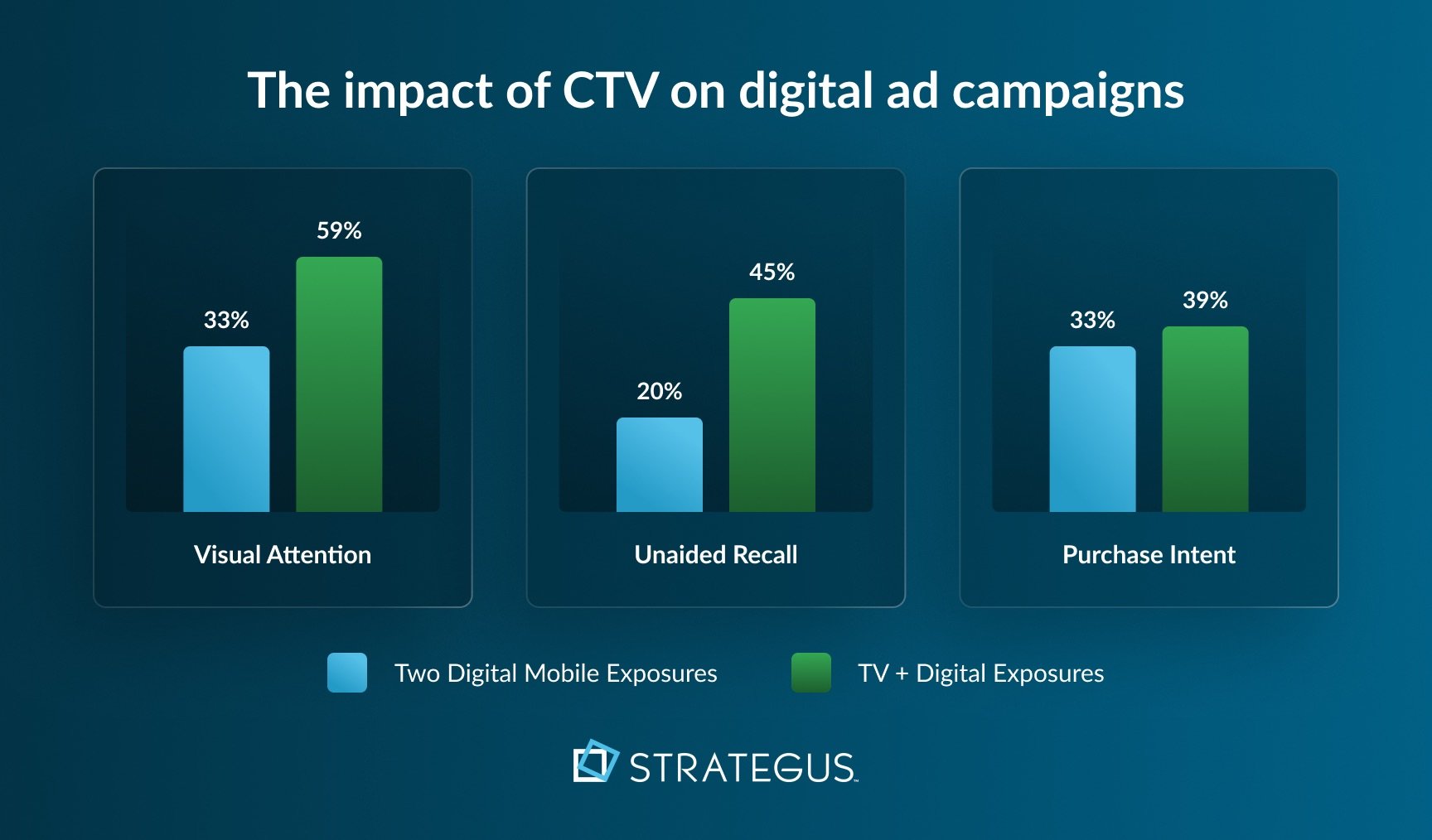
Display ads reinforce the message on mobile or desktop, guiding buyers down the funnel and nudging them toward conversion.
How to Activate Programmatic Display After CTV Exposure
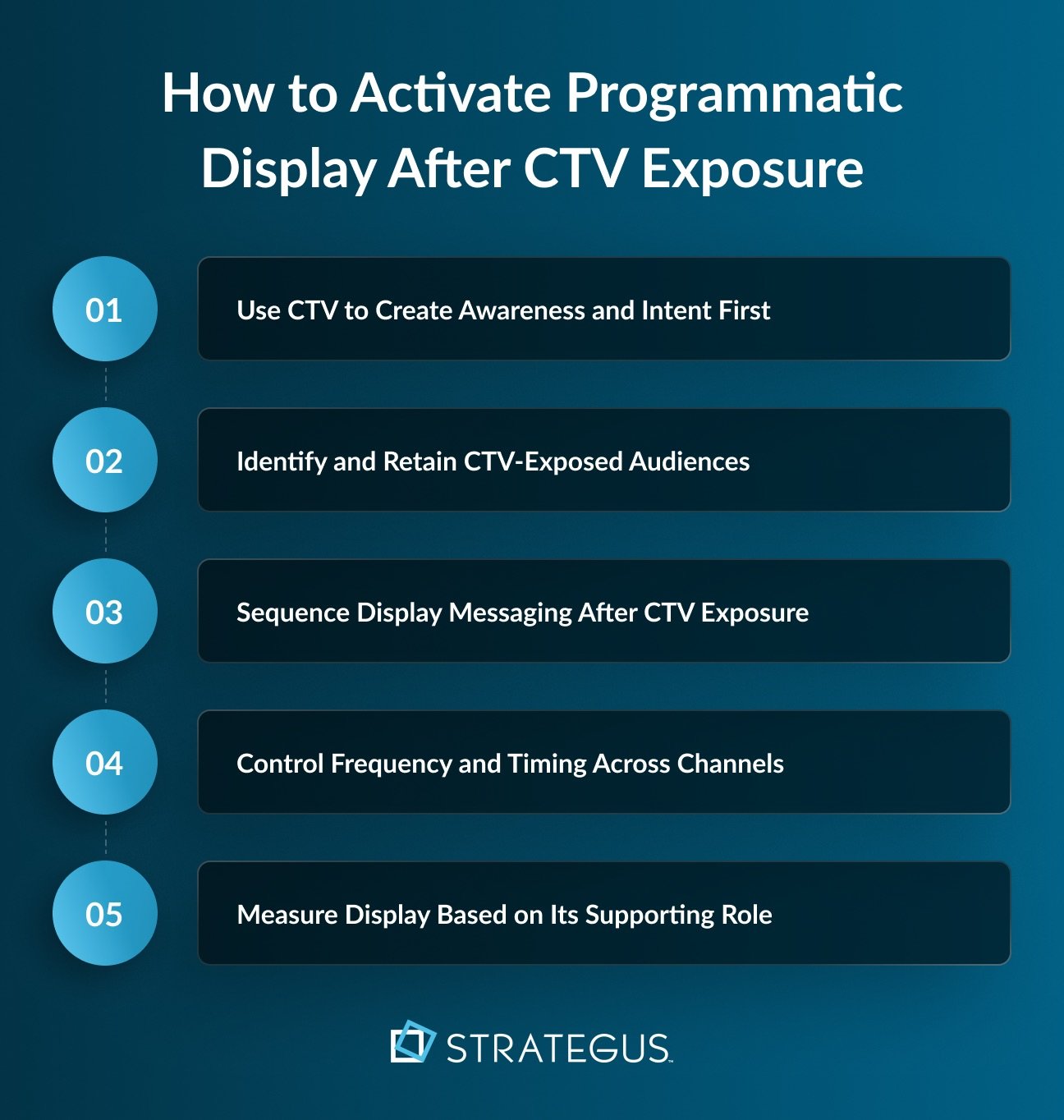
Rather than treating programmatic display as a standalone channel, Strategus runs display as a controlled continuation of CTV exposure.
Awareness and intent are created first on the largest screen in the home, with display being used to reinforce messaging to exposed audiences across mobile, desktop, and web environments where action is more likely to occur.
This framework reflects how we structure CTV-first programs in real client environments.
1. Use CTV to Create Awareness and Intent First
CTV should lead the strategy by prioritizing reach, attention, and memorability on the biggest screen in the house.
Remember, the objective here is not immediate conversion; it's to build familiarity and awareness to drive stronger performance from downstream channels.
 Start by using household-level and intent-based targeting to isolate people who are realistically in-market or in-need. This keeps spend focused on viewers with a realistic potential to purchase.
Then, set frequency caps so each household receives enough exposures to build recall without creating fatigue.
From a creative standpoint, focus on brand introduction, category framing, and value positioning. Avoid offers and direct response CTAs.
2. Identify and Retain CTV-Exposed Audiences
The value of pairing display with CTV comes from audience continuity, not volume.
That means that instead of building display targeting from scratch, you’re retaining audiences that are exposed to those awareness-focused CTV ads and carrying them over to your display program.
Here, every household or device that views a CTV is automatically captured into an exposed audience pool. This pool is updated continuously as new viewers are added, ensuring your display program is always working from an actively qualified audience.
By restricting display impressions to people who already recognize your brand, you’ll improve efficiency, relevance, and ROI on display ad spend.
3. Sequence Display Messaging After CTV Exposure
Display ad messaging should reinforce the same core value proposition introduced via CTV, rather than introducing a new concept.
But that doesn’t mean you should just reuse the same ad creative.
Display’s job in this context is to move from awareness-building into consideration and action, so the creative should be geared toward this goal.

4. Control Frequency and Timing Across Channels
Without coordination, CTV and display can overserve the same audiences or compete for attention, meaning frequency must be managed holistically across channels, not in silos.
For instance, you might set total cross-channel exposure to a range of five to nine impressions per week per user, breaking that down as such:
- CTV: Three to five exposures per household per week
- Display: Two to four impressions per user per week
Timing is equally critical.
Display performs best when it appears shortly after CTV exposure, while the message is still top of mind.
This means that CTV and display should be set up as a single system from the start, not launched separately.
Configure exposure tracking and retargeting before the first CTV impression runs so that display can begin serving as soon as someone has seen the CTV ad. Once a household completes a CTV view, it immediately becomes eligible for display ads within a defined recency window.
This ensures that display consistently follows CTV while the brand is still fresh, rather than appearing days or weeks later when recall has faded.
5. Measure Display Based on Its Supporting Role
Programmatic display shouldn’t be evaluated in isolation or solely through last-click attribution.
Its value lies in assisting conversions and reinforcing intent created elsewhere, meaning measuring lift, assisted conversions, and cross-device behavior is a more appropriate way to track impact.
A great way to evaluate performance here is to compare outcomes between users who were exposed to both CTV and display and users who were exposed to CTV alone. This isolates the incremental contribution of display rather than crediting it with full conversion ownership.

Why Brands Rely on Specialists to Run CTV and Display Together
Most failed advertising programs are a result of poor coordination, not channel choice.
When CTV and display are planned and measured in isolation, sequencing breaks performance suffers, and display ends up competing with CTV instead of extending its impact.
The thing is, coordinating CTV and display can be operationally complex.
Effective execution requires tight control over sequencing, frequency, and messaging across multiple screens, which increases measurement complexity. Without clear ownership, display is at risk of resetting the funnel rather than supporting it.
Strategus acts as the specialist partner that helps brands unify CTV and programmatic display inside one coordinated operating model, maintaining control over sequencing, frequency, and audience continuity across screens.
Talk to a Strategus expert today to discuss combining CTV and programmatic display into a unified, performance-driven strategy.
Frequently Asked Questions
What Is Programmatic Display Advertising in Simple Terms?
Programmatic display is an automated method for buying digital banner ads across websites and apps. It uses data to target specific audiences. It is best used as a way to reinforce messaging and capture demand after initial awareness has already been established.
Why Is Programmatic Display More Effective When Paired with CTV?
CTV creates attention, familiarity, and intent on the largest screen in the household.
Programmatic display is then used to re-engage those exposed audiences across devices, reinforcing the message and guiding them toward action in a more conversion-ready mindset.
Can Programmatic Display Work Without CTV?
Programmatic can deliver impressions and clicks, but performance is typically inconsistent.
Without upstream awareness, display operates without context. This limits recall, reduces engagement, and increases wasted spend because the audience has no prior familiarity with the brand or value proposition.
How Does Programmatic Display Support Conversions After CTV Exposure?
After CTV establishes awareness, display is used to re-engage those audiences on mobile and desktop. It reinforces the same message and provides a direct path to action, helping turn familiarity and intent into measurable outcomes such as site visits, leads, and purchases.
What Metrics Matter Most in a CTV Plus Display Strategy?
Focus on:
- Assisted conversion
- Lift
- Frequency
- Cross-device behavior
These metrics show how display supports CTV exposure and downstream action rather than relying solely on last-click metrics that undervalue its role.


Strategus is a managed services connected TV(CTV) advertising agency with over 60,000+ campaigns delivered. Find out how our experts can extend your team and drive the result that matter most.
What to read next