What is Foot Traffic Attribution and Why It's Important

Table of Contents
Advertising and customer research now happen almost entirely online, but although e-commerce continues to become the dominant buying method, many purchases still happen in-store.
Marketers are well-equipped to measure digital journeys. Clicks, views, conversions, and on-site behavior are easy to track when the outcome happens on a screen.
But the moment a digital ad influences a physical store visit, that visibility often disappears.
If a shopper sees an ad for a local furniture retailer and decides to visit the store instead of the website, traditional attribution has no way to capture that outcome. The marketing impact is real, but it all too often goes unmeasured.
Foot traffic attribution is designed to bridge this gap by connecting digital ad exposure to in-store visits. The problem is that it can be complex to set up, so many teams throw it in the too-hard basket.
In this guide, we explain how to measure foot traffic properly and why it’s far more achievable than most teams assume.
Key Takeaways
- Footfall attribution links ad exposure to store visits, proving offline impact and ROI beyond clicks or online conversions.
- CTV integration delivers lean-back attention and precise targeting, making foot traffic a core KPI for brick-and-mortar brands.
- Real tradeoffs exist that limit foot traffic attribution’s ability to provide reliable, cause-and-effect reporting.
- Strategus has an advanced system that uses custom geofences, cross-device attribution, and real-time dashboards to drive verified store visits. Schedule a demo with a Strategus expert to learn more today.
What Is Foot Traffic Attribution?
Foot-traffic attribution, or footfall attribution, is a way to measure how digital ads influence in-store visits. It connects ad exposure to physical store visits by using location data from mobile devices.
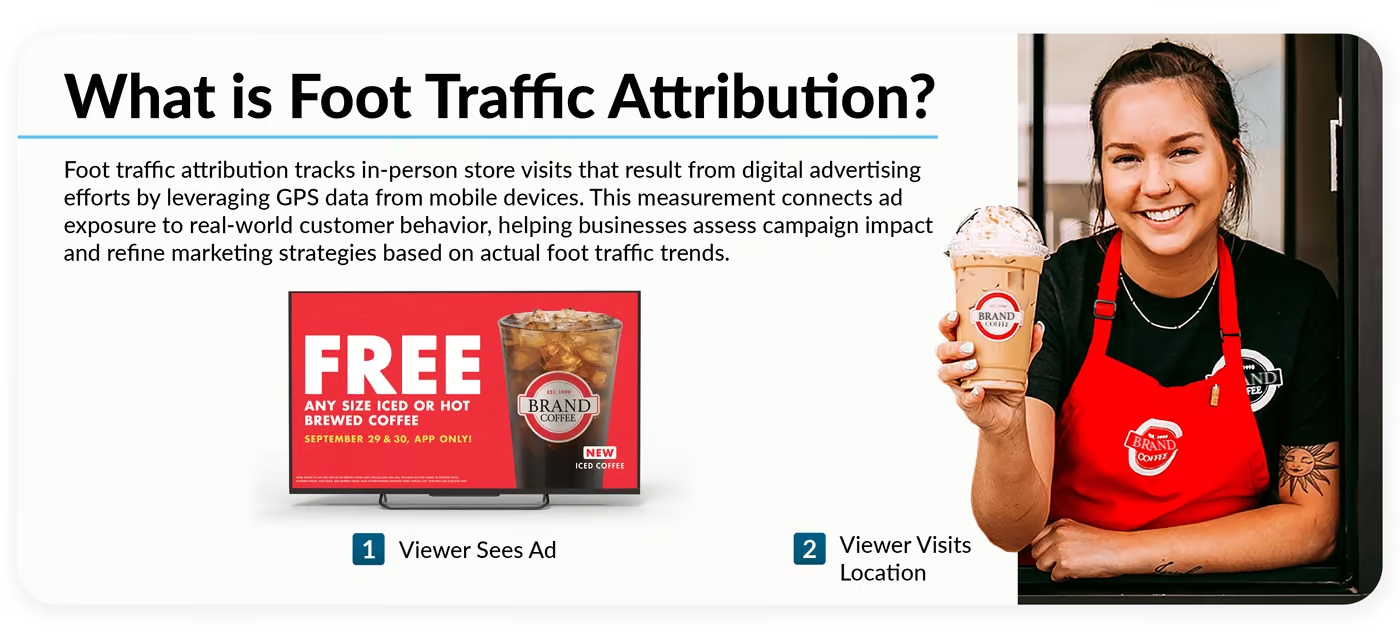
This helps advertisers understand which campaigns drive real-world actions, proving ROI beyond just online clicks or conversions.
What role does it play in CTV advertising?
For brands with a brick-and-mortar location, foot traffic can be a meaningful campaign KPI. And because CTV is a proven channel for local ad campaigns, combining the two is a no-brainer. Connected TV offers a unique advantage when it comes to getting customers through the physical door.
Unlike other digital channels that target users multitasking on phones or laptops, CTV reaches audiences in their living rooms, capturing attention on the biggest screen in the house. This creates a powerful opportunity to influence behavior and drive people to visit a store in person.
Why does it matter for brands and agencies?
Seeing an ad for a local health food store during the nightly news and then visiting the store a few weeks later while running errands is exactly the kind of behavior foot traffic attribution is designed to capture.
It allows marketers to connect in-store visits back to specific ad exposures, giving them clear visibility into how their campaigns influence real-world outcomes.

Moreover, CTV allows for precise audience targeting, ensuring that these ads are only seen by people most likely to be interested in a given product or service.
This targeted approach creates a potent combination for driving foot traffic, making it possible to personalize the messaging based on promotional events or local deals.
How Does Foot Traffic Attribution Work?
Foot traffic attribution uses smartphone GPS data to connect the dots between ad views and in-store visits. At Strategus, we work with brands and agencies to implement a simple four-step process to get this data.
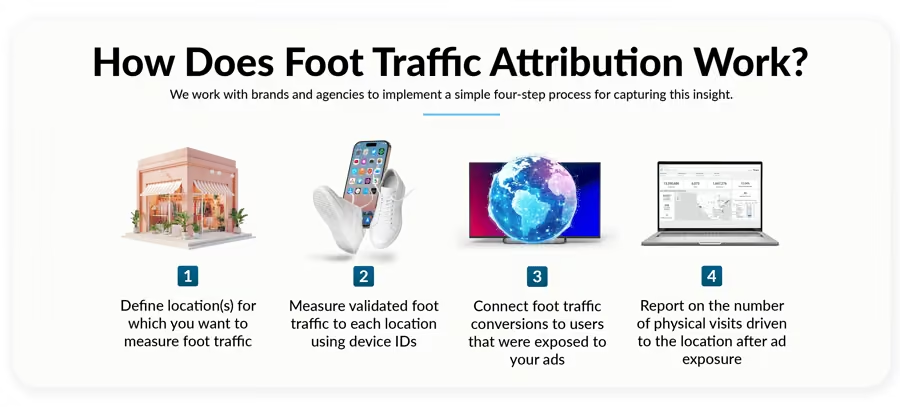
Step 1: Define locations and what counts as a visit
The foundation of accurate footfall attribution starts with smart location mapping. This means creating geofences that distinguish your store from the coffee shop next door, setting minimum visit durations (30 seconds doesn't count as shopping), and accounting for different location types. For example, a downtown flagship needs tighter boundaries than a suburban standalone.
Modern systems use polygon mapping instead of simple radius circles, ensuring you're not accidentally counting visits to neighboring businesses. You'll also need to define what constitutes a meaningful visit versus pass-through traffic. The more precise your location parameters, the more trustworthy your attribution data becomes. This precision directly impacts your ability to optimize campaigns and prove ROI.
Step 2: Validate foot traffic using multiple data signals
Raw location data is messy. Your phone, for example, might think you're in someone else’s kitchen a few houses over. That's why sophisticated attribution systems combine multiple signals:
- GPS (accurate to 5-10 meters outdoors)
- Wi-Fi network pings
- Bluetooth beacons for equipped stores
- Cell tower triangulation as backup
The real work happens in data cleaning. Advanced algorithms filter out employees (identified by visit patterns), delivery drivers (short, repeated stops), and statistical anomalies. Everything runs on anonymized, hashed device IDs that protect privacy while maintaining measurement accuracy.
This multi-layered approach ensures you're counting actual customers, not false positives. Without proper validation, you might think your campaign is working when it's really just measuring noise.
Step 3: Connect store visits to ad exposure
This is where the actual data is calculated, and it connects who saw your CTV ad to who walked through your door. The process starts by cross-referencing anonymized device IDs from store visitors with your database of ad viewers. But you have to think about the timing here as well. A restaurant might track visits within 48 hours of ad exposure, while furniture stores might extend that window to 90 days.
Cross-device resolution is also important here. Someone might see your ad on their smart TV, research your business on their tablet, and then visit your store with their phone. Advanced identity graphs connect these touchpoints while maintaining privacy.
The smartest systems also run incrementality tests, comparing exposed audiences to control groups to measure true lift, not just correlation. This tells you whether your ad drove that 15% traffic increase, or if those customers would have visited anyway.
Step 4: Report on results that drive real optimization
Tracking foot traffic attribution only matters if it influences what you do next.
Reporting should directly inform spend, creative, targeting, and market strategy decisions while campaigns are live, not after they end.
Budget allocation
Use visitation data to adjust budget data in real time.
Focus on which placements are driving store visits, not just impressions or low CPMs
If a channel is generating engagement but isn’t changing in-store behavior, pull budget away from it and shift it to channels, publishers, and formats that consistently drive higher visit rates and outperform category benchmarks.
Check this data weekly and reallocate as patterns emerge. The budget should follow what’s working now, not what looked good at the end of the campaign.
Channel mix and performance comparison
Foot traffic data allows you to compare channels on the same outcome.
Look at CTV, online video, display, and audio advertising through a single lens and how many incremental store visits each channel drives.
This removes the need to judge CTV on reach, display on clicks, and audio on frequency, and instead puts every channel on equal footing, making it clear where each channel is actually contributing.
For example, your CTV program may deliver fewer impressions but produce higher visit rates and stronger lift, while high-volume display may generate scale without meaningful impact. These comparisons make it easier to rebalance spend across the mix based on real-world outcomes rather than surface-level delivery.
Creative testing and optimization
Foot traffic data shows which creative actually motivates people to visit in person.
Compare results by creative variant to see which messages, offers, ad lengths, and content contexts drive higher visit rates and incremental lift. This moves creative evaluation beyond recall or completion rates and ties it directly to real-world behavior.
When certain creatives consistently outperform others, act on it mid-campaign. Pause underperforming ads and replace them with variants that are working better, rather than waiting for post-campaign analysis.
Over time, this turns creative into a performance lever, not just a branding exercise, with decisions guided by which ads drive store visits, not just visibility.
Geographic-level optimization
Use foot traffic reporting to find out not just whether media is working, but where it's working best.
Break results down by store, region, or trade area to see which locations are responding with higher visit rates and incremental lift. This makes it clear where media influences real-world behavior and where it doesn’t.
Increase spend in high-performing locations or tighten geofences around areas where lift is strongest to concentrate budget where it has the most impact. In weaker areas, don’t default to cutting spend entirely. Use the data to test changes to creative, offers, or audience targeting that better align with the local context.
This approach keeps decision-making local and deliberate, improving relevance at the market level while avoiding blunt, one-size-fits-all optimizations.
Benefits of Foot Traffic Attribution
For traditional street-side businesses, tying advertising effort to in-store visits is what it’s all about. Foot-traffic attribution does this by laying the foundations for a more data-driven approach.
Measuring in-store visits is critical for performance TV campaigns, but even for general awareness campaigns, it can help give a directional read on brand lift.
With foot-traffic attribution, advertisers can:

Measure Campaign Impact: If physical traffic is part of the customer journey and you’re only tracking clicks and impressions, you’re likely doing a lot of guesswork and falsely correlating data points. Foot-traffic attribution solves this, providing a complete breakdown of how your campaigns contribute to business results.

Optimize Their Media Mix: Multi-touch attribution allows you to identify which ads and channels are most effective and reallocate budget accordingly. This proactive approach is key to minimizing ad waste, especially when delivering omnichannel campaigns that retarget viewers across other digital channels.

Improve the Customer Experience: By understanding which ads and creative elements drive in-store visits, you can tailor the entire customer journey for a more seamless and engaging experience. This might involve aligning in-store displays with your most effective ad creatives or adding promotions that complement your messaging.
Limits and Trade-Offs of Foot Traffic Attribution

Accurately attributing foot traffic to marketing programs isn’t foolproof.
It’s impractical to ask every in-store buyer which ad or piece of content influenced their visit. Even if you could, most buying journeys involve multiple interactions, making it unlikely that shoppers could reliably identify a single marketing touchpoint that drove them in.
These are some of the limits and tradeoffs marketers should be aware of when implementing foot traffic attribution.
Foot traffic attribution is probabilistic, not deterministic
It identifies patterns and lift, not guaranteed cause-and-effect. It doesn’t say “Ad 34 brought in buyer 296.”
The risk involved here comes from treating the directional data it provides as an absolute truth. Instead, foot traffic attribution data should be used as one input in determining what works and what doesn’t.
Location data introduces inherent noise
Foot traffic attribution relies on smartphone location data to link ad exposure to physical store visits, but GPS accuracy can vary due to factors such as environmental density and indoor coverage.
False positives can occur due to passersby, neighboring businesses, shared parking, short dwell times, or poorly defined geofences.
Polygon-based geofencing, dwell-time thresholds, and multi-signal verification all reduce noise, but they don’t remove it entirely.
Ad exposure does not automatically equal causation
Seeing an ad and later visiting a store does not, in itself, prove that the ad drove the visit.
Correlation alone can make performance look better than it really is. Measuring true lift requires comparing exposed audiences to a clear baseline and control group. Without these safeguards, attribution becomes a reporting exercise rather than a decision tool.
Attribution windows are a tradeoff
Any attribution window you choose comes with a trade-off.
Short windows can undercount influence for considered purchases, but excessively long windows can over-attribute visits that would have happened anyway.
Calibrated windows reduce distortion but cannot fully remove ambiguity, meaning footfall attribution data should always be interpreted cautiously alongside other performance signals.
How CTV Campaigns Drive In-Store Visits
CTV can drive in-store visits by combining high-attention exposure with cross-device measurement and verified location data. The steps below show how to operationalize this process in practice, using real Strategus campaigns to illustrate how CTV impressions translate into measurable foot traffic.
CTV impressions establish initial exposure
Use initial CTV ads to build exposure among high-value audiences. When an ad is served through a programmatic buy, it runs in a lean-back, high-attention environment on the largest screen in the home, where viewers are more likely to watch without distractions.
Because CTV is non-clickable, you don’t want to measure success by immediate response. Your goal is awareness and recall that influences behavior later. This is especially important for categories where purchase decisions are tied to context rather than immediate intent.

For example, in a Strategus campaign for Arwoods Furniture, we targeted audiences in major life transition moments to build upper funnel influence that later translated into store visits.
Prioritize high-attention CTV environments and audience quality over clicks so your campaign is built to drive downstream behavior.
Household exposure is resolved to mobile devices
Measure what happens next by resolving exposed households to anonymized mobile devices using privacy-safe identity graphs. This step connects the screen that delivered the message to the devices that later move through the physical world.
Remember, resolution is probabilistic and should be intentionally conservative to avoid overmatching. This way, not every household impression is forced into a device match, prioritizing accuracy over scale.
This approach enabled Strategus to link exposure to real-world behavior across large footprints. In a regional pizza franchise campaign spanning 110 locations, household-to-device resolution measured which exposed viewers visited stores later.
Mobile exposure reinforces the message across channels
Reinforce CTV exposure with coordinated follow-up ads across mobile display, online video, and streaming audio. This ensures your message stays top of mind as viewers move from the living room to their personal devices.
Once devices are associated with exposure, use sequential messaging to build familiarity and guide the audience toward action. Follow-up impressions should appear closer to moments of intent, such as running errands, comparing options, or planning a purchase.
Avoid treating each impression in isolation. Instead, track cumulative exposure across screens to understand how repeated touchpoints influence real-world behavior over time. Consistent cross-channel presence is often what moves viewers from passive awareness to active consideration.
Store locations are defined with visit quality controls
Map store locations precisely using custom polygon geofences before counting visits. Define the exact footprint of each location to separate the store from neighboring businesses, parking areas, or shared buildings.
Set minimum dwell time thresholds to distinguish meaningful visits from pass-through traffic. This step is critical in dense retail and entertainment environments where proximity alone does not indicate intent.
Mobile location signals confirm physical visits
When exposed devices enter your defined geofences, validate visits using multiple mobile location signals, as a single GPS ping alone is rarely reliable. Instead, layer in signals such as dwell time, consistent location visits, and natural movement patterns to build confidence that a real visit occurred.
It is also important to filter out traffic that does not represent genuine customers. Apply suppression logic for devices associated with employees and delivery drivers, and for clearly anomalous behavior. This matters most in busy retail and entertainment environments where background device activity can easily distort results.
Make a habit of reviewing location accuracy and spot-checking edge cases, such as shared buildings, multi-level venues, and dense urban areas. Small mapping errors here can quietly inflate visitation numbers if left unchecked.
Done well, this validation step is what turns raw location data into credible, decision-ready foot traffic measurement.
Exposed and control groups are compared
Measure visit behavior from exposed devices against a control group that was not served ads. Focus on incremental lift rather than raw visit counts.
This comparison isolates the true impact of media exposure instead of relying on coincidence or background traffic.
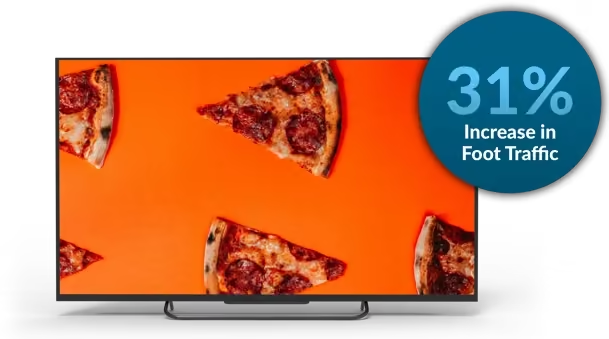
In a CTV campaign for a regional pizza franchise, this methodology confirmed that 12,195 exposed users visited stores, resulting in a 31% lift in foot traffic compared to the control group.
Verified foot traffic becomes an optimization input
Feed verified foot traffic data back into ongoing campaign optimization. Analyze performance by channel, creative, audience, and geography, then adjust budget allocation accordingly.
This closes the loop between measurement and media execution, helping scale what actually drives store visits.
In a Strategus campaign for a West Coast casino with tight geographic constraints and niche audience requirements, precise budget allocation, channel optimization, and cross-device retargeting drove 52,862 verified in-person visits.

Partner With Strategus for Accurate Footfall Attribution
Footfall attribution is not a vanity metric. It connects digital spend to real-world revenue.
At Strategus, we make this complex capability accessible and actionable for businesses of every size, from local retailers to national brands.
While others focus on impressions and clicks, we focus on what matters most: customers walking through your doors. Our attribution suite goes beyond basic visit tracking to show which creative drove traffic, when viewers converted, and how each channel contributes to revenue.
The impact is proven. We drove more than 9000 store visits for a furniture retailer in six weeks, delivered a 31% lift in foot traffic for a pizza franchise, and generated 52862 visitors for a West Coast casino under strict targeting constraints.
Stop wondering if your ads work. Schedule a demo with a Strategus expert to see your own footfall attribution data in action.
Frequently Asked Questions
1. What is considered foot traffic?
Store traffic refers to the number of people who walk into a retail location during a specific period. Marketers use this metric to understand customer interest, evaluate campaign effectiveness, and identify sales opportunities. It serves as a key performance indicator for physical retail success.
2. What is an example of foot traffic?
When people visit a real-world location, such as shoppers walking into a retail store, customers entering a café, or attendees stopping by a trade show booth.
3. Is foot traffic a KPI?
Yes, foot traffic can be a KPI. It is commonly used to measure how many people visit a physical location and to evaluate the impact of marketing, promotions, location performance, and overall customer engagement.
4. How is foot traffic calculated?
Advertisers measure store traffic by tracking mobile device signals within a defined location. They match ad exposure to footfall using device IDs and GPS data. Advanced platforms filter out noise, such as employee visits or passersby, to increase accuracy. This helps brands see how many people visited after viewing an ad.
5. What businesses get the most foot traffic?
Businesses that typically attract the most foot traffic include retail stores, supermarkets, shopping centres, restaurants and cafés, convenience stores, entertainment venues, and major transport hubs such as airports and train stations.
Locations with high visibility, easy access, and strong daily demand tend to attract the highest visitor volumes.
6. What is non-attribution traffic?
Non-attribution traffic includes visits or actions that cannot be tied to a specific ad or campaign. It may come from organic sources, direct visits, or unknown referrals. Marketers use this category to separate untracked activity from measurable campaign-driven results and to maintain clean performance reporting.
Frequently Asked Questions
Is Netflix AVOD or SVOD?
Layer interests, purchase behavior, and viewing habits on top of age and location — so every impression reaches someone who actually matters to your business.
What is Foot Traffic Attribution and Why It's Important?
Advertising and customer research now happen almost entirely online, but although e-commerce continues to become the dominant buying method, many purchases still happen in-store. Marketers are well-equipped to measure digital journeys.
What Is Foot Traffic Attribution?
Foot-traffic attribution, or footfall attribution, is a way to measure how digital ads influence in-store visits. It connects ad exposure to physical store visits by using location data from mobile devices.
What role does it play in CTV advertising?
For brands with a brick-and-mortar location, foot traffic can be a meaningful campaign KPI. And because CTV is a proven channel for local ad campaigns , combining the two is a no-brainer.
Why does it matter for brands and agencies?
Seeing an ad for a local health food store during the nightly news and then visiting the store a few weeks later while running errands is exactly the kind of behavior foot traffic attribution is designed to capture. It allows marketers to connect in-store visits back to specific ad exposures, giving them clear visibility into how their campaigns influence real-world outcomes.
How Does Foot Traffic Attribution Work?
Foot traffic attribution uses smartphone GPS data to connect the dots between ad views and in-store visits. At Strategus, we work with brands and agencies to implement a simple four-step process to get this data.
get in touch
Subscribe to our
newsletter
Stay ahead with strategies and insights from streaming advertising experts.
Learn from the field
.webp)
.webp)
.webp)
.webp)
.webp)
.webp)
.webp)
Book a demo
Talk to an expert
Tell us what you want to achieve and we'll map the media strategy to get you there — no self-serve dashboards, just a partner who does the work.